10 AI Chatbot Tools for Real Estate Lead Generation
Most real estate chatbots are a liability. They are brittle, rule-based scripts that masquerade as AI, built on a foundation of nested if-then statements that shatter the moment a prospect asks an unscripted question. The goal is not to have a friendly greeter on your website. The goal is to qualify, segment, and route leads into a CRM with structured data that a sales agent can actually use, without polluting your pipeline with noise.
The core engineering problem is twofold. First, you must accurately parse user intent from unstructured text, which is a notoriously difficult NLP challenge. Second, the tool must offer robust, well-documented APIs for ingesting the captured data into your existing systems. A chatbot that cannot post a clean JSON payload to a webhook is just a high-latency contact form.
1. Drift
Drift positions itself as a “revenue acceleration” platform, which is corporate-speak for a very expensive, sales-focused chatbot. Its primary technical strength lies in its native integrations with Salesforce and other major CRMs. Lead routing rules are granular, allowing you to map specific user inputs or page URLs to specific sales agents or teams. The bot can pull data from Clearbit to enrich anonymous visitor profiles with firmographic data, giving you a dossier on a commercial real-estate prospect before a human ever gets involved.
The trade-off is the price tag. This is a wallet-drainer, plain and simple.
2. Intercom
Intercom’s architecture is built around user segmentation and event-driven messaging. You can trigger specific conversational flows based on user behavior, like time spent on a high-value listings page or a return visit. Its “Resolution Bot” is a decent NLP-driven tool that can answer common questions by referencing a knowledge base you build out. For real estate, this means offloading repetitive queries about property taxes, school districts, or HOA fees.
Its API is solid for custom integrations, but be prepared for vendor lock-in. Migrating your user data and conversation history out of Intercom is a project in itself.
3. Rasa
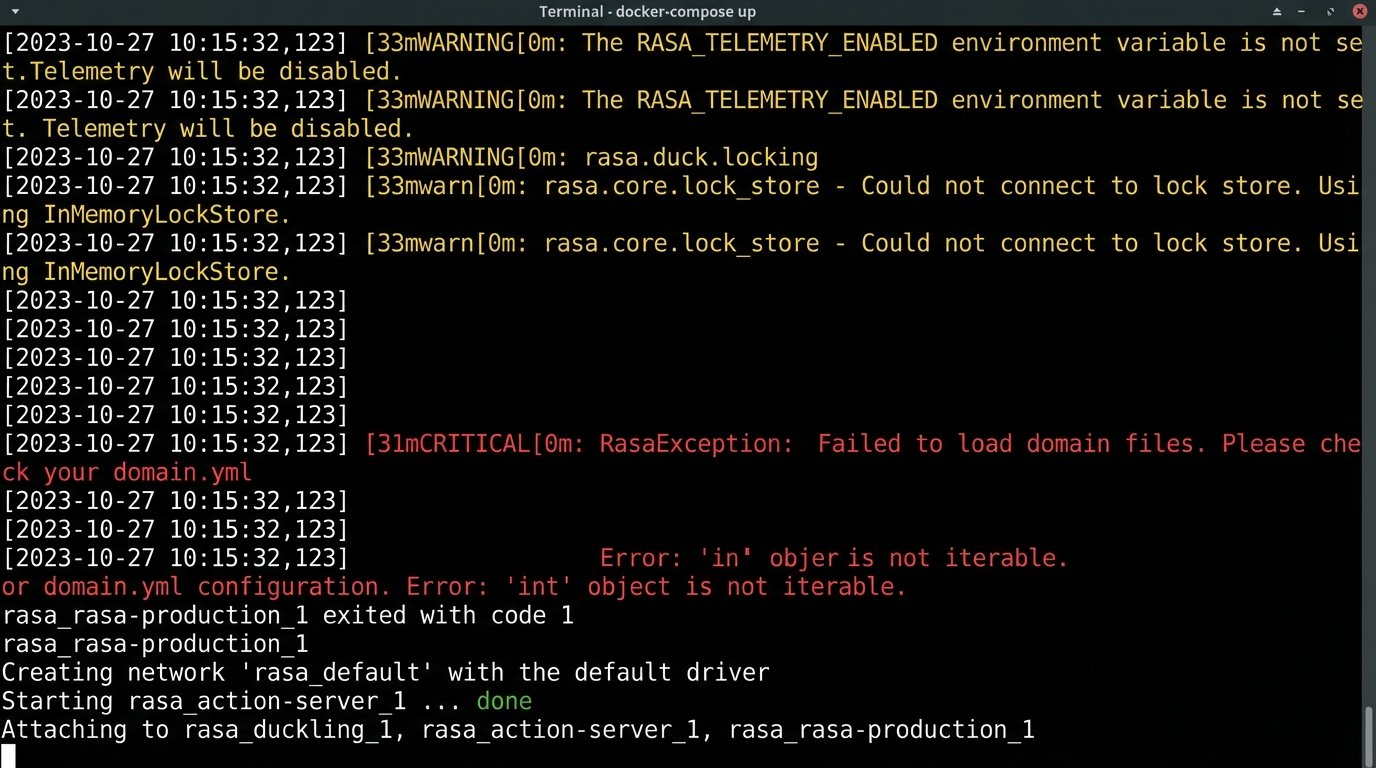
Rasa is the open-source option for teams that require absolute control over the conversational logic and data pipeline. You are not renting a cloud service. You are building and hosting the entire NLP model and application stack. This lets you build truly complex, multi-turn conversations and integrate directly with private internal systems without exposing APIs to a third-party vendor. You can fine-tune the intent recognition model on your own specific real estate jargon.
The learning curve is brutal if you’re not already familiar with NLP concepts, and you carry the full burden of infrastructure, maintenance, and security. Forget a weekend setup.
Trying to deploy a sophisticated Rasa model without a dedicated DevOps resource is like trying to shove a firehose of data through the eye of a needle. It’s a messy, high-pressure failure waiting to happen.
4. Botpress
Botpress offers a middle ground between a fully managed SaaS and a pure open-source framework. It’s an open-source platform with a visual flow editor, but it’s designed to be self-hosted. This gives you data sovereignty and deep customization options. Its modular architecture is its key strength. You can build self-contained “skills” for different tasks, like mortgage calculation or appointment scheduling, and reuse them across different bots. Webhooks are first-class citizens, making it straightforward to push lead data anywhere.
Here is an example of the kind of clean JSON payload you can structure to send to your CRM:
{

  "lead_source": "WebsiteBot_Listing_123",

  "contact": {

    "name": "Jane Doe",

    "email": "jane.doe@example.com",

    "phone": "555-123-4567"

  },

  "qualification_data": {

    "buying_timeline": "3-6 months",

    "preapproved": true,

    "min_beds": 3,

    "min_baths": 2,

    "target_zip": "90210"

  },

  "transcript_url": "https://s3.aws.com/chat-logs/log_xyz.txt"

}
The complexity of managing the underlying server and database still falls on you. It’s less overhead than Rasa, but it’s not zero-ops.
5. Tidio
Tidio is built for speed of implementation, not for complex automation. Its value proposition is a simple, clean interface and a library of pre-built templates that a non-technical user can deploy in minutes. You can build a basic lead qualification bot for a specific property listing page with a few clicks. It captures the essential name, email, and phone number and can be configured to send an email notification.
Do not mistake this for a serious AI tool. Its conversational capabilities are primitive, and its integration options are limited mostly to Zapier hooks. It fails quickly when conversations deviate from the pre-defined path.
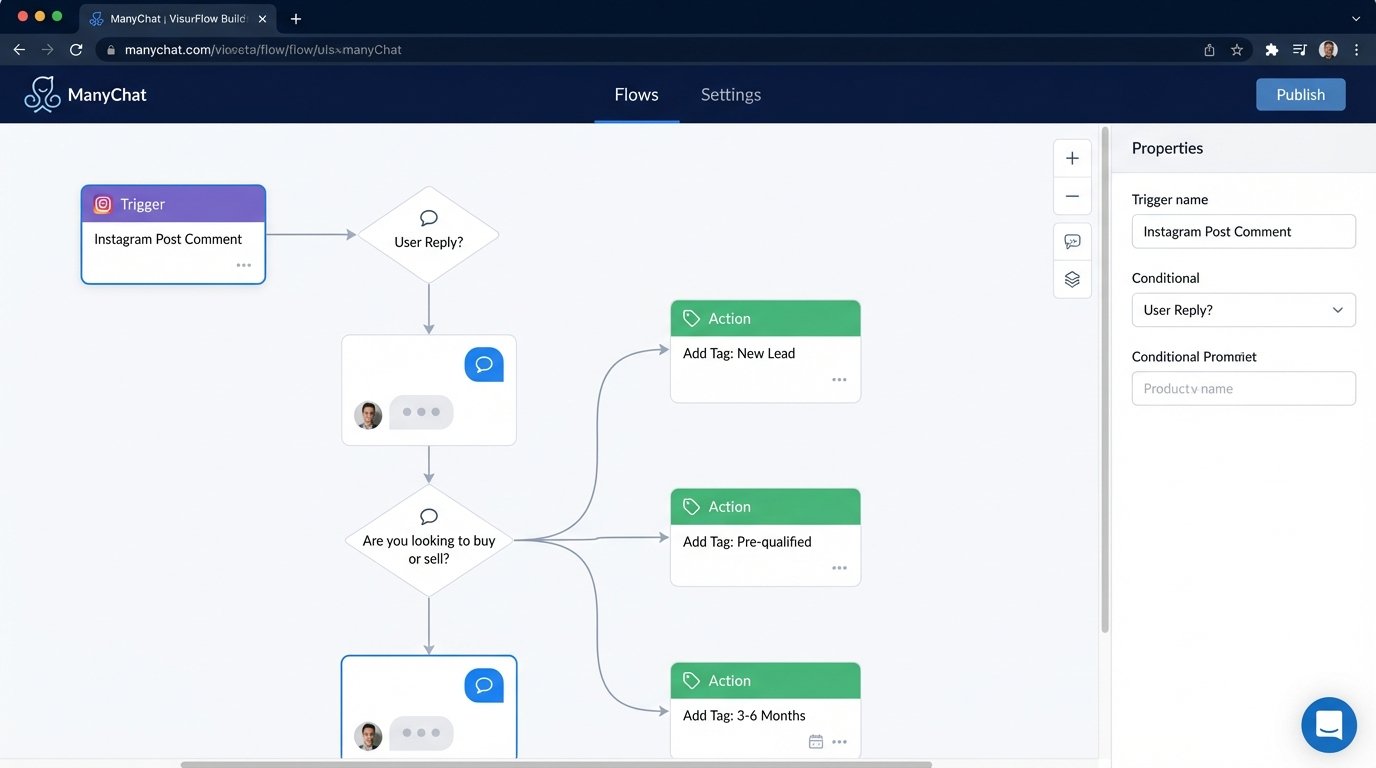
6. ManyChat
ManyChat’s strength is its origin in social media. It provides a unified platform to build chatbots that work across a website, Facebook Messenger, and Instagram DMs. For agents who generate a significant portion of their leads through social channels, this bridges a critical gap. You can start a conversation on an Instagram ad and continue it on the website, maintaining context. The backend logic allows for tagging users based on their answers, creating segmented lists for targeted follow-ups.
The challenge is data fragmentation. You end up with lead data siloed inside ManyChat’s ecosystem, and exporting it in a structured way for CRM ingestion requires careful planning and often relies on third-party connectors like Zapier, adding another point of failure.
7. Landbot
This tool is entirely centered on its visual flow builder. It allows you to construct complex conversational logic with conditional branches, variables, and formula-based operations without writing code. You can visually map out a process where the bot asks about desired square footage, calculates an estimated mortgage payment using an API call to a financial service, and then shows only matching listings. It’s a powerful tool for rapid prototyping of complex lead funnels.
The visual abstraction comes at a cost. Debugging a complex flow can become a nightmare of tracing connections on a crowded canvas. Performance can also degrade with deeply nested conditional logic, introducing noticeable lag for the user.
8. Google Dialogflow
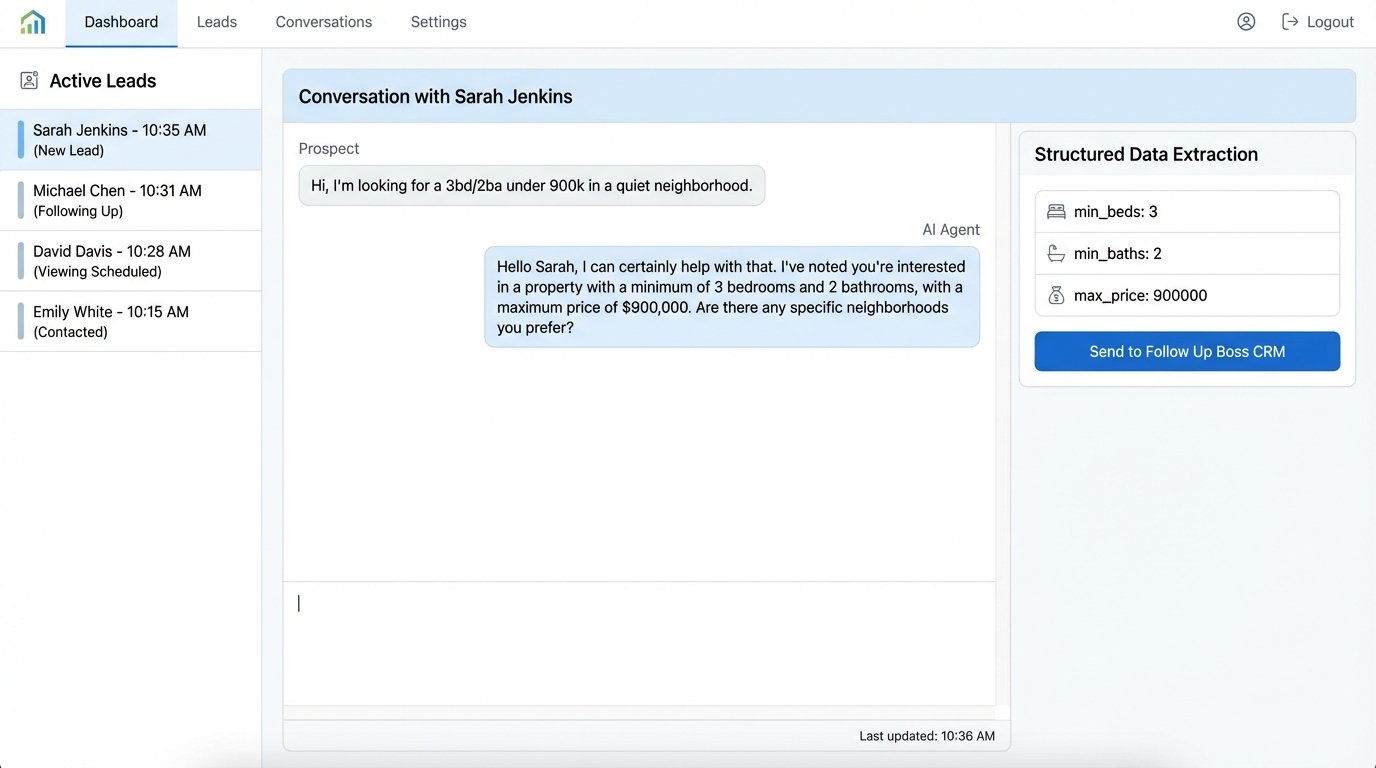
Dialogflow is not a chatbot tool. It is a raw NLP engine provided by Google Cloud. You use it as the “brain” for a custom-built chat interface. Its intent matching is world-class, capable of parsing complex sentences and extracting specific parameters (entities), like “I’m looking for a three bedroom house near downtown with a budget of nine hundred thousand dollars.” It can distinguish “three bedroom” as `min_beds: 3` and “nine hundred thousand dollars” as `max_price: 900000`.
This is a component, not a solution. You are responsible for building the entire front-end UI and the back-end application logic that integrates with the Dialogflow API. The pricing is consumption-based, and costs can escalate quickly with high traffic volumes. Integrating this properly requires a team that understands how to manage state and context across multiple API calls, which is far from trivial.
Trying to manage conversation state manually without a proper framework feels like trying to assemble a car engine while it’s running. You are constantly juggling callbacks and context flags, hoping nothing gets dropped.
9. Roof AI
Roof AI is one of the few platforms built specifically for the real estate vertical. This specialization is its main technical advantage. The AI is pre-trained on real estate-specific language and conversations, so its intent recognition for industry jargon is more accurate out of the box. It integrates with MLS data feeds to answer specific property questions and can connect directly with major real estate CRMs like Follow Up Boss and Top Producer.
This vertical focus means it is less flexible. If you need to build a conversational flow for a non-standard task, like qualifying commercial tenants or handling property management requests, you will likely hit the limits of its pre-defined capabilities.
10. Custom Scripts (Python + Selenium/Puppeteer)
For ultimate control, you can bypass dedicated platforms entirely. A custom Python script using a library like Selenium or Puppeteer can drive a web browser to scrape MLS data in real-time. It can then feed this data into a conversational front-end built with a simple framework like Flask, using a cloud NLP service for intent processing. This allows you to trigger conversations based on highly specific user actions that most platforms cannot track.
For instance, you could inject a chat prompt only after the user has scrolled through more than 70% of a listing’s photo gallery.
from selenium import webdriver
driver = webdriver.Chrome()
driver.get("http://your-listing-page.com/property-123")
# Logic to track scroll depth and time
scroll_depth = driver.execute_script("return (window.pageYOffset / (document.body.scrollHeight - window.innerHeight));")
if scroll_depth > 0.7:
# Execute JavaScript to inject and show the chat widget
driver.execute_script("showChatWidget('Interested in a private tour?');")
This approach is brittle. A minor change to a website’s front-end code can break your scrapers and triggers. The maintenance burden is immense, and it creates a siloed piece of technical debt that is difficult for anyone else on the team to support.
The choice of tool ultimately hinges on your team’s technical depth, budget, and tolerance for system maintenance. A simple, managed service works for basic lead capture. A complex, self-hosted framework is necessary for deep integration and custom conversational logic. There is no single correct answer, only a series of trade-offs between control and convenience.