The Silent Failure of Generic Chatbots
Most chatbots deployed on corporate websites are fundamentally broken. They are configured as interactive FAQ documents, designed with a single KPI in mind: ticket deflection. The logic is simple. If the bot answers a question, it saves a support agent’s time. This metric looks great on a dashboard but completely ignores the high-intent visitor who asks a question the bot cannot answer. This is where the value drains away.
The standard failure mode is a dead-end conversation. A prospect asks a complex, multi-part question about API limitations or enterprise security compliance. The bot, lacking a pre-scripted answer, responds with a variation of “I cannot help with that.” The visitor, now frustrated, closes the tab. That lead, potentially worth six figures, is gone. No record exists of their query, no alert is sent, and no one even knows the interaction happened.
The alternative failure mode is the lazy handoff. The bot gives up and presents a link to a generic “Contact Us” form. This introduces a high-friction context switch, forcing the user to re-explain their entire situation. This process kills any momentum built during the session. It is a user experience failure passed off as a resolution path. The core issue is that these bots are built to terminate conversations, not to identify and escalate valuable ones.
Architecting the Capture Mechanism
The fix requires a fundamental shift in architecture. We must move from a simple deflection model to one of active listening and conditional data extraction. The objective is to build a system that identifies high-value conversation fragments and triggers a capture flow, even when the bot itself fails to provide an answer. This transforms the chatbot from a simple shield into an intelligent sensor.
Intent-Based Triggering
The process starts by defining what constitutes a high-value interaction. This goes beyond simple keyword matching for terms like “pricing” or “demo.” A more robust system listens for patterns and concepts indicative of a qualified lead. We configure the NLP engine to detect queries about integrations, data migration, service-level agreements, or comparisons to specific competitors. These are not support questions. They are buying signals.
A user asking about batch processing capabilities for millions of records is not kicking tires. They have a specific, large-scale problem they are trying to solve. When the bot detects these intents, it should not attempt to answer if it lacks the specific data. It should immediately pivot to the lead capture flow. The intent configuration is the brain of the operation, separating noise from signal.
The Fallback Capture Flow
When a high-value intent is triggered and the bot cannot resolve the query, the standard failure message is suppressed. Instead, we initiate a specific capture module. The script is direct and framed for value. It does not say “I don’t understand.” It says, “That is a detailed question. I can have a product specialist email you the exact specifications. What is the best email to reach you?”
This reframing is critical. It acknowledges the complexity of the user’s query and offers a higher-value resolution than the bot can provide. It positions the interaction as an escalation to an expert, not a failure of the system. The user provides their email because they are being offered a direct path to a precise answer, bypassing lower-level support tiers entirely.
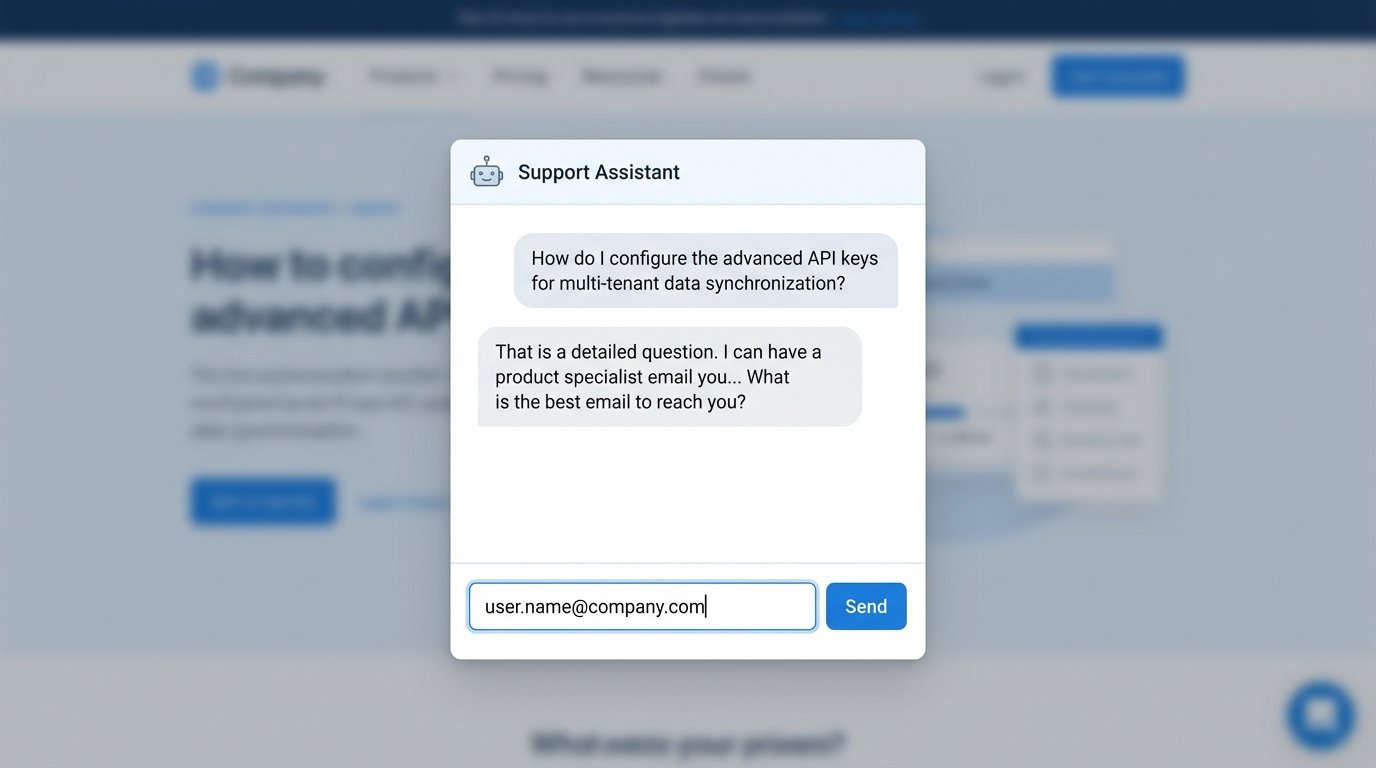
The system then confirms the capture and ends the interaction cleanly. The entire flow is designed to feel like a concierge service, not an automated dead-end. The visitor leaves with the expectation of a follow-up, and we walk away with a qualified lead that would have otherwise vanished.
Engineering the Data Pipeline
A captured email sitting in a chatbot’s proprietary dashboard is a useless artifact. To be actionable, this data must be stripped from the source and injected into the systems where the sales and engineering teams actually work. The pipeline for this data transfer must be immediate and reliable. Delays mean lost opportunities.
Webhooks as the Primary Transport
The correct tool for this job is a webhook. It is an event-driven HTTP push. The moment the chatbot captures the lead information, it bundles it into a JSON payload and fires it at a pre-configured endpoint that we control. This is superior to API polling, which is inefficient and introduces latency. The webhook provides near real-time data transfer.
The payload itself must be structured to contain all necessary context. It should not just be the captured email. A useful payload includes the visitor’s original query, the full conversation transcript, the page they were on when they initiated the chat, and any available geolocation or user agent data. This context is what allows the receiving team to respond intelligently without asking the lead to repeat themselves.
Here is a minimal example of a JSON payload fired by the chatbot’s webhook on a successful fallback capture event.
{

  "event": "lead_capture_fallback",

  "timestamp": "2023-10-27T10:00:00Z",

  "visitor_id": "anon-f8a9b2c1",

  "conversation_id": "conv-12345",

  "captured_email": "potential.lead@example.com",

  "trigger_query": "Does your API support batch processing for over 1 million records?",

  "conversation_transcript_url": "https://api.chatbot.com/transcripts/conv-12345",

  "metadata": {

    "source_url": "/pricing/enterprise",

    "ip_address": "203.0.113.1",

    "user_agent": "Mozilla/5.0 (Windows NT 10.0; Win64; x64) AppleWebKit/537.36 (KHTML, like Gecko) Chrome/118.0.0.0 Safari/537.36"

  }

}
It is also mandatory to force signature validation on the receiving endpoint. The webhook provider will sign each payload with a secret key. Our receiving application must use that same key to generate a signature from the incoming payload and check that it matches the one in the request header. This prevents unauthorized actors from injecting junk leads into our pipeline.
The Middleware Logic
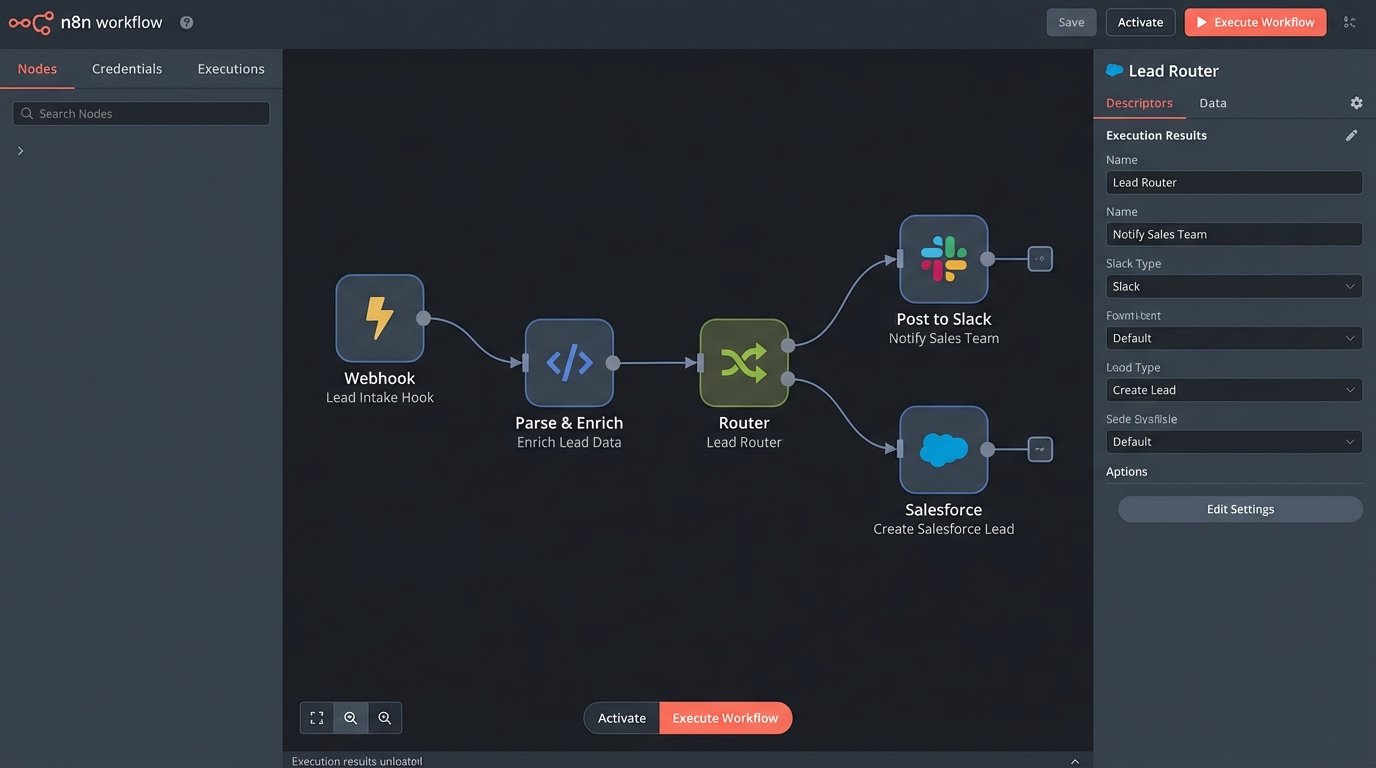
The webhook needs a destination. Dumping raw JSON into a Slack channel or a generic CRM inbox is lazy and ineffective. The correct approach is to aim the webhook at a middleware application, such as a serverless function on AWS Lambda, Google Cloud Functions, or a dedicated Node.js service. This middleware acts as a routing and enrichment engine.
The function of this middleware is to parse the incoming payload and make intelligent decisions based on its contents. It is the logic that connects the raw signal from the chatbot to a specific business action. This is like trying to shove a firehose of data through a needle. The middleware sorts the flow so the right people get the right information without getting drowned in noise.
- Data Parsing: The first step is to validate and parse the JSON. If any key fields are missing, the function should log an error and terminate.
- Data Enrichment: The middleware can take the source IP address and use a third-party service to look up firmographic data, like the company name and size. This adds immense value before the lead even hits the CRM.
- Conditional Routing: The core logic resides here. The function inspects the payload content and routes it accordingly. If the `trigger_query` contains “API” or “integration,” it formats a message for a specific `#dev-sales` Slack channel. If the `source_url` was `/pricing/enterprise`, it uses the Salesforce API to create a new Lead object and assigns it directly to the enterprise sales queue.
This intelligent routing ensures the lead is delivered with context to the team best equipped to handle it. A technical query about the API goes to a solutions engineer, not a general sales rep. This drastically shortens the sales cycle.
Closing the Loop: Alerting and Validation
Capturing data and storing it in a system of record is only half the battle. The final piece of the architecture involves creating immediate visibility for the human teams and building resilience into the system itself. A lead that is not seen is a lead that does not exist.
Real-Time Alerting
A new entry in a CRM is a passive event. A human must remember to check a list view or run a report to find it. This is too slow. The middleware should be configured to push a real-time, high-visibility alert for every high-value lead. The most effective tool for this is a team messaging platform like Slack or Microsoft Teams.
The alert message must be structured for immediate action. It should contain the captured email, the triggering question, a link to the CRM record, and any enriched data like the potential lead’s company name. This gives the sales representative enough information to perform a quick qualification check and decide on the next action within minutes of the lead being captured.
System Health and Error Handling
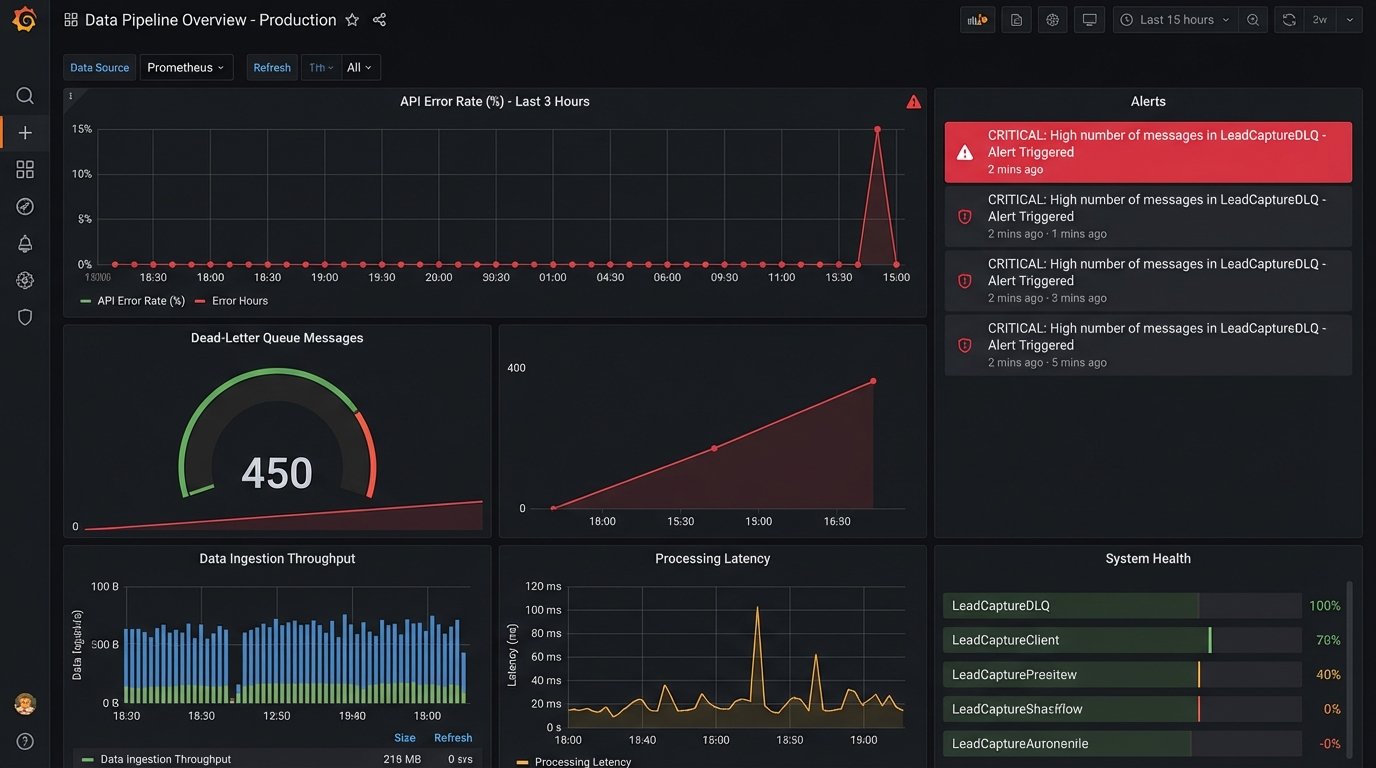
Production systems fail. APIs have downtime, networks experience transient blips, and code has bugs. A robust lead capture pipeline must be architected with failure in mind. What happens if our middleware function attempts to create a lead in Salesforce, but the Salesforce API returns a 503 Service Unavailable error? If there is no error handling, that lead is permanently lost.
The standard solution is to implement a dead-letter queue (DLQ). When our middleware function fails to process a webhook payload after a certain number of retries, it pushes the entire payload into a queue like Amazon SQS or Google Cloud Pub/Sub. A separate monitoring system watches this queue. If the queue depth increases, it triggers an alert to the engineering team. This allows us to inspect the failed payloads, diagnose the root cause of the failure, and manually re-process the leads once the downstream system is available again. No data is lost.
From Deflection to Intelligence
This architecture transforms a simple chatbot from a cost center into a proactive revenue generator. By shifting the primary goal from pure ticket deflection to intelligent lead qualification and capture, we build a system that surfaces opportunities that were previously invisible. It requires more engineering effort than dropping in a pre-built widget, but the return is substantial.
The system stops ignoring your most valuable visitors. It listens for their specific, complex needs and provides a direct escalation path to the humans who can solve their problems and close the deal. This is not a free upgrade. It requires a chatbot platform with webhook capabilities and developer hours to build and maintain the middleware. The cost of losing a single enterprise lead because your bot said “I don’t understand” makes this investment trivial.