6 Real Estate Integrations That Aren’t Just API Calls
Lead data in real estate is a mess. It’s siloed in CRMs, trapped in MLS systems, and gets mangled by email parsers before an agent ever sees it. The goal isn’t just to connect two systems. The goal is to force a single source of truth for a lead’s entire lifecycle, from the initial ad click to the final commission check. Most off-the-shelf integration platforms promise this but deliver a fragile bridge built on hope and hourly syncs. The following integrations are fundamental connections that, if built correctly, actually solve a problem instead of just creating a new dashboard nobody looks at.
1. Zillow Tech Connect to a Production CRM
This is the most fundamental integration for any brokerage paying for Zillow leads. Bypassing the email notification system is not optional. It’s a requirement for speed-to-lead. The direct API connection injects leads into your CRM in seconds, not minutes. This allows for the immediate triggering of automated follow-up sequences before the lead’s attention drifts to a competitor’s listing.
The technical benefit is data integrity. Email parsing is notoriously unreliable, failing with minor template changes from the source. An API feed provides structured data, typically JSON, that maps directly to CRM fields. You get clean inputs for name, email, phone, and the specific property of interest. This prevents the operational drag of agents having to manually clean up garbled contact records.
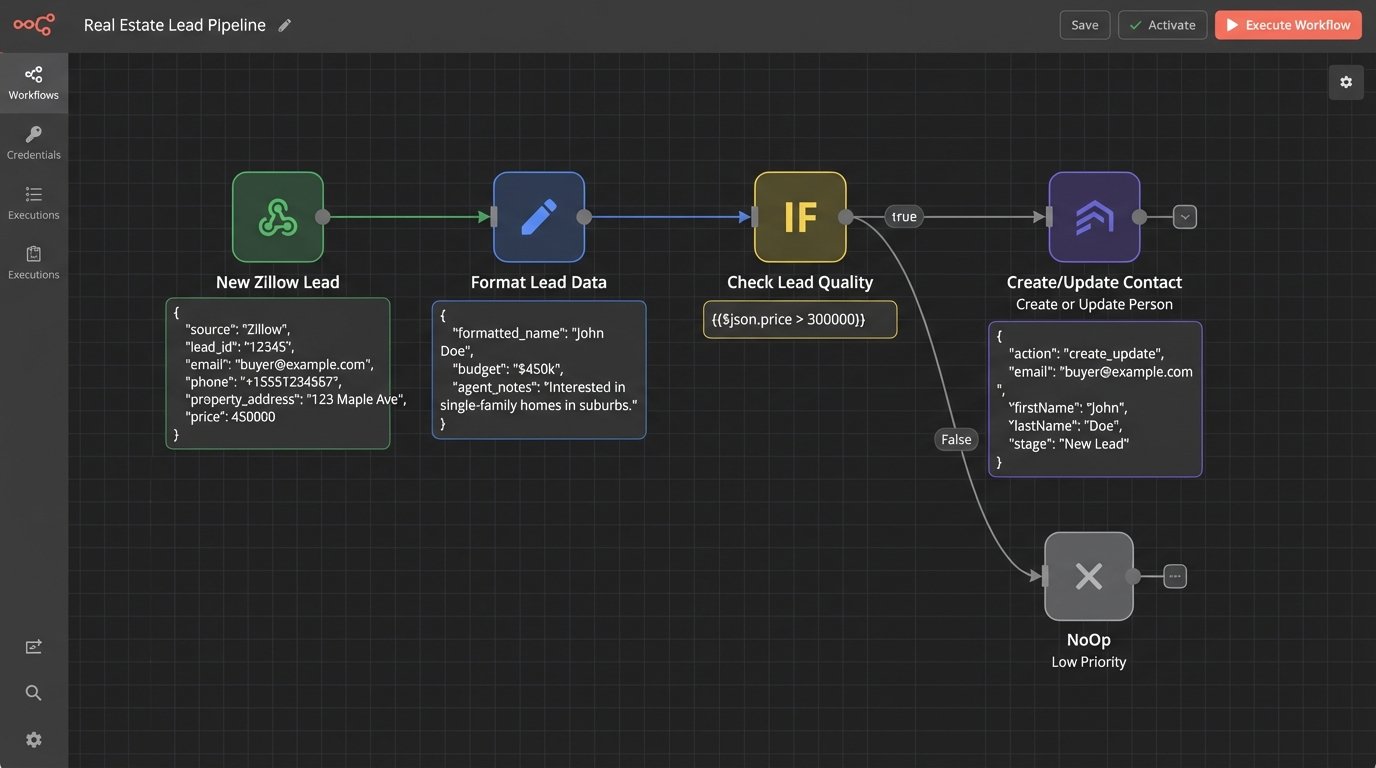
A common use case involves a lead from a Zillow Premier Agent account hitting your endpoint. The system logic-checks the incoming data, creates or updates a contact record in a CRM like Follow Up Boss, applies a “Zillow Lead” tag, and assigns it to an agent based on a predefined round-robin or territory rule. Simultaneously, it can add the lead to an “Initial Contact” smart list that kicks off an SMS and email drip campaign.
Here is a simplified look at the kind of payload you’re working with. Notice how the property information is nested, requiring you to properly parse the object to get the address and MLS number.
{
"lead": {
"source": "Zillow",
"leadType": "ListingInquiry",
"contact": {
"firstName": "John",
"lastName": "Doe",
"email": "johndoe@example.com",
"phone": "555-123-4567"
},
"property": {
"streetAddress": "123 Main St",
"city": "Anytown",
"state": "CA",
"zip": "90210",
"mlsNumber": "1234567"
},
"message": "I'm interested in this property."
}
}
The fragility here is Zillow’s API itself. It is not the most stable platform, and documentation can be outdated. You need robust error handling and a fallback mechanism, like a supervised email inbox, for when the API inevitably fails. Without it, you are flying blind and losing leads that you paid a premium for.
2. MLS Data Feed (RESO Web API) to a Marketing Automation Platform
Relying on agents to manually create “Just Listed” or “Price Reduced” emails is a losing battle. It’s slow, inconsistent, and prone to errors. A direct integration between your local MLS feed and a marketing platform like Mailchimp or Klaviyo allows you to automate this entire process based on real-time property status changes.
The RESO Web API is the modern standard, slowly replacing the archaic RETS protocol. It uses standard OData queries, which are far more manageable. The core task is to run a scheduled job, perhaps a cron running every 10-15 minutes, that queries the MLS for listings with a recently changed modification timestamp. You are looking for status changes like `Active`, `Pending`, `Sold`, or a price change event.
Once a relevant change is detected, the integration logic kicks in. For a new listing, the system pulls the property details, primary photo URL, and agent information. It then cross-references this against your contact database, finding subscriber segments that match the property’s location, price range, or type. The data is then injected into a pre-approved email template and sent automatically. This hammers the marketing message out while the listing is still fresh.
Getting the data is one thing. Normalizing it is the real work. Trying to merge data from three different MLS boards, each with its own field conventions and required data points, is like trying to shove a firehose through a needle. It requires building a transformation layer that strips and maps incoming data to a unified internal schema before it ever touches your marketing platform. Without this step, your personalization tokens will be a disaster of missing data and improperly formatted values.
3. DocuSign API to a Transaction Management System
The gap between a verbal agreement and a signed contract is where deals die. This integration closes that gap by programmatically generating and managing signature envelopes. Connecting a system like SkySlope or Brokermint directly to the DocuSign eSignature API removes the human bottleneck of an agent or transaction coordinator manually creating documents for every single deal.
The workflow is event-driven. When a transaction’s status is updated to “Under Contract” in your management platform, a webhook should fire. This webhook carries a payload with the necessary data: buyer names, seller names, property address, purchase price, and other key terms. Your intermediary service listens for this webhook, then constructs an API call to DocuSign to create an envelope from a predefined template, populating the fields with the payload data and assigning signer roles.
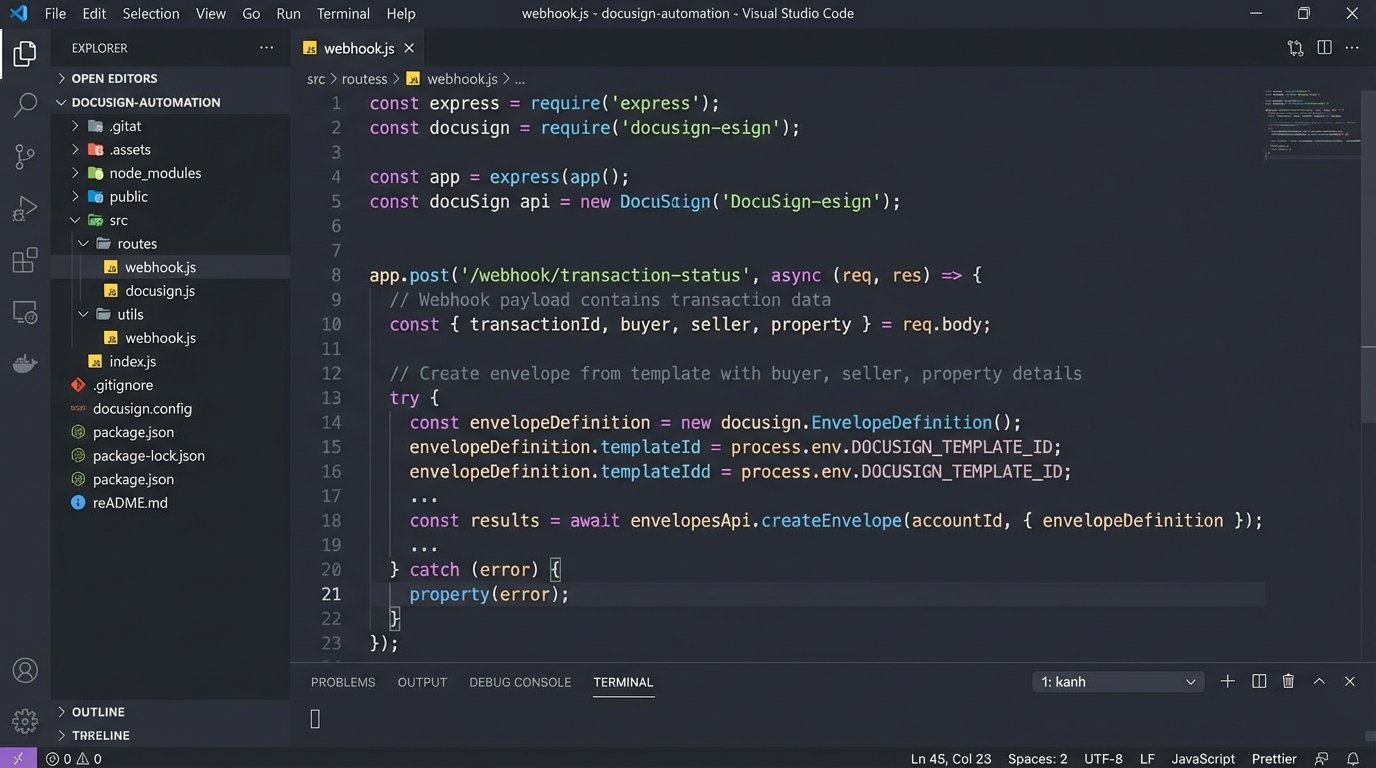
A more advanced implementation uses DocuSign Connect, their webhook service. You configure it to send you real-time status updates as the envelope moves through the signing process. When an `envelope-completed` event is received, your system can automatically pull the signed PDF, file it in the correct transaction folder, and update the deal status to “Executed Contract.” This creates a closed-loop system that reduces compliance overhead.
This is a wallet-drainer. DocuSign’s API pricing is steep, especially at scale. Every envelope sent is a metered event. You also have to architect for failure scenarios. What happens if a signer declines to sign, or if an email address is bad? Your system needs to catch these webhook events and create tasks for the transaction coordinator to manually intervene. Leaving these edge cases unhandled leads to stalled transactions and furious agents asking why their documents were never sent.
4. Google Ads API to a Backend Sales Database
Most real estate marketing teams operate on vanity metrics like cost-per-lead. This is useless. The only metric that matters is cost-per-closed-deal. Bridging the Google Ads API with your CRM or sales database is the only way to get this number. It requires stitching together ad data with actual transaction outcomes.
The technical challenge is maintaining the attribution chain. When a user clicks a Google Ad, they are assigned a Google Click ID (GCLID). This ID must be captured by a hidden field in your lead form and passed along with the lead’s contact information into the CRM. This is the key that links a specific ad click to a specific person.
Your integration then runs a periodic script. First, it calls the Google Ads API to pull campaign, ad group, and keyword performance data, including cost. It stores this data, indexed by date and campaign ID. Second, it queries your CRM for all deals that closed within a given timeframe, making sure to retrieve the GCLID that was stored with the original lead. By joining the sales data with the ad spend data on the GCLID, you can finally calculate the true return on ad spend for specific campaigns.
This entire chain is incredibly fragile. If your website’s URL redirect strips the GCLID parameter, the link is broken. If your form fails to capture the hidden field, the link is broken. You will have data gaps. The objective is not 100% perfect attribution, which is impossible, but to get a directionally accurate picture of which marketing channels are generating revenue versus just clicks.
5. Plaid API to a Mortgage Application Portal
The pre-approval process is bogged down by manual document verification. Agents and loan officers spend days chasing down PDF bank statements to get proof of funds. The Plaid integration bypasses this entire manual loop. It allows a potential borrower to securely connect their bank account and provide instantaneous, verifiable proof of their assets.
From an engineering perspective, the front-end implementation involves integrating the Plaid Link module into your application form. When the user needs to verify their assets, you initialize Link with your public key. This opens Plaid’s secure iframe, where the user selects their bank and enters their credentials. Plaid handles the multi-factor authentication and tokenizes the connection. It never exposes the credentials to your system.
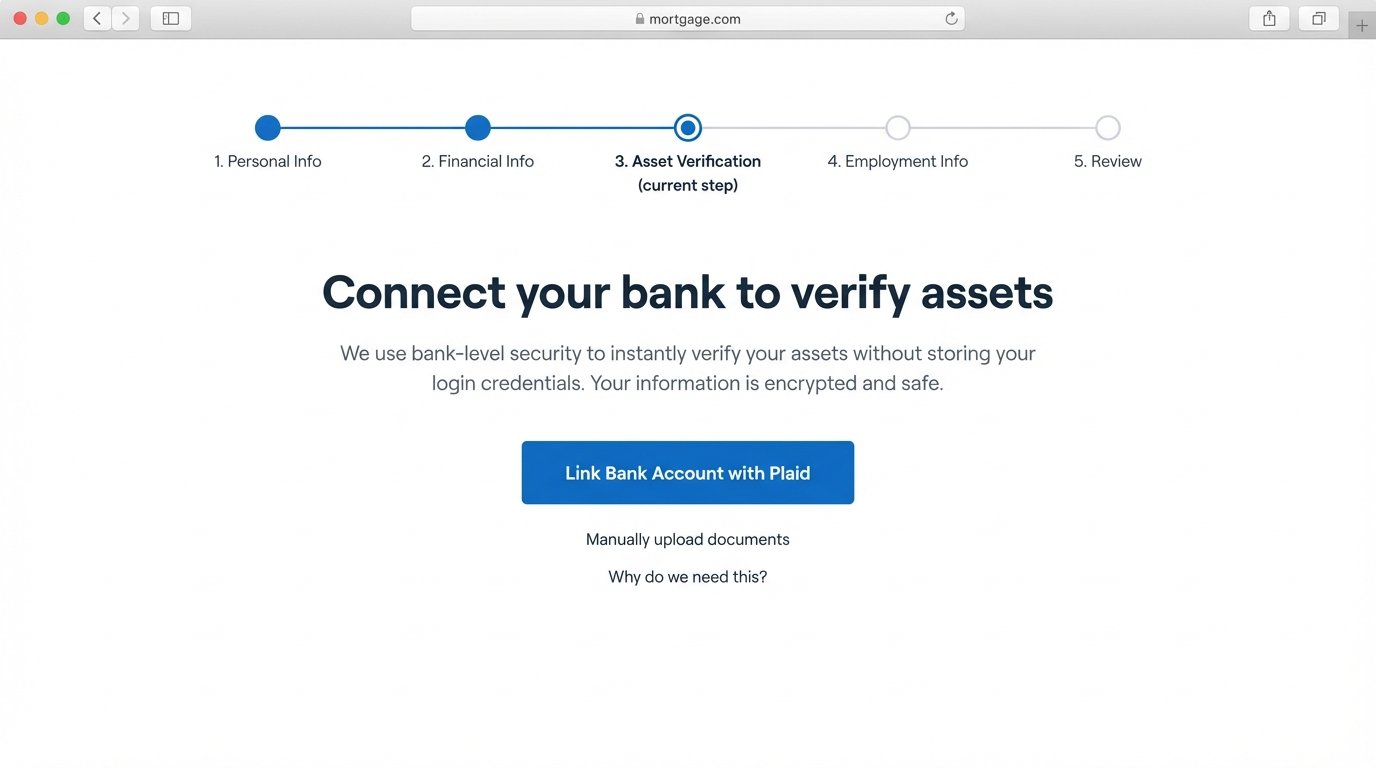
Once the user successfully connects, Plaid’s client-side module returns a `public_token`. Your front end sends this short-lived token to your server. Your server then makes a secure, server-to-server API call to exchange the `public_token` for a permanent `access_token`, which you store securely. This access token is what you use to make subsequent API calls to endpoints like `/accounts/balance/get` to retrieve real-time account balances and ownership details.
The main hurdle is not technical, but psychological. Users are justifiably wary of entering their banking credentials into a web form. The user experience and security messaging around the Plaid module must be perfect. Any ambiguity will cause users to abandon the application. You are also handling extremely sensitive data, which brings a heavy compliance burden for data storage and access control.
6. Twilio API to a First-Response Lead Router
In online real estate leads, the agent who responds first wins. A five-minute delay in response can cause lead conversion rates to plummet. Integrating a programmable communications API like Twilio is the most direct way to engineer an instant response and connection system.
The architecture is simple and brutally effective. A new lead submitted through a website form or landing page triggers a webhook to your own API endpoint. This endpoint, often a serverless function for scalability and low cost, immediately initiates a sequence of actions through the Twilio API.
A common sequence is a “text-then-call” cadence. First, the function sends an SMS to the lead acknowledging their inquiry. This provides instant gratification. Second, the function looks up the on-duty agent from a schedule or round-robin list and initiates a voice call connecting the agent directly to the lead. This is done by first calling the agent, and when they pick up, playing a pre-recorded whisper message (“New lead for 123 Main Street, press 1 to connect”), and then dialing the lead to bridge the call.
The biggest problem is deliverability. Mobile carriers are extremely aggressive with spam filtering, especially with the rollout of A2P 10DLC registration requirements for business texting. If your messaging volume is high or your opt-out handling is sloppy, your phone numbers will be flagged and blocked. You must build robust logic for managing consent and processing STOP replies to avoid having your entire communication infrastructure shut down without notice.