
Most real estate tech is a fresh coat of paint on a crumbling foundation. We are sold on “platforms” that are little more than brittle frontends duct-taped to a Salesforce instance. The goal of a modern stack is not to collect more dashboards. The goal is to build a data assembly line that automates the expensive, error-prone, manual work that kills deals and burns margins.
The following is not a list of perfect tools. It is a list of applications with functional, documented APIs that can be chained together to solve specific problems. Integration is a slog. The real value is unlocked when you strip these tools for parts and bridge their data streams to force a single, coherent workflow. Prepare for budget fights and late nights debugging opaque error messages.
1. Reonomy: Bypassing County Clerk Drudgery
Acquiring clean commercial property data is a fundamentally broken process. You can either hire an army of interns to scrape archaic county assessor websites or pay a fortune for aggregated data feeds of questionable quality. Reonomy sits in the middle, providing API-level access to a massive dataset of commercial properties, ownership records, and debt information. It normalizes data from thousands of public sources, which saves countless engineering hours.
The real power is in its query capabilities. You are not just pulling property records. You are running targeted searches for off-market assets that meet specific financial triggers, like loan maturity dates or recent sales history. This allows you to build an automated prospecting engine that surfaces opportunities before they hit the open market.
Core Technical Benefits:
- Entity Resolution: It does a decent job of resolving a single property across multiple public records, which is a massive headache to build in-house.
- Debt & Ownership Data: Access to loan origination dates, lender information, and true owner contact details, all via API endpoints.
- Filtering Logic: You can construct complex queries that filter by asset class, transaction history, and even opportunity zone status.
Integration Use Case: Automated Lead Generation
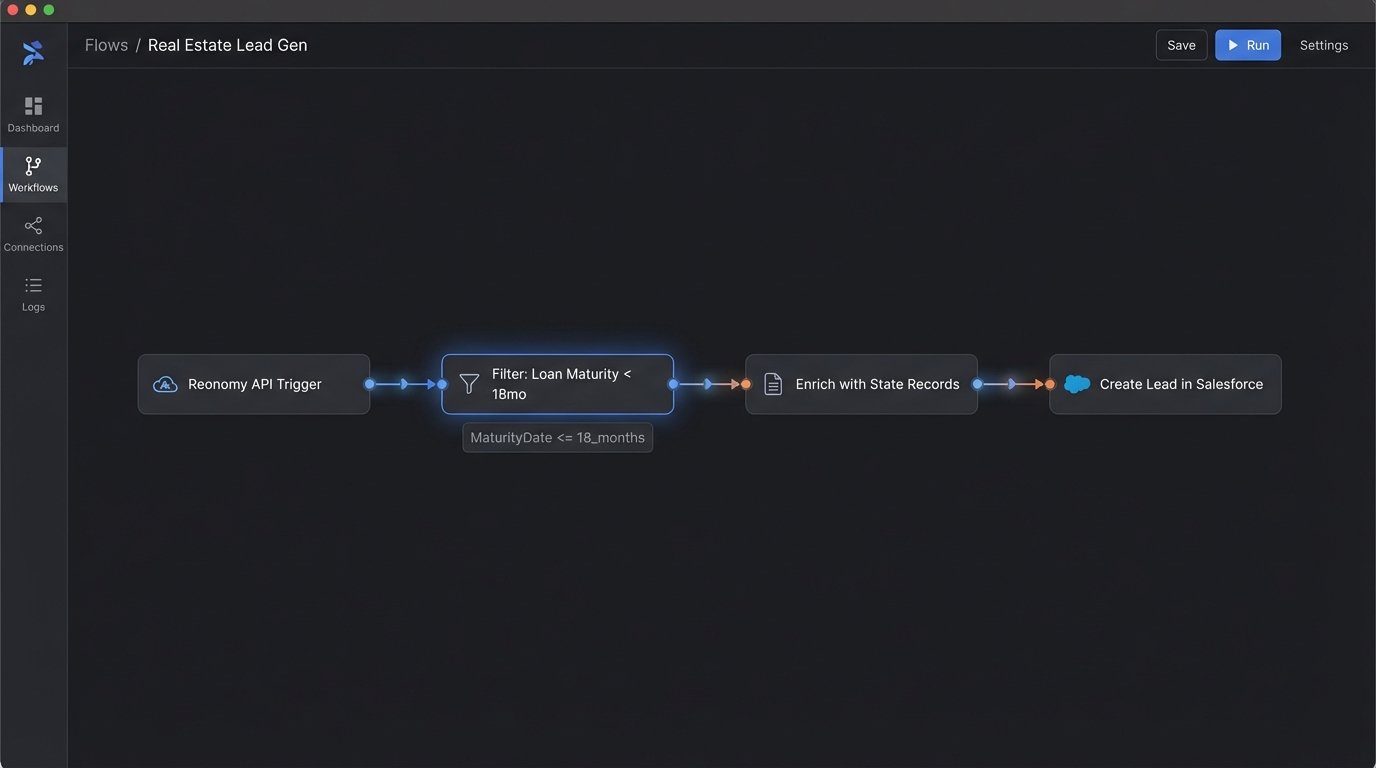
We built a service that polls the Reonomy API daily for multifamily properties in a target zip code with loans maturing in the next 18 months. The script pulls the property details and ownership LLC. It then cross-references this with secretary of state data to find the managing partners. The final, enriched lead is injected directly into our CRM with a new task assigned to the acquisitions team.
This tool is a wallet-drainer, so treat every API call like it costs money, because it does. You must cache aggressively and logic-check every query before you send it.
2. Placer.ai: De-Anonymized Foot Traffic Without the Guesswork
Broker-supplied foot traffic numbers are marketing material, not data. Placer.ai offers a brutal dose of reality by providing aggregated foot traffic analytics from anonymized mobile device location data. For any commercial property, you can pull visitation trends, visitor demographics, and trade area analysis. This moves due diligence from subjective guesswork to objective data analysis.
The platform allows you to draw a polygon around any property or shopping center and get a historical view of traffic. You can then compare it to a competitor’s location across the street. The API lets you automate this process, pulling data for hundreds of properties to build competitive landscape reports without touching their sluggish UI.
Core Technical Benefits:
- Competitive Benchmarking: Directly compare foot traffic between two or more locations over time.
- Trade Area Analysis: Understand the geographic reach of a property by seeing where its visitors live and work.
- Cross-Shopping Behavior: Identify other brands and locations that your target property’s visitors frequent.
Integration Use Case: Retail Lease Validation
Before signing a major retail tenant, we automate a due diligence report. A script uses the Placer.ai API to pull the last 24 months of foot traffic for the target location and its three closest competitors. It visualizes daily traffic patterns, weekend vs. weekday volume, and the loyalty of the customer base. This data is attached to the deal record in our CRM, giving the leasing committee a non-biased view of the location’s health.
The API can be slow on complex geospatial queries, so design your jobs to run asynchronously and expect to implement retry logic.
3. Cherre: A Central Nervous System for Disparate Data Feeds
A typical real estate operation runs on a dozen disconnected systems: MLS for listings, a CRM for deals, Yardi for accounting, and a mountain of spreadsheets for everything else. Cherre is a data warehousing and connection platform built specifically for this mess. It ingests data from multiple sources and attempts to map it all to a unified real estate data model, creating a single source of truth.
Its primary function is to serve as a data backbone. You pipe your feeds into Cherre, and it handles the brutal work of entity resolution. For instance, it connects the property record from your accounting system to the same property record from a public data source. Connecting these data sources yourself is like trying to wire a modern smart home with speaker wire from 1985. Cherre provides the unified bus.
Core Technical Benefits:
- Pre-built Connectors: It has a library of connectors for common real estate data sources, which saves significant initial development time.
- Knowledge Graph: Links disparate datasets through resolved entities, allowing you to run queries that span your entire data ecosystem.
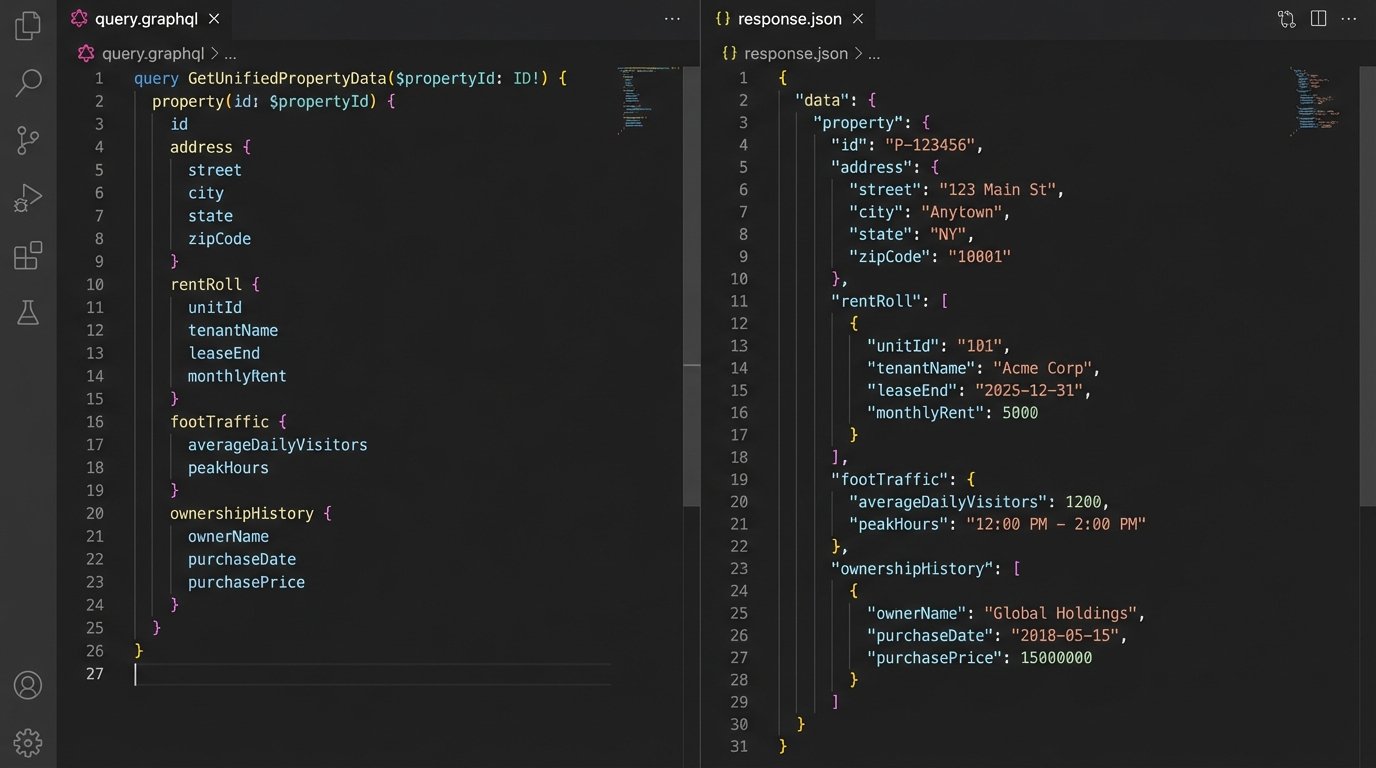
- GraphQL API: Provides a flexible way to query the exact data you need from your connected sources without over-fetching.
Integration Use Case: Portfolio-Wide Valuation Modeling
We feed Cherre everything: our internal rent roll data from Yardi, acquisition data from Reonomy, and even foot traffic metrics from Placer.ai. Once Cherre connects these datasets at the property level, our data science team can access a clean, unified data stream. They use this to build and train machine learning models that produce more accurate property valuations across our entire portfolio.
The initial setup is a monster. Expect to spend weeks mapping your source data to their schema and validating the output. If you feed it garbage, it will give you back well-organized, expensive garbage.
4. VTS: Forcing Order onto the Chaos of Commercial Leasing
Commercial leasing is often managed by a chaotic mix of emails, phone calls, and spreadsheets. VTS is a leasing and asset management platform that centralizes deal tracking, tenant management, and portfolio analytics. It provides a structured environment for a process that is inherently unstructured. From an automation perspective, its value is in the API.
The API exposes all the critical leasing data: deal stages, lease terms, tenant requirements, and stacking plans. This allows you to pull operational data out of the silo of the leasing team and integrate it with financial and asset management systems. You can programmatically track the entire leasing pipeline from first contact to signed lease without relying on manual reports.
Core Technical Benefits:
- Deal Pipeline Access: Get structured data on every deal in the pipeline, including size, timing, and probability.
- Lease Comp Database: Programmatically access data on executed leases to feed your own internal comp database and valuation models.
- Tenant Information: Pull data on existing tenants, lease expirations, and options.
Integration Use Case: Real-Time Portfolio Health Dashboard
A scheduled script runs every hour, querying the VTS API for key leasing metrics: new deals added, deals moved to the next stage, and leases signed. It also flags any major leases set to expire in the next 12 months. This data is then pushed to a live dashboard, giving executives a real-time view of portfolio leasing velocity and future occupancy risk.
The platform’s biggest weakness is its reliance on manual data entry. The API is only as good as the data the brokers put in it, and data hygiene is a perpetual war.
5. Procore: Injecting API-Driven Sanity into Construction Projects
Construction management is a notorious black box for capital partners and asset managers. Procore centralizes project documentation, financials, and communication, bringing a degree of transparency to the process. It tracks everything from RFIs and submittals to budgets and change orders. Its API is what elevates it from a simple project management tool to a system of record that can be integrated into a larger data architecture.
Using the API, you can extract critical financial and operational data without ever logging into the Procore interface. You can monitor budget vs. actuals, track the status of change orders, and analyze subcontractor performance programmatically. This is about building an early warning system for project distress.
Here is a basic Python snippet to pull open RFIs for a given project. It is simple but illustrates how you can start extracting operational data.
import requests

import json
def get_open_rfis(project_id, access_token, api_base_url):
headers = {
'Authorization': f'Bearer {access_token}',
'Procore-Company-Id': 'YOUR_COMPANY_ID'
}
params = {
'project_id': project_id,
'filters[status]': 'open'
}
response = requests.get(f'{api_base_url}/rfis', headers=headers, params=params)
if response.status_code == 200:
return response.json()
else:
print(f"Failed to fetch RFIs: {response.status_code} {response.text}")
return None
# Usage
project_id_to_check = 12345
token = 'YOUR_OAUTH_ACCESS_TOKEN'
base_url = 'https://api.procore.com'
open_rfis = get_open_rfis(project_id_to_check, token, base_url)
if open_rfis:
print(f"Found {len(open_rfis)} open RFIs for project {project_id_to_check}.")
Integration Use Case: Automated Risk Alerting
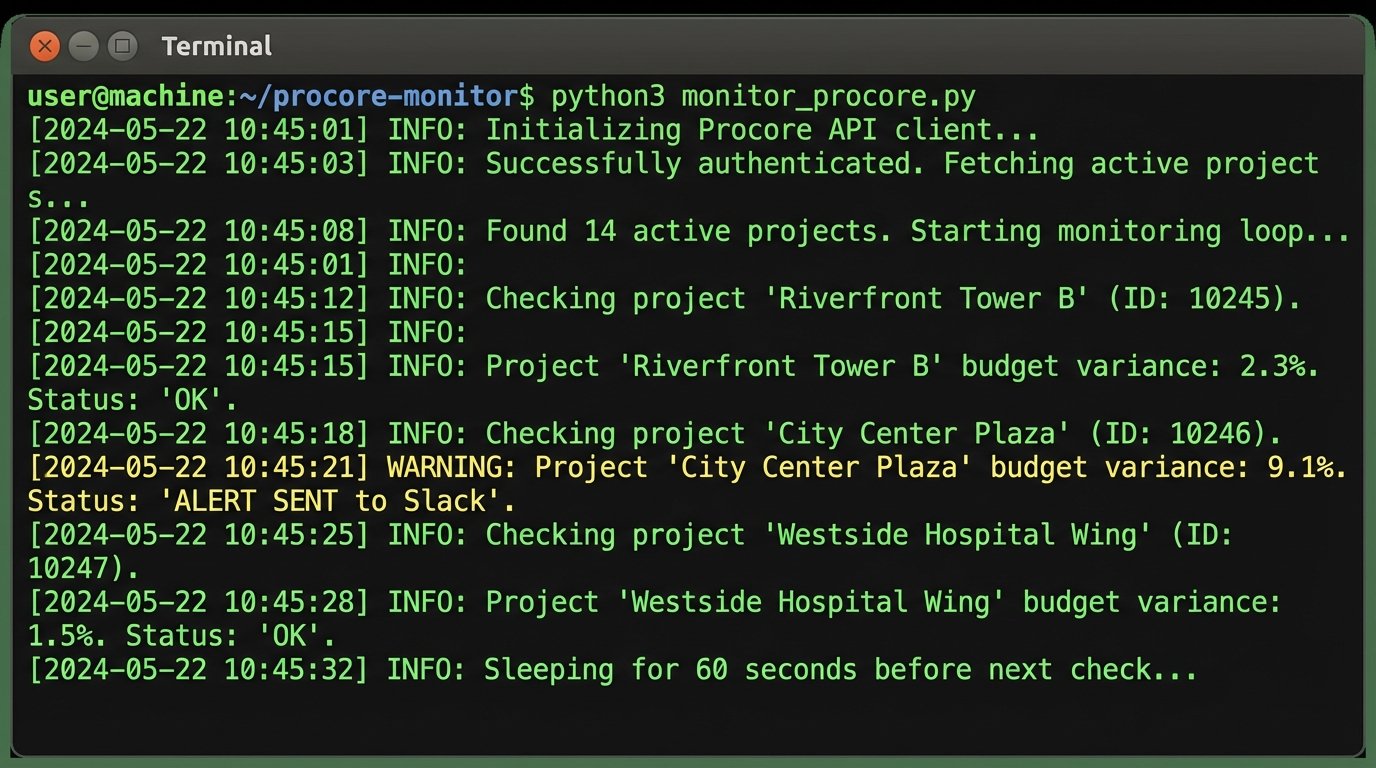
We have a cron job that hits the Procore API every night. It pulls the budget summary for every active project and compares the “projected cost” to the “original budget.” If the variance exceeds a 7% threshold, it automatically triggers an alert in a dedicated Slack channel for the asset management team, flagging the project for immediate review.
The tool is painfully expensive. You will likely find its native reporting modules are too rigid for your needs, forcing you to use the API to pull raw data and build your own reports.
6. Docusign API: Automating the Final Mile
Manual document preparation is a bottleneck. The process of taking deal terms from a system of record and manually creating a lease or purchase agreement is slow and ripe for copy-paste errors. The Docusign eSignature API lets you automate this entire workflow, from document generation to final execution.
Its power lies in its templating and data-tagging features. You create a master template for a document type, like a lease agreement, with placeholder tags for all variable fields. Then, using the API, you can create a new “envelope” from this template and dynamically inject data from your CRM or another system. This ensures consistency and eliminates manual data entry errors.
Core Technical Benefits:
- Dynamic Document Generation: Populate templates with data from any source system to generate contracts on the fly.
- Webhooks: Configure webhooks to get real-time status updates as a document moves through the signing process.
- Embedded Signing: Embed the signing experience directly into your own application or portal for a seamless user flow.
Integration Use Case: Zero-Touch Lease Execution
When a broker marks a deal as “Lease Out” in our CRM, a trigger fires a cloud function. The function calls the Docusign API, selects the appropriate lease template based on property type, and pulls all the deal specifics from the CRM record. It injects the data into the document, defines the signing order for the tenant and landlord, and sends it out. A webhook listens for the “Completed” event and, once received, automatically updates the CRM record to “Executed” and archives the signed document.
The OAuth 2.0 JWT Grant flow required for service-to-service authentication is a pain to configure correctly, and its sandbox environment can be an unreliable predictor of production behavior.