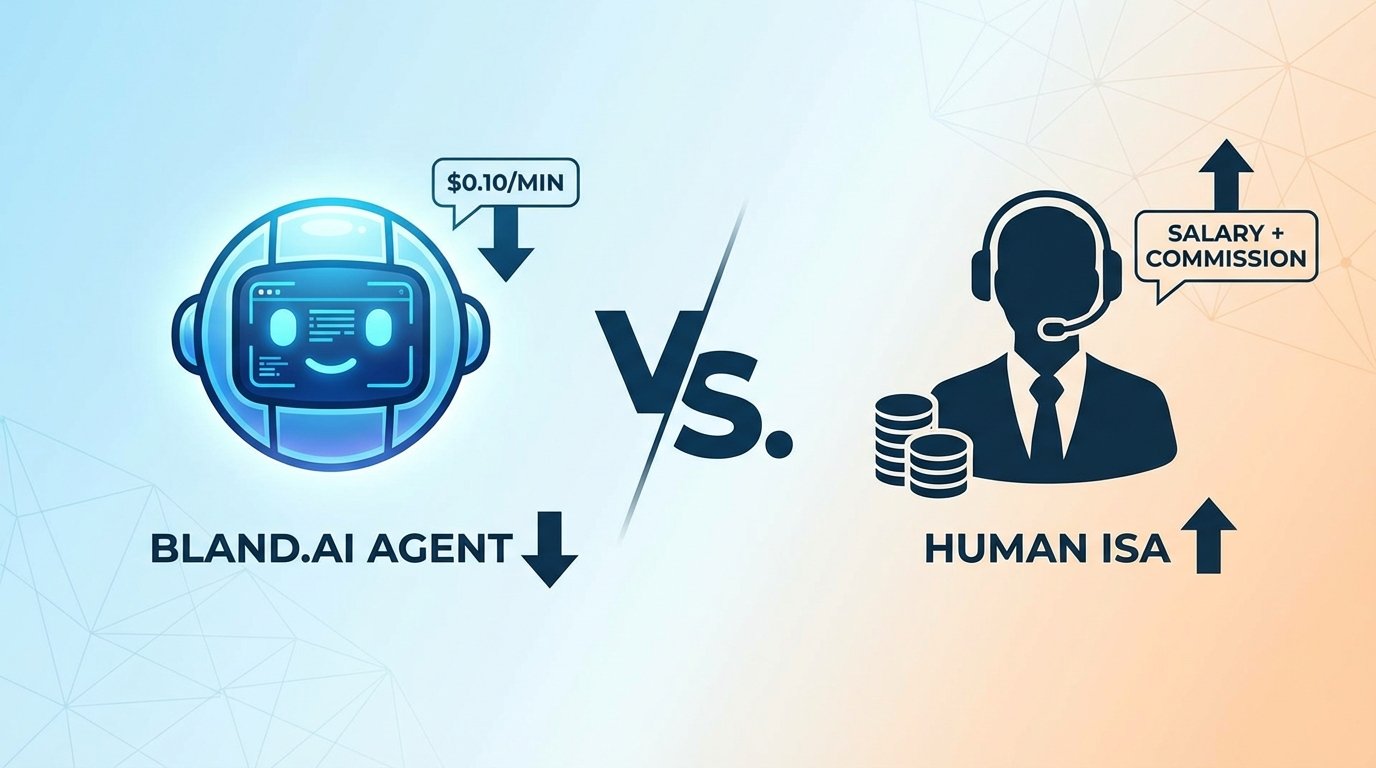
The Ten-Cent-Per-Minute Illusion
The sticker price is the first trap. Bland.ai advertises rates around ten cents per minute. A human Inside Sales Agent costs a brokerage about sixty thousand a year plus benefits and commission. The math looks simple until you factor in the engineering payroll required to prevent the AI from burning your lead list to the ground.
A human ISA requires a manager, a CRM license, and a phone line. An AI agent requires a developer to build and maintain the infrastructure that glues it to your systems. This includes API orchestration, state management for callbacks, and a webhook ingestion pipeline to process the results. That developer’s time is not free.
We are not comparing an apple to an orange. We are comparing a finished vehicle to a crate engine. One is ready to drive off the lot. The other requires you to build the car around it.
Onboarding and “Training” Protocol Differences
Training a human involves scripts, role-playing, and shadowing. It’s time-intensive and notoriously inconsistent. The output is a person who can navigate nuance, detect sarcasm, and pivot a conversation when they hit a wall. Their performance degrades with burnout and improves with experience.
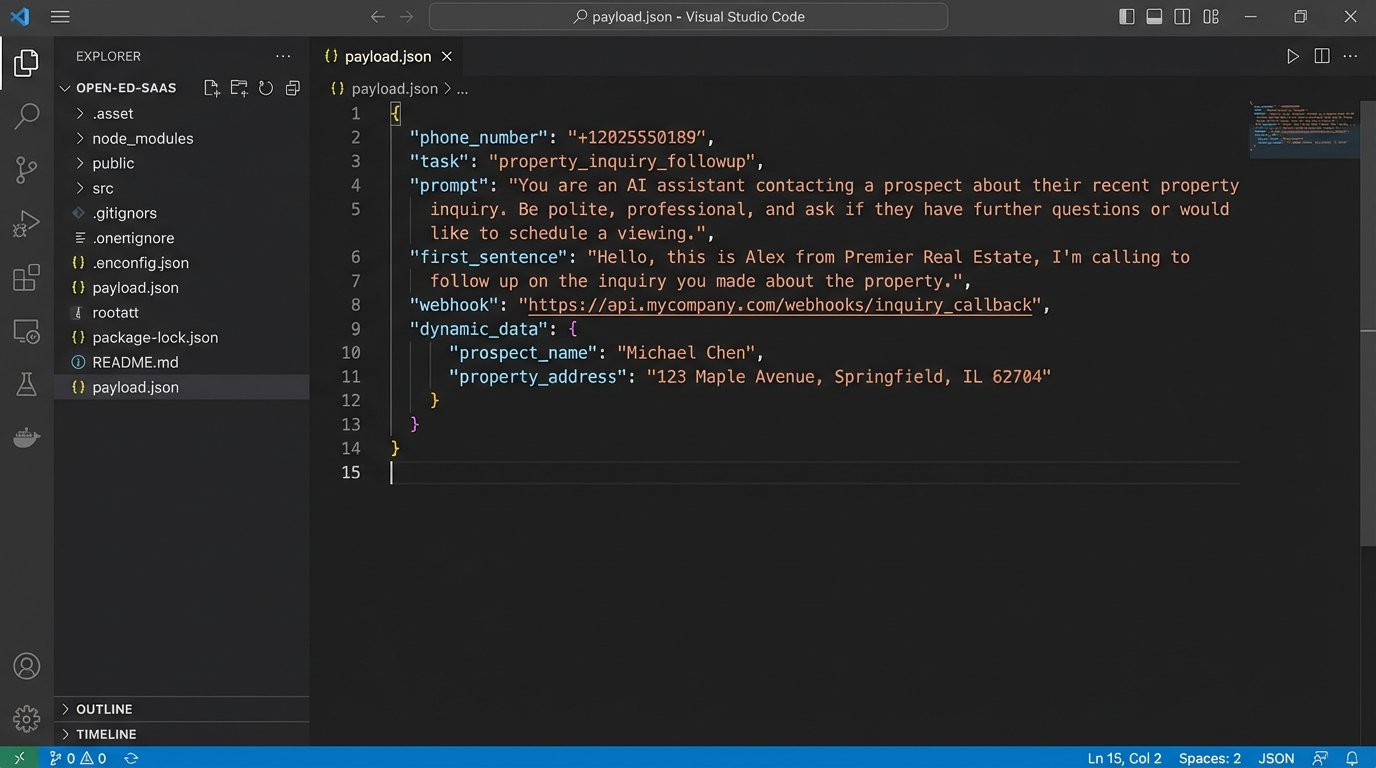
Training Bland.ai is a logic-driven process. You construct a state machine through prompt engineering and API parameters. The “first_sentence” and “prompt” fields are your primary control surfaces. You inject dynamic data like prospect names and property details directly into the call payload. The AI does not get tired or have bad days, but it will follow a broken instruction with perfect, idiotic precision a thousand times in a row.
Forget the idea of a self-learning entity. You are programming a voice-activated IVR with a more sophisticated natural language processor. Every conversational branch must be anticipated and coded for. If a prospect asks a question outside your defined logic paths, the agent either defaults to a generic fallback or hangs up. There is no improvisation.
The Technical Overhead of an AI Agent
To run a single AI call, you send a POST request to Bland’s API endpoint. The payload contains the phone number, the task prompt, and crucially, a `webhook` URL. This URL is the central nervous system of your entire operation. Without a resilient, scalable endpoint to receive the call data, you are flying blind.
This endpoint must be able to handle asynchronous JSON payloads that detail every stage of the call: `ringing`, `answered`, `completed`. The `completed` event contains the full transcript, metadata, and any structured data you instructed the AI to extract. Your backend service has to parse this payload, logic-check the outcome, and then perform an action. This action is usually a sequence of API calls to update your CRM.
Here is a minimal example of a webhook handler using Python with Flask. This is the absolute base level of what you need to build. It receives the call data and assumes you have a function `update_crm` to do the actual work. Notice the lack of error handling, authentication, or retry logic. That’s all on you.
from flask import Flask, request, jsonify

app = Flask(__name__)

# This key should be stored securely, not hardcoded.
# Used to verify the webhook is from Bland.ai.
BLAND_WEBHOOK_SECRET = 'your_secret_here'

@app.route('/webhook/call_result', methods=['POST'])
def handle_call_result():
    # Basic security check. In production, use a proper signature verification.
    auth_header = request.headers.get('Authorization')
    if not auth_header or auth_header != f'Bearer {BLAND_WEBHOOK_SECRET}':
        return jsonify({'status': 'error', 'message': 'Unauthorized'}), 401

    data = request.json
    call_id = data.get('call_id')
    status = data.get('status')
    transcript = data.get('transcript')

    if not call_id or status != 'completed':
        # Log non-completed events or handle them as needed.
        return jsonify({'status': 'received_interim_update'}), 200

    # At this point, the call is done. Process the data.
    # The 'update_crm' function is where your business logic lives.
    # It would connect to Salesforce, HubSpot, etc., and update the lead record.
    try:
        crm_update_status = update_crm(call_id, transcript)
        return jsonify({'status': 'success', 'crm_status': crm_update_status}), 200
    except Exception as e:
        # Proper error logging is critical here.
        print(f"Error processing call {call_id}: {e}")
        return jsonify({'status': 'error', 'message': 'Internal Server Error'}), 500

def update_crm(call_id, transcript_data):
    # Placeholder for your actual CRM integration logic.
    # This might involve multiple API calls to find a contact, create a note,
    # and update a lead status based on the call outcome.
    print(f"Updating CRM for call {call_id} with transcript.")
    # In a real system, this would return a meaningful status.
    return "updated"

if __name__ == '__main__':
    app.run(port=5000)
This snippet is deceptive. The real work is in `update_crm`. That function has to be fault-tolerant and idempotent. You are shoving the firehose of unstructured human conversation through the needle of a structured CRM API, and it will break.
Call Execution and Failure Modes
A human ISA handles network drops or bad connections intuitively. They call back. They send a text. They update the CRM with “Bad connection, will try again later.” This manual error handling is so ingrained we forget it’s a critical function.
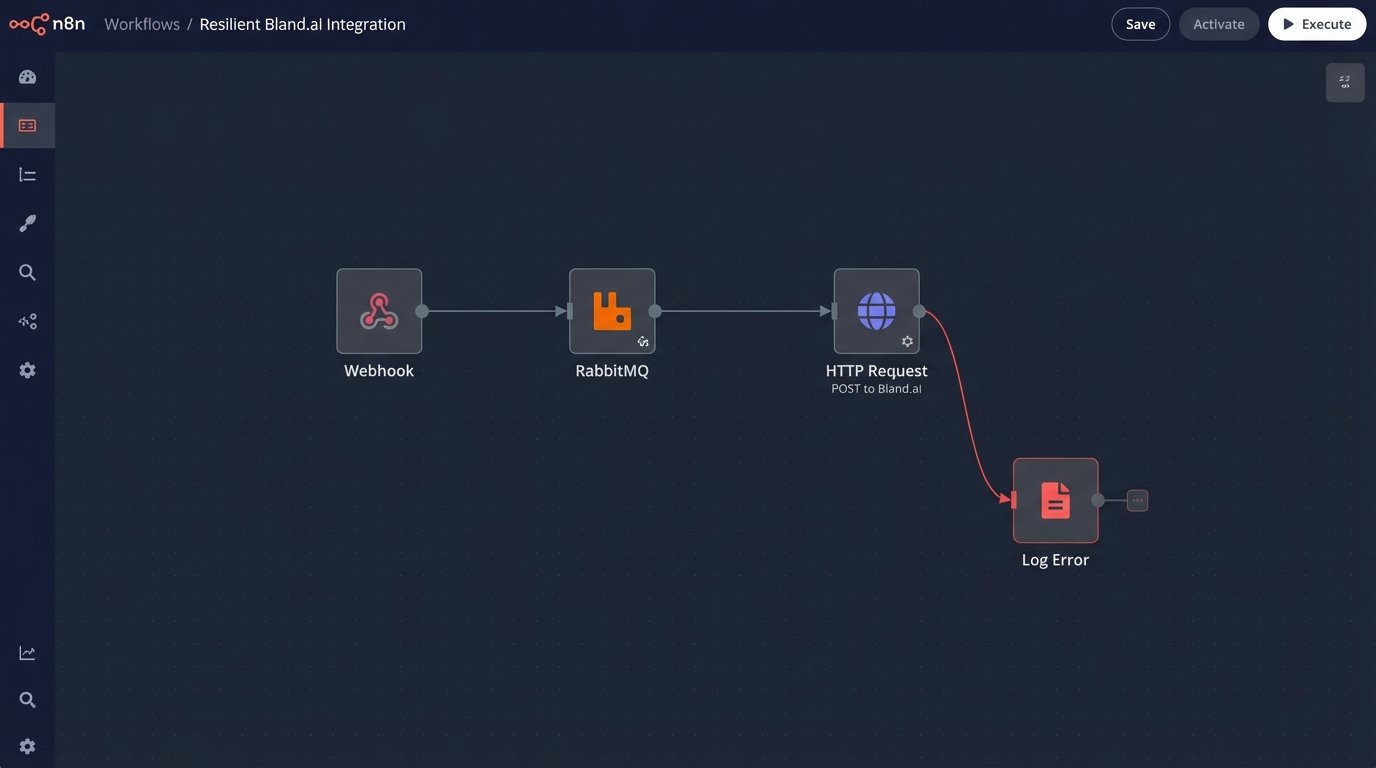
Bland.ai’s failure mode is silence. If your API call to initiate the conversation fails, or if their service has an outage, nothing happens. You need to build your own monitoring and retry system. This often involves a message queue like RabbitMQ or SQS to hold call requests, a separate worker process to dispatch them, and a dead-letter queue to catch the ones that fail repeatedly.
The cost of building that resilient infrastructure can easily eclipse the salary of a junior ISA for a year. It’s a capital expenditure in engineering to achieve a lower operational expenditure on calls. Brokerages must be honest about whether they have the in-house talent to build and support this.
Data Integrity and System of Record
Human ISAs produce low-quality, unstructured data. Their CRM notes are filled with typos, abbreviations, and subjective summaries. Getting clean data for analysis from a team of ISAs is a nightmare of data cleansing and normalization projects. The process is manual and error-prone.
The AI agent is the opposite. It produces perfectly structured JSON output every single time. You can command it to extract specific entities like “appointment_time” or “is_interested” and return them as clean key-value pairs. This data is immediately ready for ingestion into analytics platforms or downstream automations. The data quality is pristine.
This is the AI’s single greatest advantage. You bypass the entire human data entry problem. Your CRM becomes a clean, reliable system of record driven by machine-generated events, not human memory. For operations that depend on data-driven decisions, this alone can justify the switch.
Scalability: The Brutal Reality
Scaling a team of human ISAs is a linear problem. To double your call volume, you double your headcount. The process is slow, expensive, and burdened by recruiting, hiring, and training cycles. You are constrained by the local labor market and management overhead.
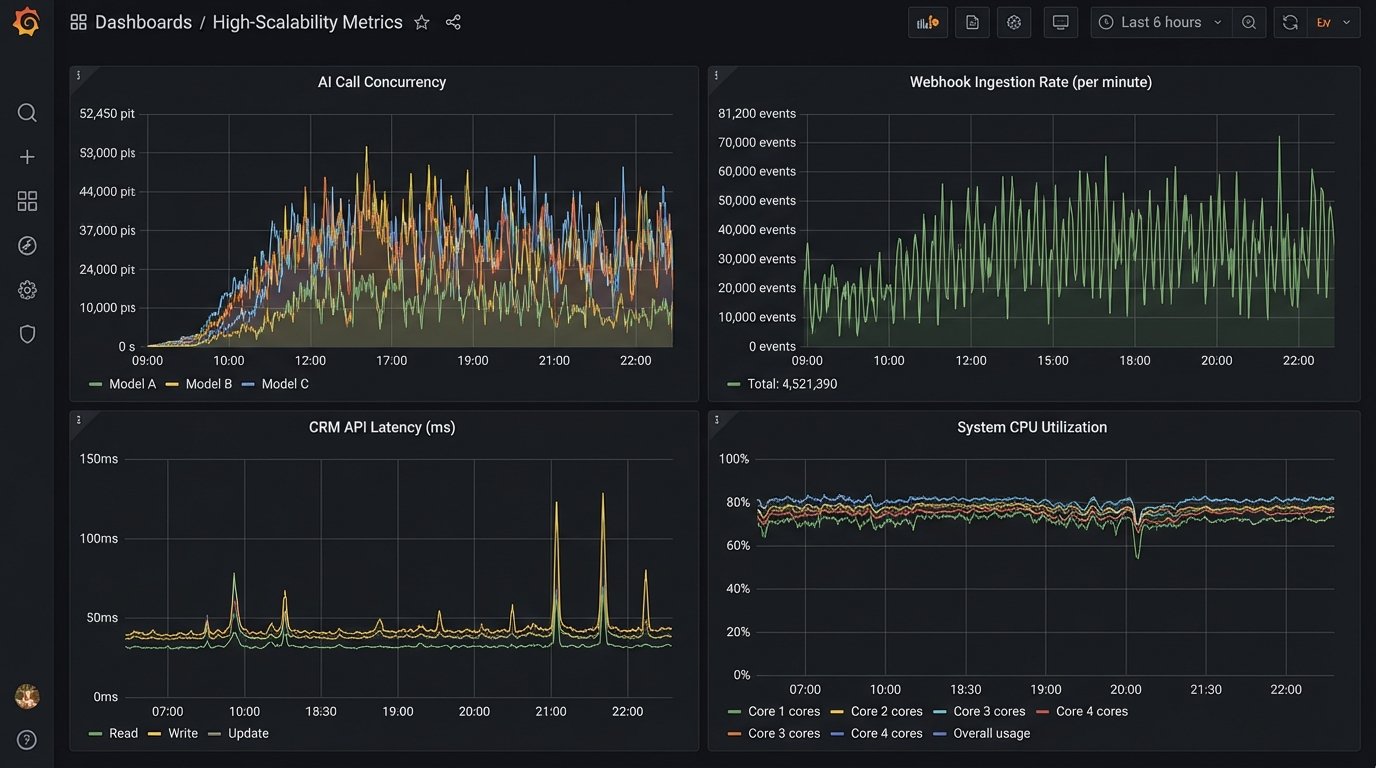
Scaling an AI operation means increasing the concurrency limit on your API key and ensuring your backend infrastructure can handle the load. You can go from one hundred calls a day to ten thousand overnight. The primary constraint is not people, but system architecture. Can your webhook handler process thousands of requests per minute? Is your database connection pool large enough? Did you set up auto-scaling for your cloud servers?
Comparing the two is like comparing a horse to a locomotive. A horse is versatile and can navigate complex terrain, but its top speed is fixed. A locomotive requires a track to be laid first, a massive upfront investment, but once built, it can move a staggering amount of freight at a constant speed.
Choosing the Right Tool for the Job
Bland.ai is not a replacement for a high-performing human sales agent. It is a tool for automating repetitive, low-context conversations at massive scale. Use it for initial lead qualification, appointment setting, or surveys. These are predictable conversations with a limited number of desired outcomes.
A human ISA should be reserved for high-value leads, complex negotiations, and relationship management. Their ability to empathize and problem-solve in real-time is something no current API can replicate. Using a human to ask “Is now a good time?” a thousand times a day is a waste of their potential and your money.
The final calculation is not just cost per minute. It’s Total Cost of Ownership. You must factor in the engineering investment, the cost of infrastructure, and the operational risk of managing an automated system. For simple, high-volume tasks, the AI is cheaper and more efficient. For anything requiring genuine human connection, the cost of a person is a necessary and worthwhile investment.