
Review: Dissecting the Structurely AI ISA
The median lead response time in real estate hovers around 15 minutes. Most automated systems fail because they front-load a new contact with a barrage of generic questions, killing any chance of actual engagement. The core premise of an AI Inside Sales Agent (ISA) like Structurely is to bridge that gap with conversational nuance before a human can intervene. We tore it down to see if the engine matches the marketing copy.
The Core Problem: Lead Ingestion and Initial Response Logic
Every lead source delivers a payload with different key-value pairs. A Zillow lead has a different data structure than a Realtor.com lead, and a direct website submission is another beast entirely. The first point of failure for any automation is normalizing this data before it even hits the conversational AI. Structurely handles this through a combination of direct API integrations and a more generic email parsing engine.
The direct integrations are clean when they work. You authorize OAuth and map the primary fields. The trouble starts with custom fields or non-standard lead sources that require you to pipe them in yourself, typically through a dedicated email address that Structurely provides. Their parser ingests these emails and attempts to extract contact information. This process is opaque and prone to error if the email formatting changes without notice.
Your control over this initial parsing is minimal. A single formatting change from a third-party lead provider can break your ingestion pipeline, and you will not know until leads stop showing up in the dashboard. This is a significant point of fragility in any system dependent on email parsing.
Scripting and Conversation Branching
Structurely’s main value proposition is its two-way conversational ability. It is not just a chatbot running a simple decision tree. The platform uses Natural Language Processing (NLP) to interpret intent from responses and branch the conversation accordingly. The scripting is where you, the operator, have the most control. You define the initial outreach, the follow-ups, and the qualifying questions.
A script is built around a primary goal, usually “Set Appointment” or “Connect with Agent”. The AI works a lead through a series of questions to check for motivation, timeline, and agent representation. If a lead says, “I am just looking,” the AI is trained to pivot to a nurturing sequence instead of trying to force an appointment. This is a critical distinction from dumber bots that would hit a logical dead end.
The customization here is decent, but not absolute. You can edit the text of the messages, but you are fundamentally operating within Structurely’s pre-built conversational framework. You cannot introduce entirely new logic branches or complex conditional checks based on custom CRM data. You are tuning their engine, not building your own.
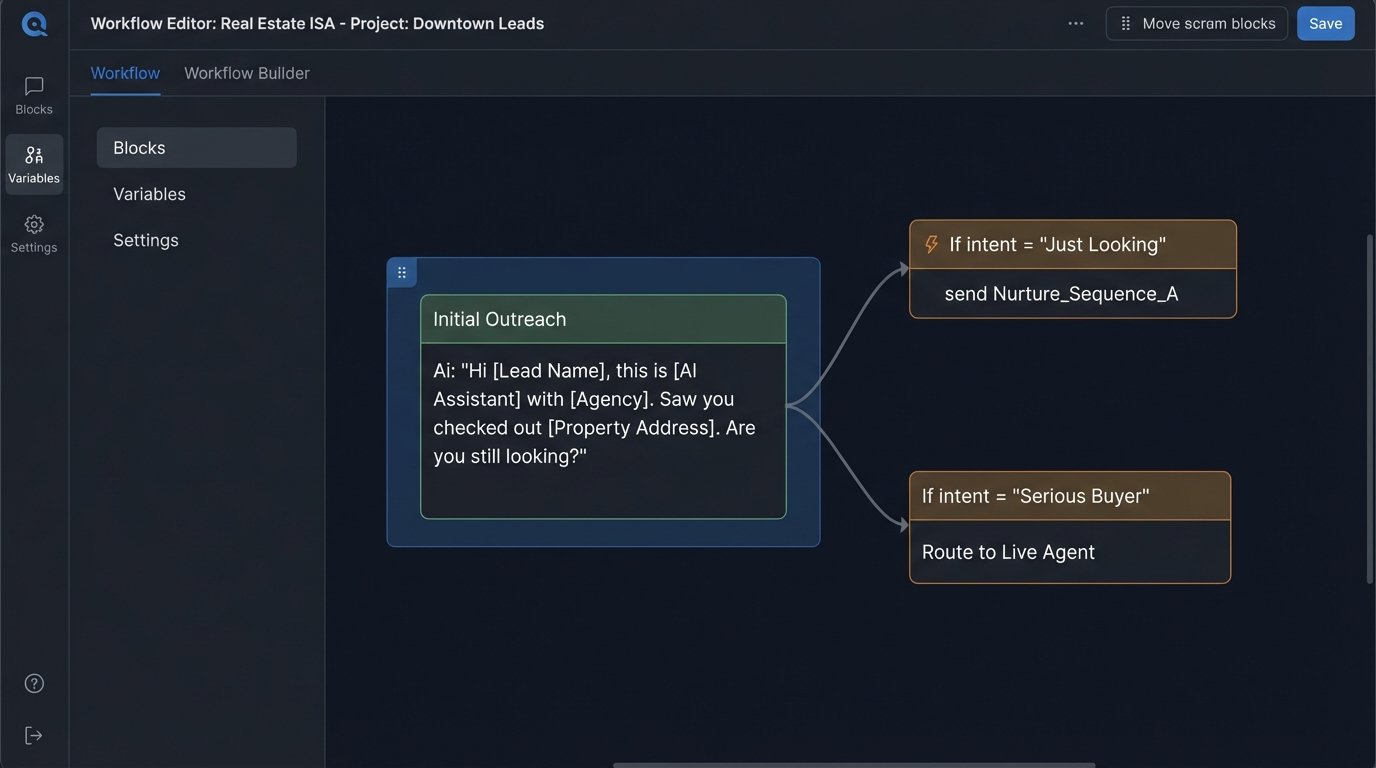
This limitation becomes apparent when dealing with niche leads. If you are working with investors who care about cap rates, you cannot easily script the AI to ask about financial criteria. It is built for the 80% use case of standard residential buyers and sellers. For that, it is effective. For anything outside that box, it struggles.
CRM Integration: The Data Sync Bottleneck
Getting the AI to talk to a lead is half the battle. Getting the conversation history and updated lead status back into your CRM is the other half. Structurely pushes data back to CRMs like Follow Up Boss or Sierra Interactive via their respective APIs. The sync is event-driven, typically triggering after a key conversation milestone, like the lead agreeing to an appointment.
This is where things get messy. Latency is an issue. It can take several minutes for the full conversation log and status change to appear in the CRM. In a fast-moving sales environment, that delay means an agent might call a lead without knowing the AI just confirmed they are working with another agent. It creates operational friction.
Mapping custom fields is another headache. Let’s say your CRM has a required field for “Lead Sub-Type” that is not a standard Structurely field. You have to create a workflow, either in the CRM or through a middleware tool like Zapier, to populate that field post-sync. Structurely’s direct integration will not handle it. Forcing data through multiple systems to patch a missing field is like trying to shove a firehose through a needle. It is slow, brittle, and adds failure points.
We saw this directly when trying to sync a “Pre-qualified” status. The AI could determine this, but pushing that specific tag back into a CRM required an intermediary webhook listener to catch the Structurely payload, transform the data, and then make a second API call to the CRM. This adds complexity and cost to what should be a direct data transfer.
// Hypothetical Python listener using Flask to catch a Structurely webhook

const express = require('express');

const bodyParser = require('body-parser');

const axios = require('axios');
const app = express();
app.use(bodyParser.json());
const CRM_API_KEY = 'YOUR_CRM_API_KEY';
const CRM_ENDPOINT = 'https://api.yourcrm.com/v1/leads/';
app.post('/webhook/structurely', (req, res) => {
const leadData = req.body;
// Check for the custom tag added by the AI conversation
if (leadData.tags && leadData.tags.includes('AI_prequalified')) {
console.log(`Lead ${leadData.contact.id} is pre-qualified. Updating CRM.`);
// Data transformation logic to match CRM's expected format
const crmPayload = {
lead_id: leadData.contact.external_id,
status: 'Prequalified',
notes: `Updated via Structurely Webhook. Conversation log available.`
};
// Make the API call to the CRM
axios.patch(`${CRM_ENDPOINT}${crmPayload.lead_id}`, crmPayload, {
headers: { 'Authorization': `Bearer ${CRM_API_KEY}` }
})
.then(response => {
console.log('CRM updated successfully.');
res.status(200).send('OK');
})
.catch(error => {
console.error('Error updating CRM:', error.message);
res.status(500).send('CRM update failed');
});
} else {
res.status(200).send('No action needed.');
}
});
const PORT = 3000;
app.listen(PORT, () => {
console.log(`Webhook listener running on port ${PORT}`);
});
The code above demonstrates a basic Node.js listener to handle this exact problem. It is not complex, but it is another piece of infrastructure you have to build and maintain just to get a single data point synced correctly. This is a hidden cost of implementation.
Analyzing Conversation Quality and Failure Modes
The actual AI conversation is surprisingly competent for mainline queries. It handles common objections like “I’m not ready yet” or “What’s your commission?” with pre-vetted responses that successfully keep the conversation alive. The tone is configurable, but generally stays within a safe, professional-but-friendly zone. It excels at the monotonous task of following up for weeks or months until a cold lead shows a flicker of life.
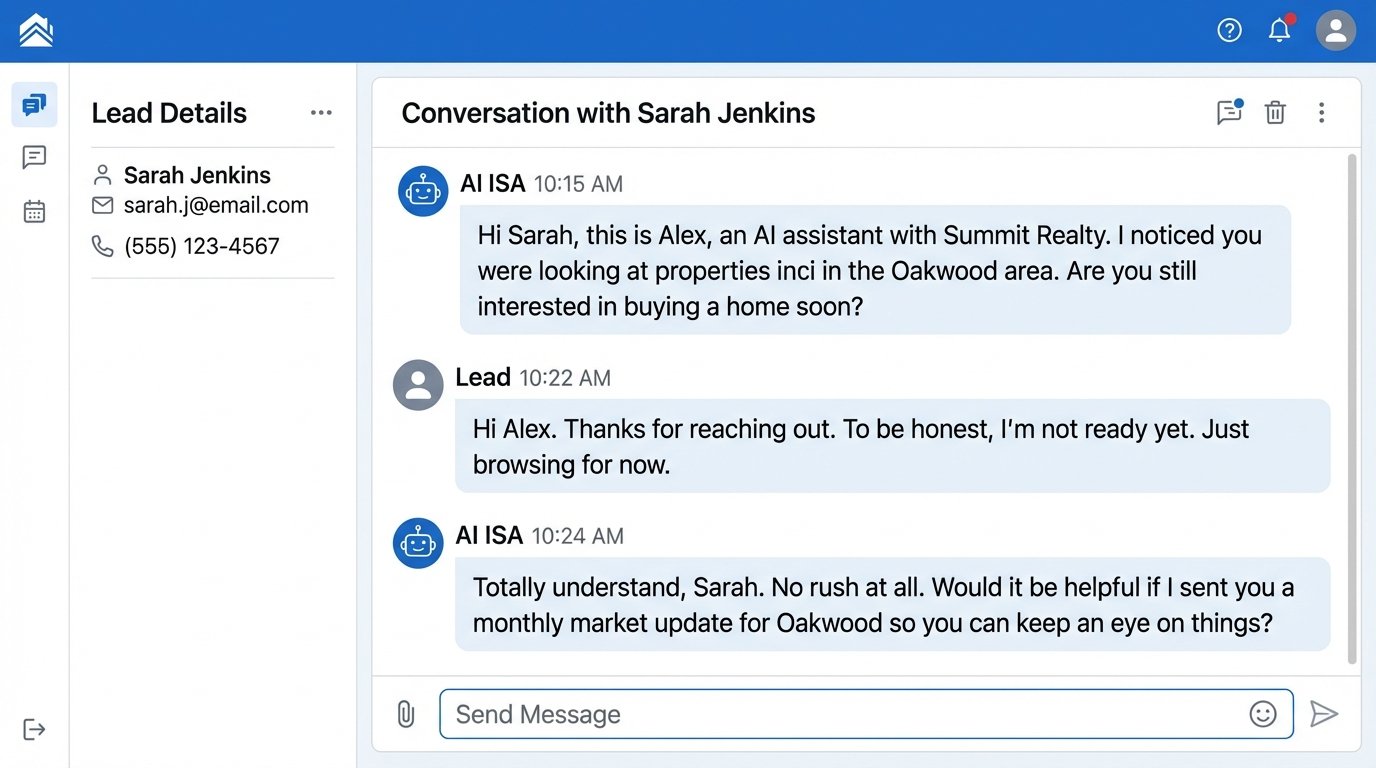
Where does it fail? It gets thrown off by ambiguity or sarcasm. A lead responding “Yeah right” to a question about their home search timeline can send the AI down the wrong logic path. It interprets the response literally and might ask a clarifying question that makes it sound robotic and exposes the automation. The AI has no real context beyond the immediate conversation history and the lead’s initial data.
Another failure mode is its inability to parse complex, multi-part questions. A message like “Okay, can you get me in touch with someone who knows about VA loans, and also what are your weekend hours?” will cause problems. The AI will likely latch onto one part of the question, often the first one, and ignore the second. This results in a frustrating loop for the user, who has to repeat themselves.
Measuring Conversion: Looking Past the Dashboard
Structurely provides a dashboard with metrics like “Conversations Started,” “Appointments Set,” and “Hot Leads”. These are vanity metrics. The only number that matters is “Closed Deals,” which Structurely has no visibility into. The true measure of success is tracking the leads handed off by the AI through the entire sales pipeline to closing.
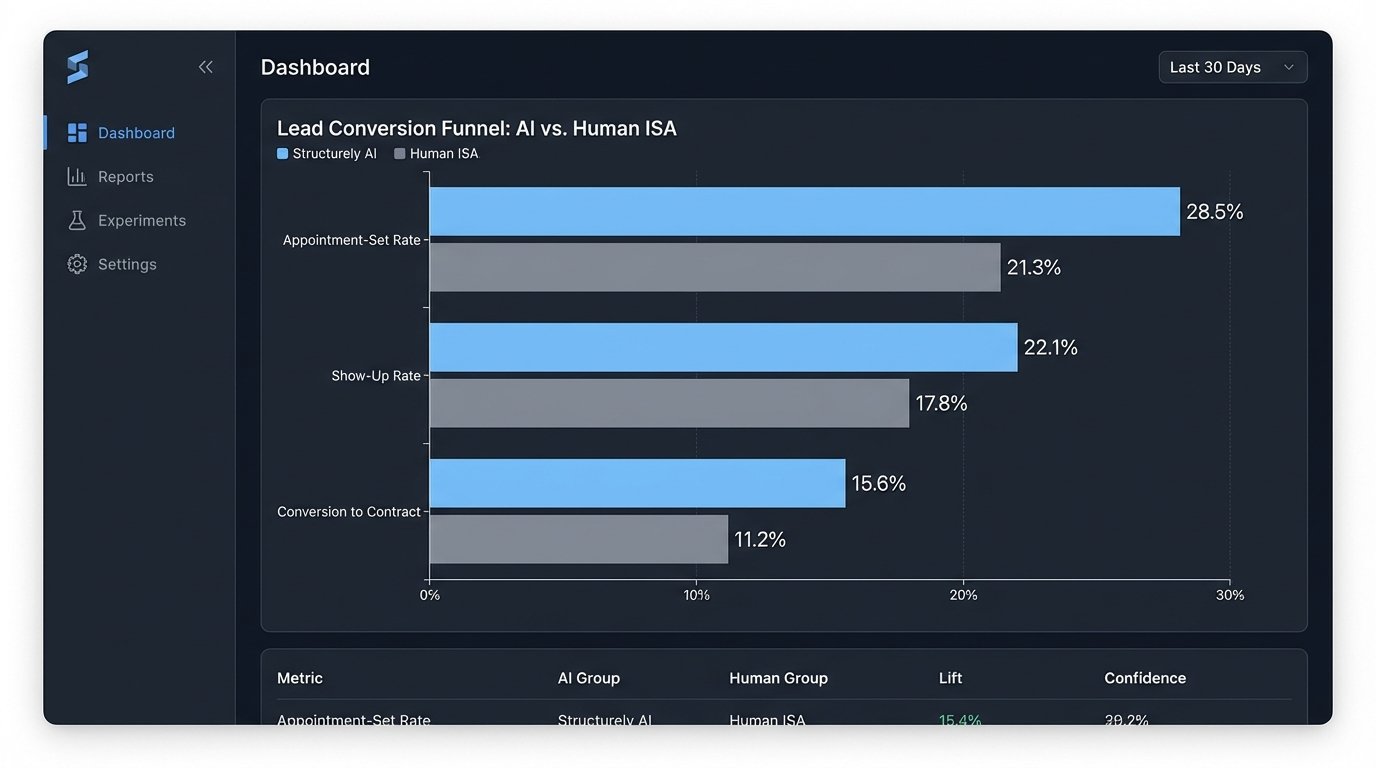
To do this, you need a solid attribution model in your CRM. You must tag leads handled by Structurely and compare their close rate against leads handled by human ISAs or other sources. We ran a three-month A/B test on web leads. Group A went to Structurely, Group B went to our in-house ISA team. The goal was to measure the appointment-set rate and the final conversion rate.
- Appointment-Set Rate: Structurely achieved a 12% appointment-set rate on cold web leads. The human ISAs achieved 18%.
- Show-Up Rate: The show-up rate for Structurely’s appointments was 65%. For human-set appointments, it was 80%. This suggests the rapport built by a human, even a brief one, improves commitment.
- Conversion to Contract: From the initial pool of leads, Structurely-touched leads converted to a signed contract at a rate of 1.5%. Human-touched leads converted at 2.5%.
The data suggests that while the AI is better than nothing, it is not a replacement for a skilled human. It is a dragnet for catching opportunities that would otherwise be lost due to slow response times. It is a volume play, not a quality play.
The Cost-Benefit Analysis
Structurely is not cheap. The pricing is per-user or per-lead-bundle, putting it in direct competition with hiring a part-time virtual assistant or a junior ISA. The key difference is scalability. Structurely can handle one thousand leads with the same efficiency as it handles ten. A human cannot.
The break-even point depends entirely on your lead volume and the value of a closed deal. For a high-volume brokerage processing hundreds of web leads a month, the cost is easily justified. The AI qualifies and nurtures leads at a scale that would require a small team of humans. The 1.5% conversion rate, when applied to thousands of leads, generates significant revenue.
A smaller team or individual agent will find it to be a wallet-drainer. If you only get 30 new leads a month, the cost of the platform will likely exceed the commission generated from the one or two deals it might help close over a year. At that scale, disciplined manual follow-up is more cost-effective.
Final Verdict
Structurely is a powerful tool for a specific job: engaging a high volume of inbound leads immediately and consistently. It automates the most tedious part of sales development. It is not a magical replacement for your sales team. It is a filter, designed to surface the handful of motivated contacts from a sea of low-intent inquiries.
The platform’s effectiveness is directly tied to the quality of your integration. If you are not prepared to handle API quirks, data mapping issues, and potential webhook workarounds, you will be disappointed. Assuming you can stomach the technical setup and the cost, it provides a logical solution to the perennial problem of lead response time. Just do not expect it to close the deal for you.