
Review: Dissecting the Lofty (Chime) AI Assistant
Lofty’s AI Assistant promises to automate the grunt work of real estate communication and content creation. The sales pitch is seductive: an AI that qualifies leads, writes listing descriptions, and drafts ad copy while you focus on closing. We are going to strip away the marketing layer and inspect the engine underneath. The core question isn’t whether it works, but what breaks when it’s left unsupervised.
This is not a theoretical exercise. We are analyzing a tool designed to sit between a brokerage and its revenue. Failure isn’t a bug report; it’s a lost commission. Let’s get to it.
Function One: AI-Powered Listing and Ad Copy Generation
The first feature set is content generation. You feed it structured data from an MLS entry or an ad campaign goal, and it spits out descriptive text. Under the hood, this is a straightforward prompt engineering task. The system likely bundles property details into a formatted string and injects it into a predefined prompt sent to a large language model API.
The output is fast. It can generate three variations of a property description in about ten seconds. The quality, however, is predictably sterile. It excels at rephrasing facts: “This 3-bedroom, 2-bathroom home features granite countertops” becomes “Discover a gourmet kitchen equipped with elegant granite countertops in this spacious 3-bedroom, 2-bathroom residence.” It’s a word randomizer that understands grammar.
This process is the equivalent of shoving a firehose of generic adjectives through the needle-sized hole of an MLS data feed. You get volume, not precision.
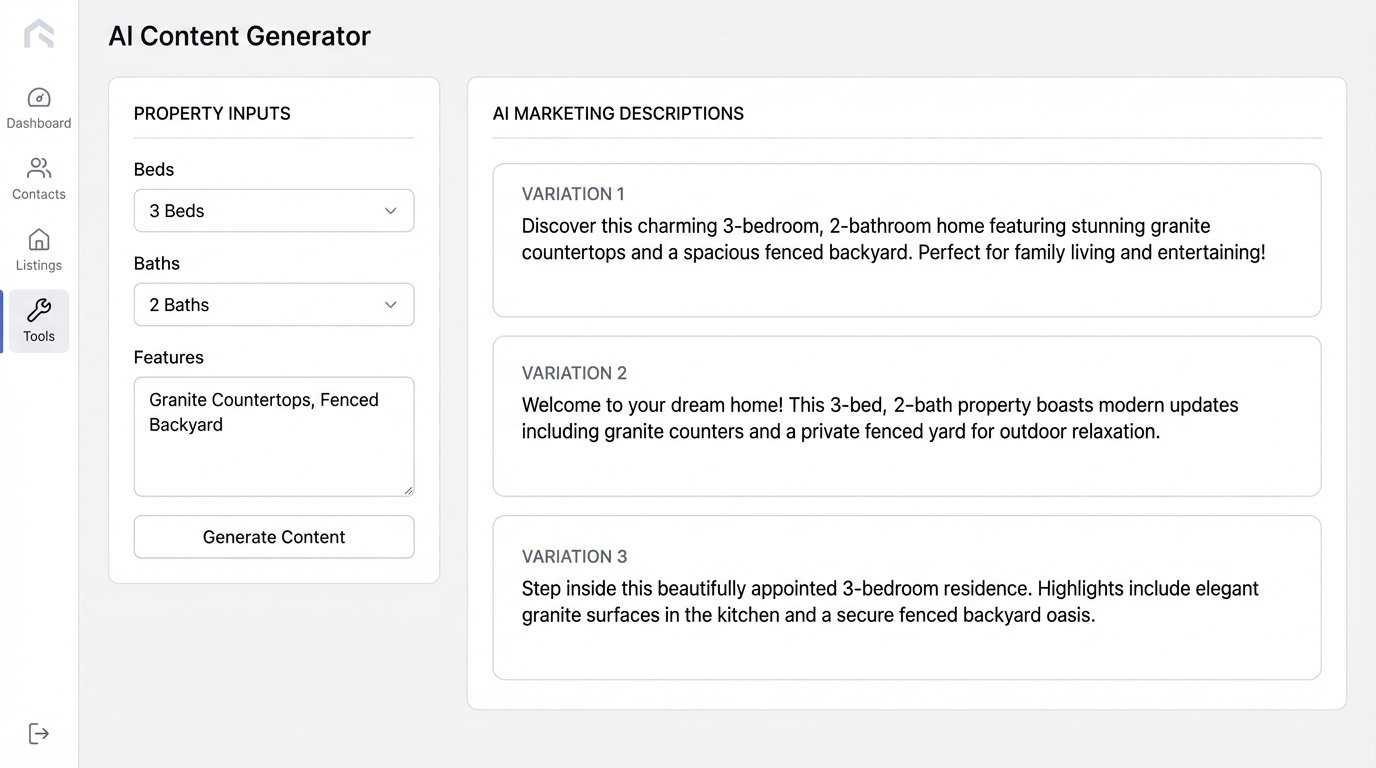
The problem is its inability to infer value or local context. The AI does not know that “close to the highway” is a feature for a commuter in Atlanta but a bug for a retiree in Naples. It regurgitates data points wrapped in bland, positive sentiment. For a high-volume brokerage churning out hundreds of standard rental listings, this tool could genuinely shave hours off the weekly workload. For a luxury brand, using this copy verbatim is malpractice.
The ad copy generator suffers from the same ailment. It creates technically correct but soulless headlines and body text for social media ads. It can produce five different ways to say “Just Listed,” but it cannot formulate a compelling hook based on a unique property feature that would resonate with a specific buyer persona. It’s a dictionary, not a copywriter.
Function Two: The AI Assistant for Lead Follow-Up
This is the high-stakes part of the ecosystem. The AI Assistant is designed to intercept new leads from Zillow, Realtor.com, or your IDX site and engage them via SMS or email. Its goal is to ask qualifying questions about timeline, financing, and viewing availability before handing the lead off to a human agent. The entire operation rests on the AI’s ability to parse natural language and stay on script.
Its conversational ability is rigid. The AI follows a very clear, hard-coded decision tree. If a lead’s response maps cleanly to a known intent like “yes,” “no,” or a specific day of the week, the system functions. The moment a lead introduces ambiguity, sarcasm, or a question outside its narrow programming, the cracks appear. A response like “I might be, depends on the price” can send it into a repetitive loop, asking again if they are interested.
This reveals the system isn’t a true conversational agent but a glorified interactive voice response (IVR) system ported to text. It pattern-matches keywords rather than understanding intent. When it fails, it defaults to a generic “I’m sorry, I didn’t understand. Would you like to speak to an agent?” This failure mode can be jarring and immediately exposes the automation, killing any rapport it might have built.
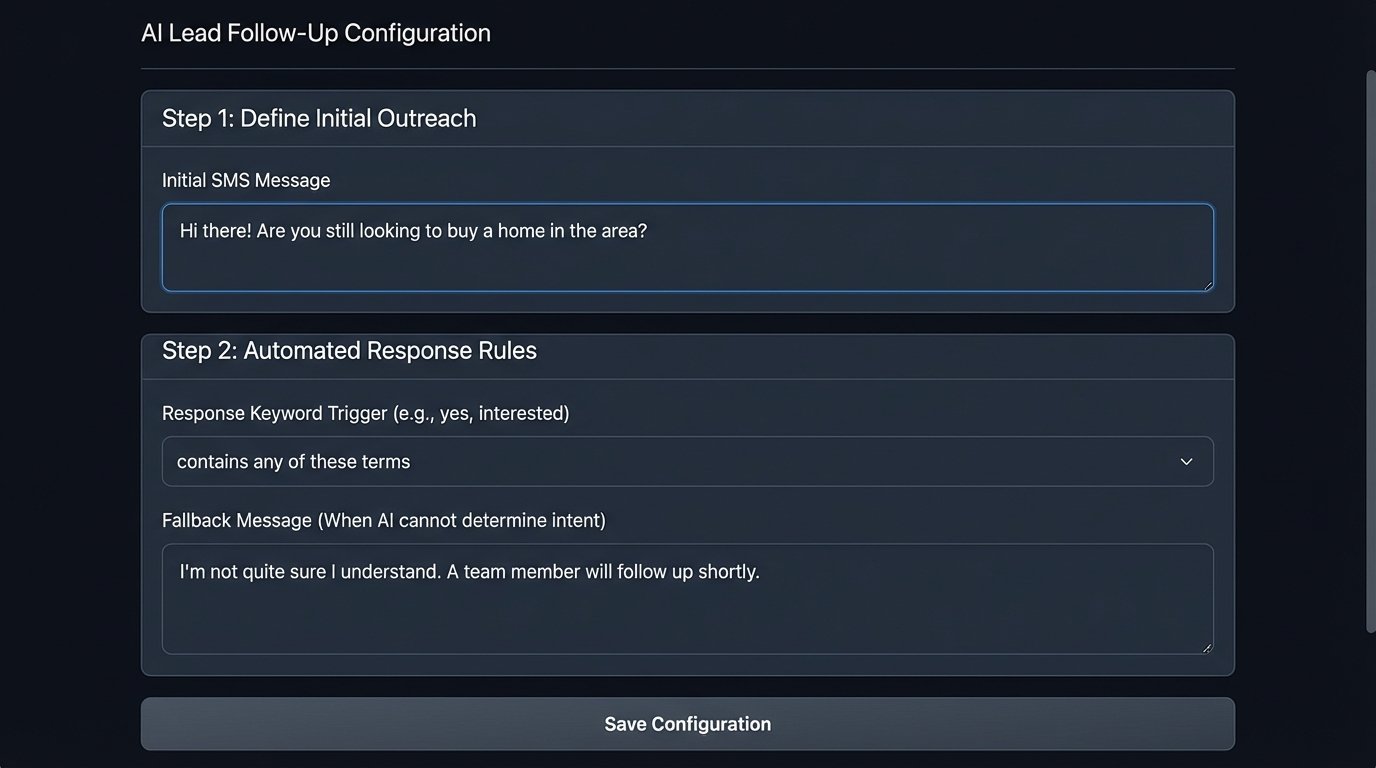
The configuration for this is buried in settings that give you a false sense of control. You can set the initial questions and response delays, but you cannot fundamentally alter its logic core. You are not programming a workflow; you are just tweaking the inputs on a black box. Forcing this tool on your entire lead pool without rigorous testing is an invitation for disaster.
We saw it fail on simple, common real estate slang. A lead asking, “Is there an HOA fee or is it fee simple?” resulted in the AI misinterpreting “fee” and asking about financial pre-qualification. The AI is deaf to nuance, and in a sales context, that deafness is expensive.
The Technical Architecture: A Thin Wrapper
Lofty does not own a foundational AI model. No CRM company does. They are clients of OpenAI, Anthropic, or a similar provider. The “AI Assistant” is an API wrapper with a user interface and some pre-built prompts tailored for real estate. Lofty’s value-add is the integration, not the intelligence. They manage the API keys, handle the billing passthrough, and build the UI to trigger the prompts.
This is critical to understand. You are not buying a proprietary intelligence; you are renting API access through a middleman. The performance, reliability, and even the “personality” of the AI are subject to the upstream provider’s models. When OpenAI has an outage, your AI assistant goes offline. When they update a model, your AI’s responses might change without warning.
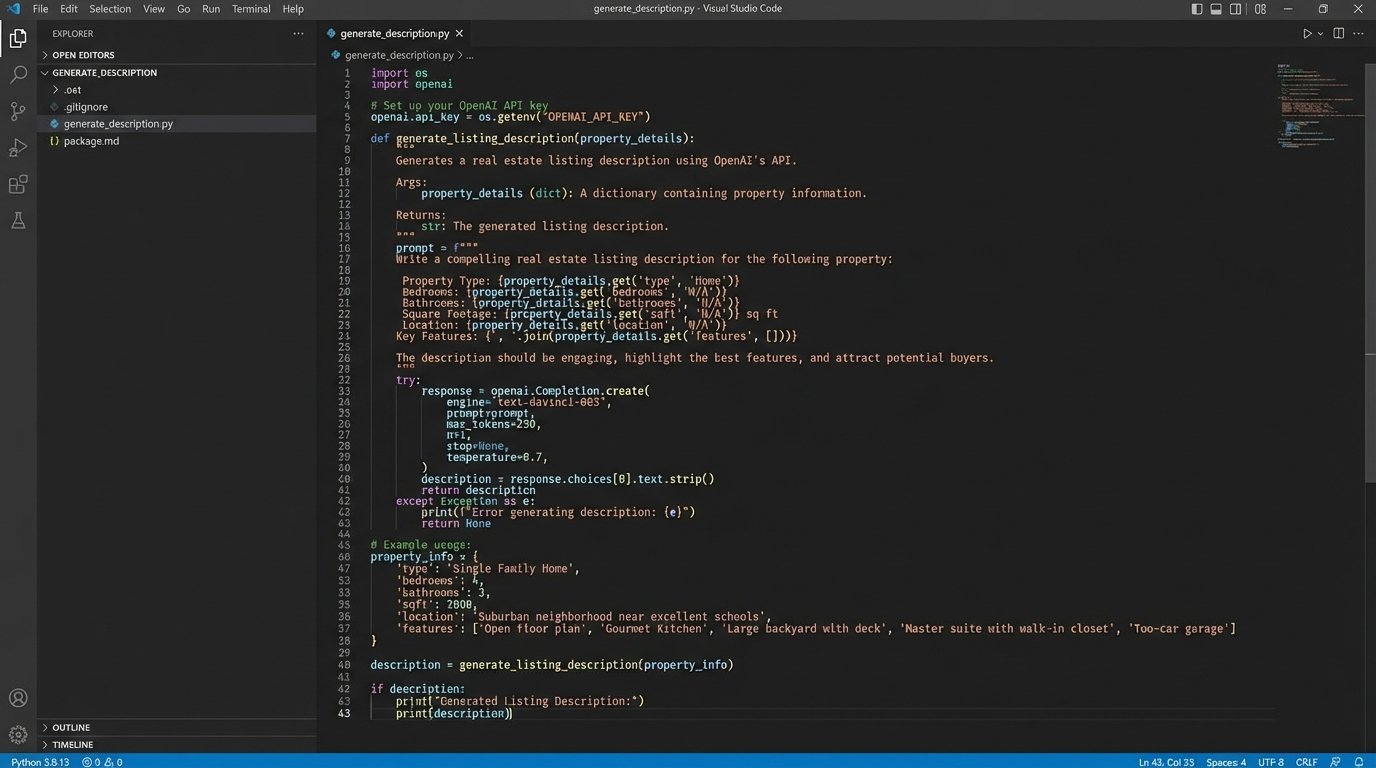
To demonstrate the simplicity of the text generation component, here is a basic Python script that accomplishes the same core task as the listing description writer. It uses a popular library to call an outside model and formats a prompt with property data.
import openai
# This is a conceptual example. Do not run with actual keys in production code.
# You would use environment variables and secure key management.
openai.api_key = 'YOUR_API_KEY'
def generate_listing_description(property_details):
prompt = f"""
Generate a compelling real estate listing description for a property with the following details:
- Address: {property_details.get('address')}
- Bedrooms: {property_details.get('bedrooms')}
- Bathrooms: {property_details.get('bathrooms')}
- Key Features: {', '.join(property_details.get('features', []))}
- Neighborhood Vibe: {property_details.get('vibe')}
The description should be professional, engaging, and around 150 words.
"""
try:
response = openai.ChatCompletion.create(
model="gpt-3.5-turbo",
messages=[
{"role": "system", "content": "You are a real estate marketing assistant."},
{"role": "user", "content": prompt}
]
)
return response.choices[0].message['content'].strip()
except Exception as e:
# Proper error handling is essential here
return f"Error generating description: {e}"
# Example Usage
property_data = {
"address": "123 Maple St, Anytown, USA",
"bedrooms": 4,
"bathrooms": 3,
"features": ["updated kitchen", "hardwood floors", "fenced backyard"],
"vibe": "quiet and family-friendly"
}
description = generate_listing_description(property_data)
print(description)
This is not complex engineering. The hard part is building a reliable, scalable system around these calls, handling errors, and managing costs. But the “magic” is just a well-worded API call. Lofty’s integration saves you from building this yourself, but it comes at a significant premium and a loss of control.
Data Privacy and The Training Loop
A final point of friction is data privacy. When your AI assistant communicates with a lead, where does that conversation data go? The terms of service are often vague. Is Lofty, or its AI provider, using your private sales conversations to train future versions of their models? This is a significant business risk.
Injecting a third-party AI into your client communication pipeline means you are sending potentially sensitive financial and personal data to an external processor. Without explicit, auditable guarantees that your data is not being stored indefinitely or used for model training, you are taking a massive compliance gamble. The convenience of automated follow-up might not be worth the risk of data leakage.
Final Verdict
The Lofty AI Assistant is a tool of convenience, not a strategic asset. Its content generation features are useful for low-priority, high-volume tasks where speed matters more than quality. It can provide a decent first draft that a human must then gut and rewrite to inject any real brand voice or sales acumen.
The lead-nurturing AI assistant is a different beast entirely. In its current state, it is too brittle for unsupervised use. The risk of it misunderstanding context and alienating a valuable lead is unacceptably high. It should be used as an internal assistant, perhaps summarizing long email chains or suggesting replies, but never as a direct, autonomous agent. Letting this AI manage your inbound lead flow without a human logic-checking every interaction is not automation; it’s abdication.