
The marketing departments for real estate CRMs have discovered the “AI” button. Suddenly, every platform has an “AI-powered” assistant that spits out bland, generic follow-up emails. They call this innovation. I call it a distraction from the fundamental, septic-tank-level problem with their data architecture.
Let’s be blunt. The core challenge in real estate isn’t writing a slightly better email to a cold lead. The core challenge is data logistics.
The Garbage In, Garbage Intelligence Out Problem
Every brokerage operates on a chaotic soup of fragmented information. The MLS has one version of a property’s status. Your agent’s calendar has the showing appointment. The feedback from that showing lives in an email thread. The client’s actual interest level is a gut feeling in the agent’s head. The CRM has a contact record with a misspelled name and a three-year-old phone number.
This is the reality. A dozen disconnected sources, each with its own latency and data schema.
Trying to run “AI” on top of this mess is like trying to build a skyscraper on a swamp. The foundation is garbage, and everything you build on top will eventually sink. The AI can’t score a lead accurately if the underlying data is stale, incomplete, or just plain wrong. It’s a pointless exercise in decorating a condemned building.
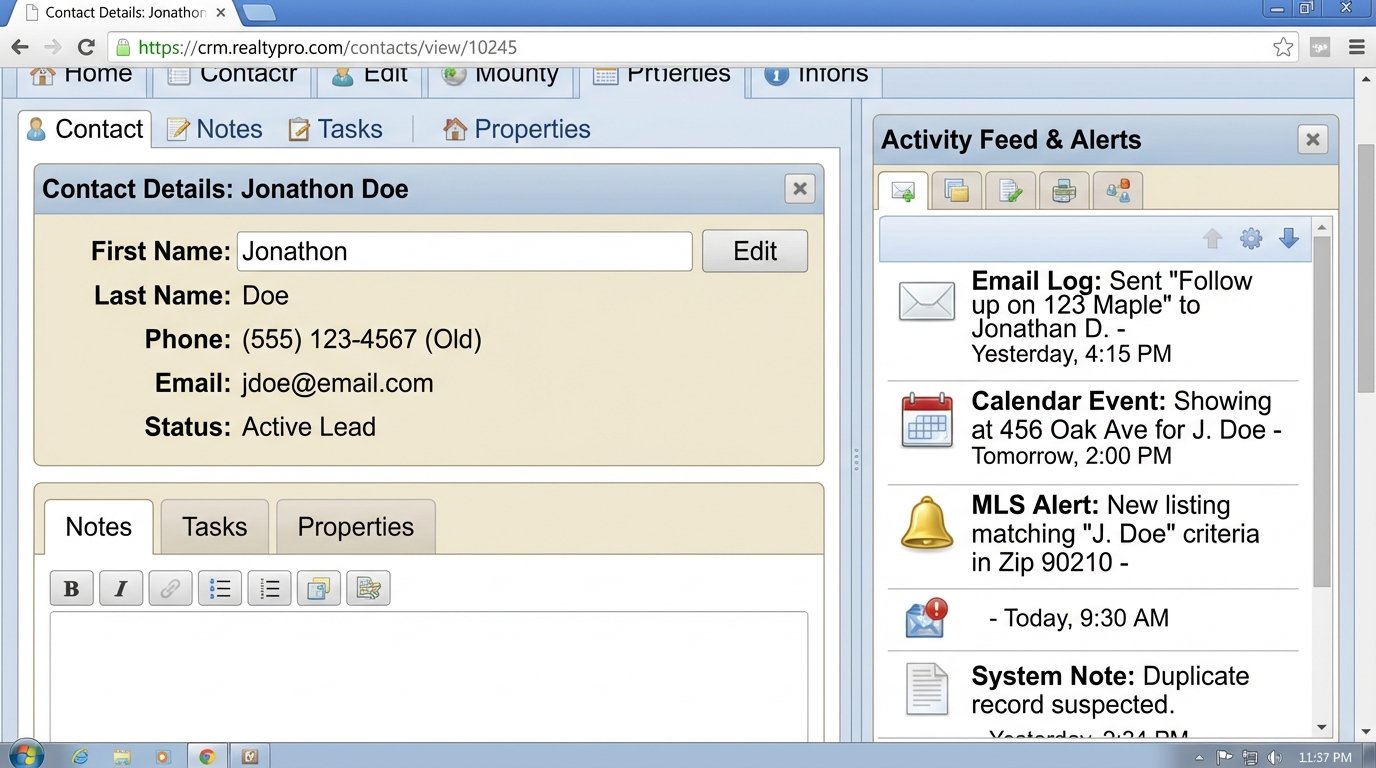
Vendors sell you the dream of an intelligent system that surfaces hot leads. What they deliver is a glorified cron job that reminds you to call someone you haven’t spoken to in six months, based on the fact that they opened one email. That’s not intelligence. That’s a slightly smarter alarm clock.
Forget the AI Assistant. Build a Data Logistics Engine.
The next evolution of the real estate CRM won’t come from a better natural language generator. It will come from a system architected to aggressively ingest, clean, and map data from the ground up. It stops being a passive bucket for agent input and becomes an active data aggregation engine.
Think of it as three distinct jobs:
- Job 1: Ingest Everything. Hammer the APIs. Scrape what you must. We need to pull data from the MLS via RESO Web API, parse email bodies for showing feedback, hook into calendar events, and connect to public tax records. The goal is to get all the raw, conflicting signals into one place.
- Job 2: Normalize and Enrich. This is where the real machine learning happens. We don’t need a model to write “Just checking in!”. We need a model that can perform entity resolution. It needs to figure out that “123 Main St” and “123 Main Street” are the same property, and that “Jen Smith” in the CRM and “Jennifer Smyth” from a lead form are the same person. It should then go out and enrich that contact with data from other sources.
- Job 3: Build the Knowledge Graph. The final step is to connect the dots automatically. This Contact viewed this Property, which triggered this Showing Event, which generated this Feedback Document. When you build these relationships, you create a true, living profile of your business, not a static list of contacts.
From Messy to Mapped
The raw input is a disaster. You get a lead from one source and property data from another. They don’t speak the same language. For example, a raw lead object and a property object might look like this:
    // Raw Lead from Web Form
    {
      "name": "bob vance",
      "email": "bob.vance@vancerefrigeration.com",
      "inquiry": "info on 456 oak ave"
    }

    // Raw Property from MLS Feed
    {
      "ListingId": "10-2345",
      "StreetNumber": "456",
      "StreetName": "Oak Avenue",
      "City": "Scranton",
      "Status": "Active"
    }
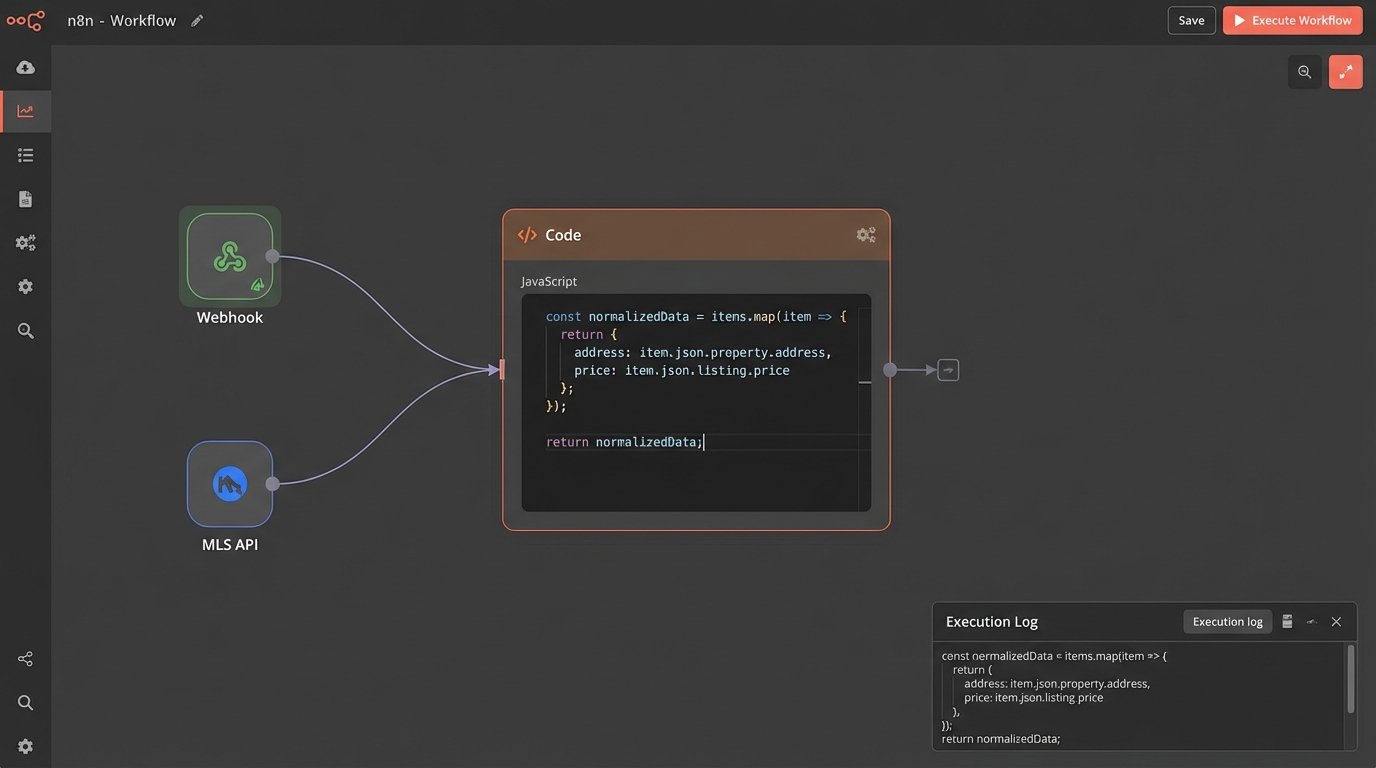
The system’s job isn’t to ask the agent to link them. The system’s job is to figure it out. A simple normalization function might start by cleaning up the text and creating a common key.
    // Simplified n8n Expression Logic
    const normalizeAddress = (inquiry) => {
      return inquiry
        .toLowerCase()
        .replace('info on', '')
        .replace('ave', 'avenue')
        .trim();
    };

    // Output: "456 oak avenue"
Now you have a primitive key to start matching against normalized property data. This is a trivial example. A real system would use more sophisticated fuzzy matching and entity resolution models, but the principle is the same: the machine does the thankless work of cleaning the data, not the human.
The Real Payoff: Predictive Opportunity
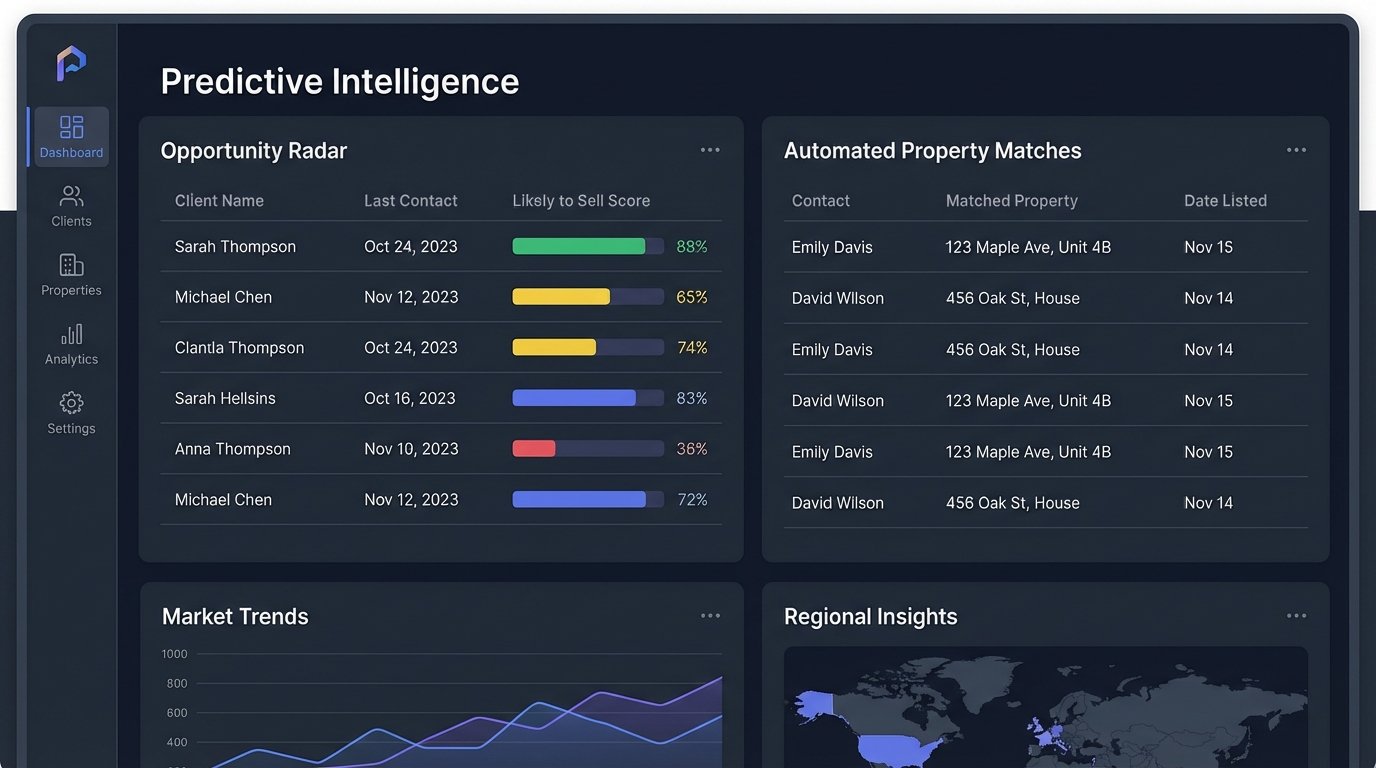
Once you have a clean, connected, and real-time data foundation, then you can apply meaningful AI. You can move beyond parlor tricks. The system can now answer questions that are actually valuable.
- Which of my past clients are showing behavior (viewing properties online, mortgage pre-qual checks) that indicates they’re preparing to sell?
- Based on showing feedback sentiment across all our listings, which neighborhoods are heating up for buyers who want “a big yard”?
- Is there a property that just came on the market from another brokerage that perfectly matches the criteria of three of my dormant buyer leads?
This is predictive intelligence. It’s not about generating content. It’s about spotting opportunities hidden in the noise. You can only do this when you trust the underlying data. No one trusts the data in their CRM right now, because they know it was entered by a busy agent on a Tuesday afternoon between showings.
The Inevitable Trade-Off
Building a data logistics engine is not a weekend project. It’s a wallet-drainer. It requires deep, often brittle, integrations with data sources that were never designed to work together. You need engineers who understand data pipelines, not just front-end configuration.
You can have your shiny AI email writer today. It’s cheap and looks good in a demo.
Or you can invest in the plumbing required to build a system that actually understands your business. The choice determines whether your brokerage will be reactive or predictive for the next decade.
The current generation of “AI-enabled” CRMs is a fresh coat of paint on a crumbling foundation. Don’t be fooled by the marketing. Look at the data architecture. If it still relies entirely on manual human input, it’s a legacy system waiting to be replaced.