
Manual billing isn’t a process problem. It’s a data integrity failure waiting to happen. Every time a paralegal copies a time entry from a spreadsheet into a practice management system, you introduce a potential point of corruption. The core issue is the latency and human intervention between the moment work is performed and the moment it’s recorded as a billable event. This gap is where revenue leaks and disputes are born.
Deconstructing the Manual Billing Failure Cascade
The entire manual workflow is a series of dependencies prone to collapse. It starts with attorneys logging time, often days after the fact, leading to block billing and vague descriptions that clients inevitably question. This data is then manually keyed into a central system, a task ripe for transposition errors. The billing department then spends the first week of the month trying to reconcile these entries against matter codes, client agreements, and special billing rules stored in yet another document.
This reconciliation phase is the bottleneck. It forces a halt on generating invoices while staff chase down attorneys to clarify entries or correct codes. The result is a delayed invoicing cycle, which directly impacts cash flow. The problem compounds with scale. A ten-person firm might manage this with brute force. A hundred-person firm finds it an operational quagmire that bleeds money through unbilled time and administrative overhead.
Your billing department isn’t just sending invoices. They are performing data sanitation on a deadline.
The Latency Tax on Revenue
Time entry latency is a direct tax on your firm’s revenue. Studies consistently show that the longer the delay between performing a task and recording the time, the less accurate the entry becomes. An entry logged immediately captures the full six minutes. An entry logged at the end of the day might get rounded to five, or forgotten entirely. Logged at the end of the week, it’s a guess at best.
Automation forces the issue by integrating time capture directly at the source. Modern tools can link time tracking to calendar events, document creation, or even specific application usage. The goal is to shrink the time-to-record interval to near zero. By capturing the data packet at its origin, we bypass the flawed mechanism of human memory and prevent the initial data degradation that plagues manual systems.
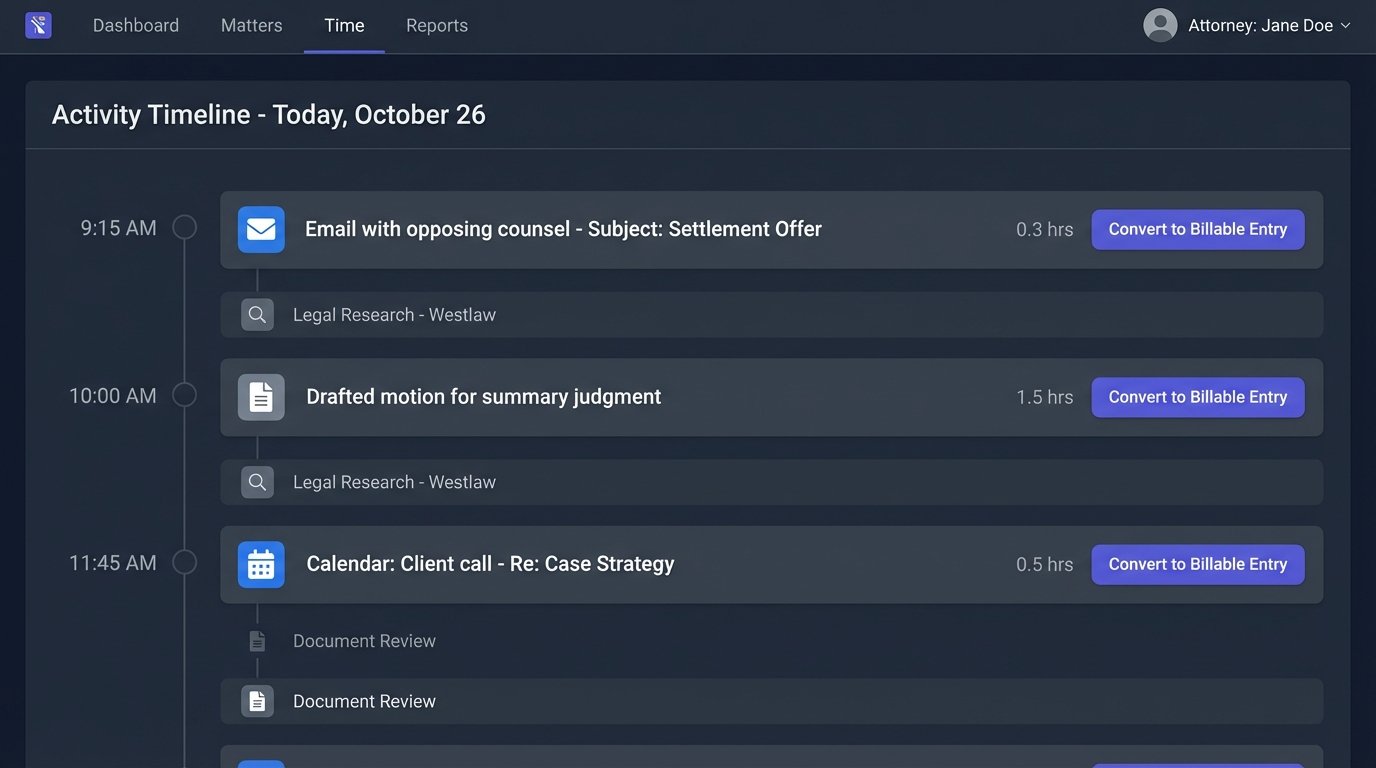
This isn’t about nagging attorneys. It’s about engineering a system where correct data entry is the path of least resistance.
Architecting an Automated Billing Pipeline
A functional automated system is a data pipeline, not a collection of apps. The architecture must treat time entries as structured data packets that flow from a capture point to a final invoice without manual intervention. The pipeline begins with a defined trigger, typically the end of a billing period, which initiates a series of automated jobs.
The first job queries the practice management system’s API for all unbilled time and expense entries within the date range. It pulls this raw data into a staging environment. This is a critical step. Never operate directly on your production data. The staged data is then run through a validation engine, a set of scripts that logic-check each entry against predefined rules.
Building this pipeline is like plumbing for data. You’re connecting disparate systems with API calls and data transformation scripts, forcing them to communicate in a structured way. This is fundamentally different from buying an all-in-one suite, which often turns into a walled garden that is impossible to integrate with anything else. You end up trying to shove a firehose of custom firm requirements through the needle of a vendor’s limited feature set.
The Validation Layer: Your System’s Immune Response
Before any invoice is generated, the staged data must be scrubbed. The validation layer is where you enforce your firm’s billing hygiene automatically. This is a series of conditional checks that flag entries for review or, in some cases, automatically correct them. The goal is to catch the 95% of common errors before they ever reach a client.
Typical validation rules include:
- Code Mismatch: Flags time entries where the matter ID does not exist in the client database.
- Rate Anomaly: Identifies entries where the billing rate doesn’t match the approved rate for that attorney or matter type.
- Vague Descriptions: Scans for blacklisted generic phrases like “work on file” or “review documents” without further detail.
- Block Billing Detection: Identifies single time entries that bundle multiple distinct tasks, which are often rejected by clients with strict billing guidelines.
A simple check for a valid matter ID might look something like this in Python, assuming you have functions to query your databases.
def validate_time_entries(staged_entries):

    flagged_entries = []

    valid_matter_ids = get_all_matter_ids_from_pms()
for entry in staged_entries:
if entry['matter_id'] not in valid_matter_ids:
entry['error_code'] = 'INVALID_MATTER_ID'
flagged_entries.append(entry)
# Log the error, do not stop the process
log_validation_error(entry)
return flagged_entries
This script doesn’t fix the problem. It isolates it. The flagged entries are kicked to an exception queue for a human to review, while the 99% of clean entries proceed through the pipeline. You’re isolating the exceptions, not halting the entire process for one bad entry.
From Generation to Collection: Closing the Loop
Generating a PDF is only half the job. An invoice that sits in an outbox or requires a client to write a physical check is still an inefficient asset. The final stage of the automation pipeline must bridge the gap between invoice creation and cash collection. This means integrating directly with a payment gateway like LawPay or Stripe.
The process involves generating a unique payment link for each invoice amount and embedding it directly into the invoice template. When the client clicks the link, they are taken to a secure, pre-populated payment page. The real technical lift is what happens next. You must configure a webhook listener, a small web service that waits for a signal from the payment gateway.
When the payment is successfully processed, the gateway sends a payload of data to your webhook URL. Your listener service then parses this payload, extracts the invoice number and payment amount, and makes an API call back to your practice management system to automatically mark the invoice as paid. This closes the loop without a single person needing to check a bank statement and manually update a record.
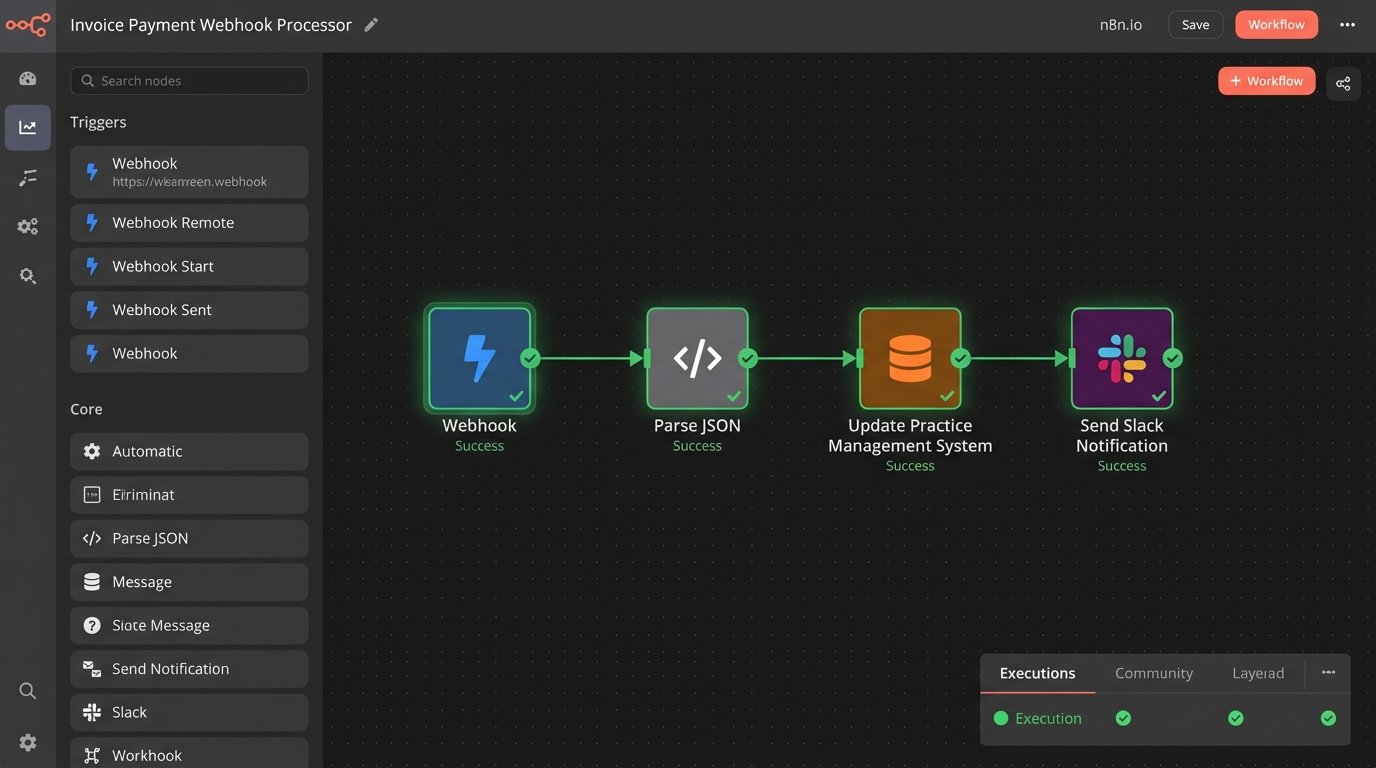
This single integration can slash days or even weeks off your days sales outstanding (DSO). It turns the invoice from a static document into an interactive tool for payment.
The Audit Trail: Your Non-Repudiable Record
A side effect of this automation is the creation of a perfect, machine-generated audit trail. Every step, from the initial API call for time entries to the final webhook confirming payment, is timestamped and logged. This creates a non-repudiable record of the entire billing lifecycle for a specific matter.
When a client disputes a charge, you no longer have to dig through emails and spreadsheets to reconstruct the history. You query a log file. You can show exactly when the time was approved, when the invoice was generated, when it was sent, when the client viewed it, and when it was paid. This level of data fidelity is nearly impossible to achieve with a manual system.
A manual audit trail is like trying to reassemble a shredded document. An automated one is a git commit history for your firm’s revenue.
Implementation Pitfalls and Technical Debt
Executing this strategy is not a simple software purchase. It requires a clear understanding of your existing data structures and a willingness to enforce process discipline. The most sophisticated automation pipeline will fail if it’s fed garbage data.
The primary pitfall is underestimating the data cleansing effort. Before you write a single line of automation code, you must sanitize your core data sources. This means enforcing a strict taxonomy for matter codes, standardizing client names, and establishing clear rules for time entry descriptions. Automating a messy process just gets you to the wrong answer faster.
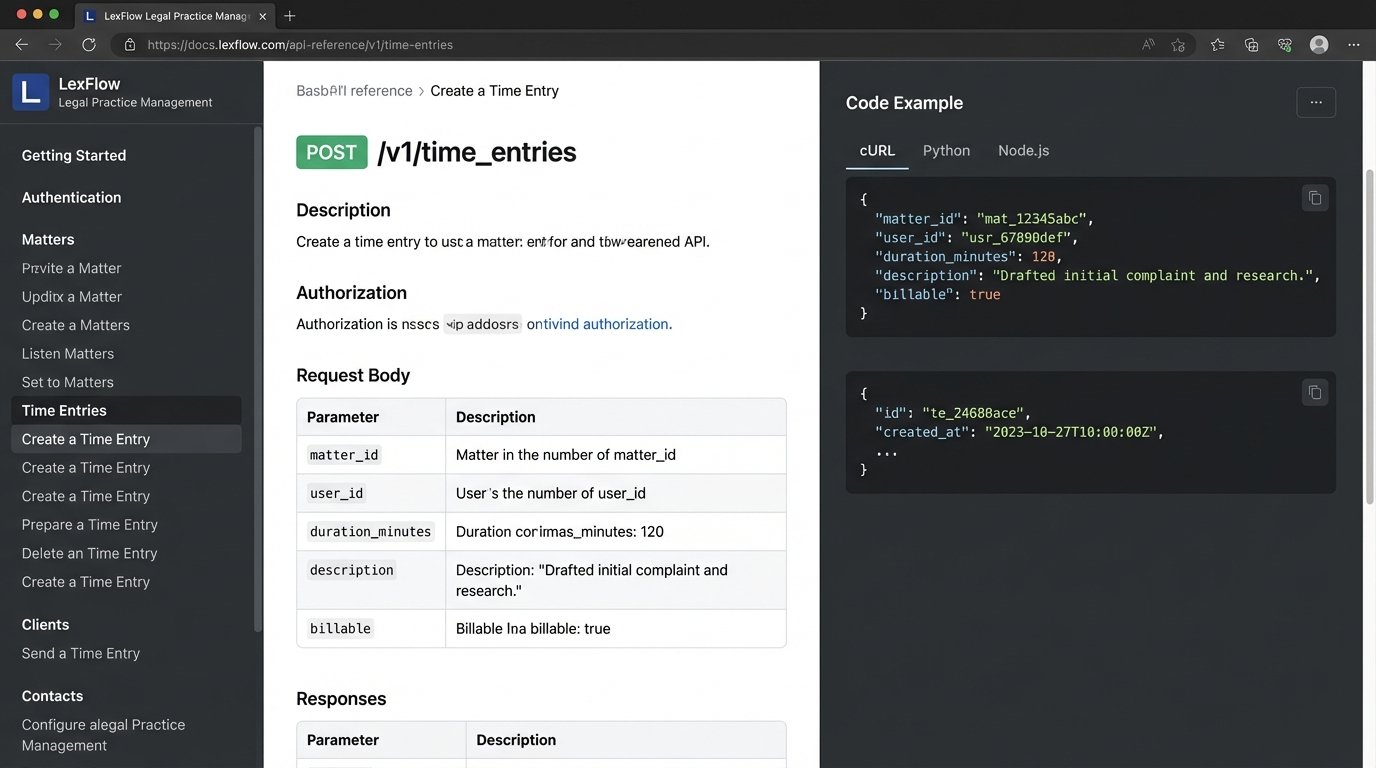
Another major risk is vendor lock-in. Be wary of “all-in-one” practice management solutions that promise seamless automation but have closed, undocumented APIs. A healthy technical ecosystem is built on interoperability. You need the ability to plug and unplug different components, like your timekeeping tool or payment gateway, without having to rebuild the entire pipeline. Always prioritize platforms with robust, well-documented REST APIs.
Finally, don’t boil the ocean. Start with the most painful, repetitive part of your current process. Automate the generation of simple, single-matter invoices first. Once that is stable and reliable, then you can start layering in logic for more complex scenarios like split billing, retainers, or contingency fee calculations. A phased rollout minimizes risk and demonstrates value quickly.
Measuring Success with Hard Metrics
Forget soft metrics like “hours saved.” Your success should be measured by hard, quantifiable improvements in your billing system’s performance. The goal is not just to reduce costs but to build a more predictable, reliable revenue machine.
Key performance indicators to track are:
- Invoice Error Rate: The percentage of invoices that require manual correction after being generated. Your target should be near zero.
- Time-to-Invoice: The number of days from the end of the billing period to the moment the last invoice is sent. Automation should shrink this from weeks to a day.
- Days Sales Outstanding (DSO): The average number of days it takes to collect payment after an invoice is sent. Integrating a payment gateway will drive this number down significantly.
- Billing Leakage Percentage: The estimated percentage of billable work that goes unrecorded or unbilled. Tighter time capture reduces this.
These numbers expose the health of your financial operations. They provide a clear, data-backed justification for the investment in automation architecture. This is not about marginal efficiency gains. It is about fundamentally re-engineering the financial engine of your law firm for accuracy and speed.