A large law firm’s profit margin is often a story of a thousand small cuts. This firm, with over 800 attorneys spread across a dozen offices, was bleeding out from operational friction. Their core problem wasn’t a lack of legal talent, but a crippling dependency on manual, repetitive processes chained to a case management system (CMS) that predated modern API design. Every new matter, every standard document, every invoice was a monument to wasted billable hours.
The symptoms were obvious to anyone in the trenches. Paralegals spent hours copy-pasting client data into engagement letter templates. The intake team chased partners for missing information via email chains that forked into oblivion. The finance department manually reconciled time entries against byzantine client billing guidelines, a monthly exercise in frustration that delayed cash flow. The firm was successful in spite of its operations, not because of them.
The Diagnosis: Process Inconsistency and Siloed Data
Our initial audit uncovered three primary failure points. These weren’t isolated issues; they were interconnected, feeding a cycle of inefficiency. The root cause was a fundamental disconnect between the firm’s operational needs and the capabilities of its technology stack. The stack itself was a brittle collection of systems that barely spoke to one another.
Failure Point 1: Manual Document Assembly
The firm’s document generation process was pure chaos. Each practice group maintained its own set of “gold standard” templates on a shared drive. Version control was non-existent. A junior associate in the M&A group might use an NDA template that the IP litigation group had updated six months prior, exposing the firm to unnecessary risk. We clocked the average time to generate a standard engagement letter, from finding the template to final review, at 45 minutes.
This wasn’t just slow. It was dangerous.
Failure Point 2: The Intake Bottleneck
Matter intake was the firm’s front door, and it was jammed. A partner would email a distribution list with a new client’s details. A paralegal would then manually key this information into a spreadsheet. A different person would run a conflicts check, and yet another would re-key the same data into the legacy CMS to officially open the matter. This multi-step, multi-system process took an average of three business days.
Data integrity was abysmal. Typos from manual entry cascaded through the system, leading to incorrect client names on invoices and flawed conflict reports. The process was a perfect recipe for error, designed to fail at scale.
Failure Point 3: Revenue Leakage via E-Billing
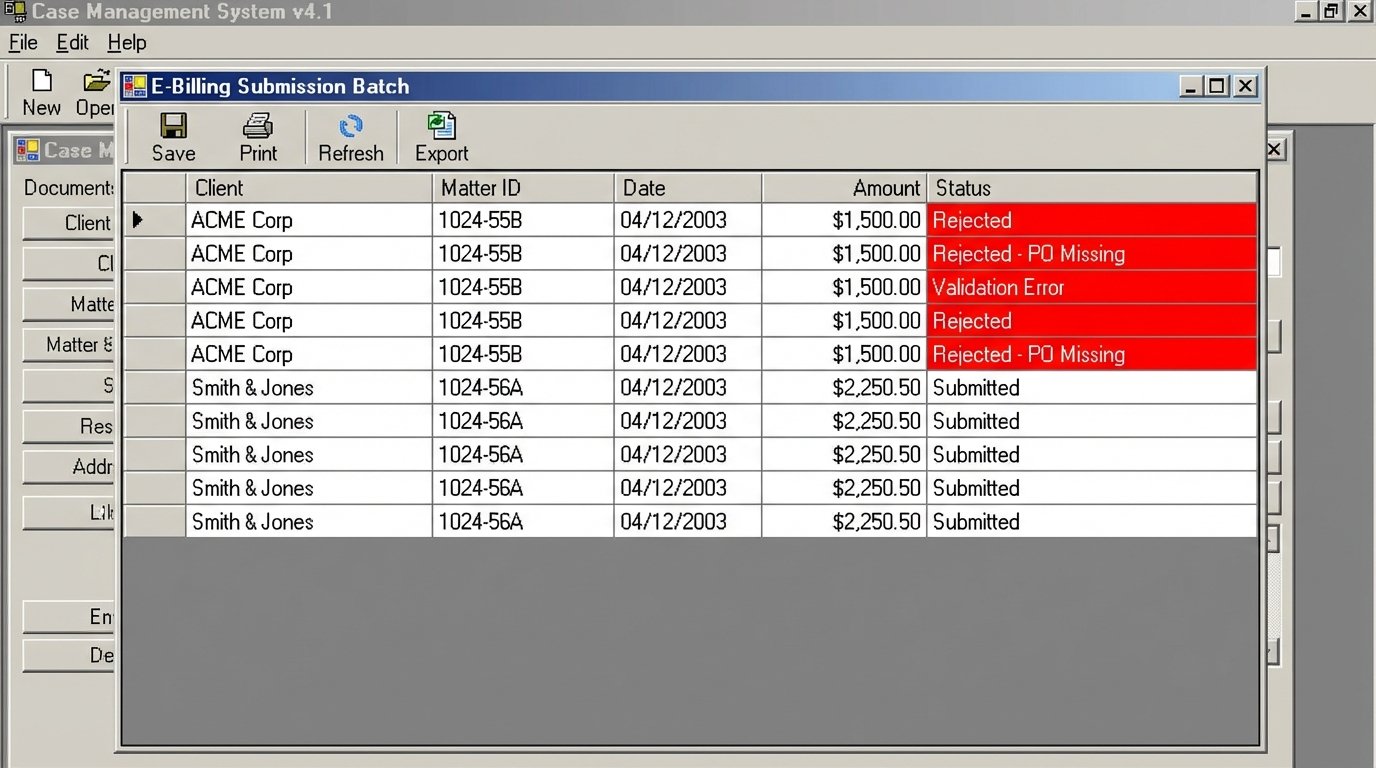
The final insult was the billing cycle. The firm dealt with numerous corporate clients who required electronic billing submissions with strict validation rules. The finance team would export time data, manually check each line item against client-specific codes, and then attempt to upload the files. Rejection rates were high, averaging 15-20% on first submission. Each rejection meant more manual rework and a longer wait to get paid.
The firm was effectively giving clients an interest-free loan due to its own operational drag.
The Strategy: Bypass, Don’t Replace
A full “rip and replace” of the legacy CMS was a non-starter. The cost was prohibitive, and the disruption to a firm of this size would have been catastrophic. The existing system, for all its faults, was the central repository of decades of client data. Our strategy was to quarantine the problem. We decided to build a lightweight, intelligent automation layer that would sit on top of the existing infrastructure.
This layer’s job was to orchestrate workflows and force data consistency *before* any information touched the old CMS. We treated the legacy system like a dumb database, a black box with a few sticky levers we could pull from the outside, rather than trying to perform open-heart surgery on it.
Architecture: The Anti-Corruption Layer and Workflow Engine
The solution had two core components. First, we built a dedicated microservice that functioned as an API bridge or “anti-corruption layer.” This service’s sole purpose was to communicate with the poorly documented, SOAP-based API of the legacy CMS. It exposed a clean, modern RESTful interface to the rest of our new tools, effectively translating modern requests into the archaic language the old system understood.
This was the most critical piece of the puzzle. It isolated the mess.
The second component was a workflow automation platform, in this case, a self-hosted instance of n8n. This platform acted as the brain. It would receive triggers from our new input sources (like a web form for intake), execute a series of logic checks, call other services, and finally, instruct the API bridge to push clean, validated data into the CMS. We deliberately avoided putting complex business logic inside the CMS itself.
Phase 1: Targeting Document Generation
We needed a quick win to build momentum and prove the concept. We chose to tackle document generation for the Real Estate practice group, a high-volume, template-driven area. We integrated Docmosis into our workflow. The new process was simple: a paralegal would access a simple web form, enter key data points for a lease agreement (lessee name, address, rent amount, dates), and click “Generate.”
The workflow engine would take this data, format it as a JSON object, and pass it to the Docmosis API along with the ID of the master template. Docmosis would then return a perfectly formatted PDF or DOCX file. The data was also simultaneously pushed to the client matter in the CMS via our API bridge. The 45-minute manual task now took less than three minutes.
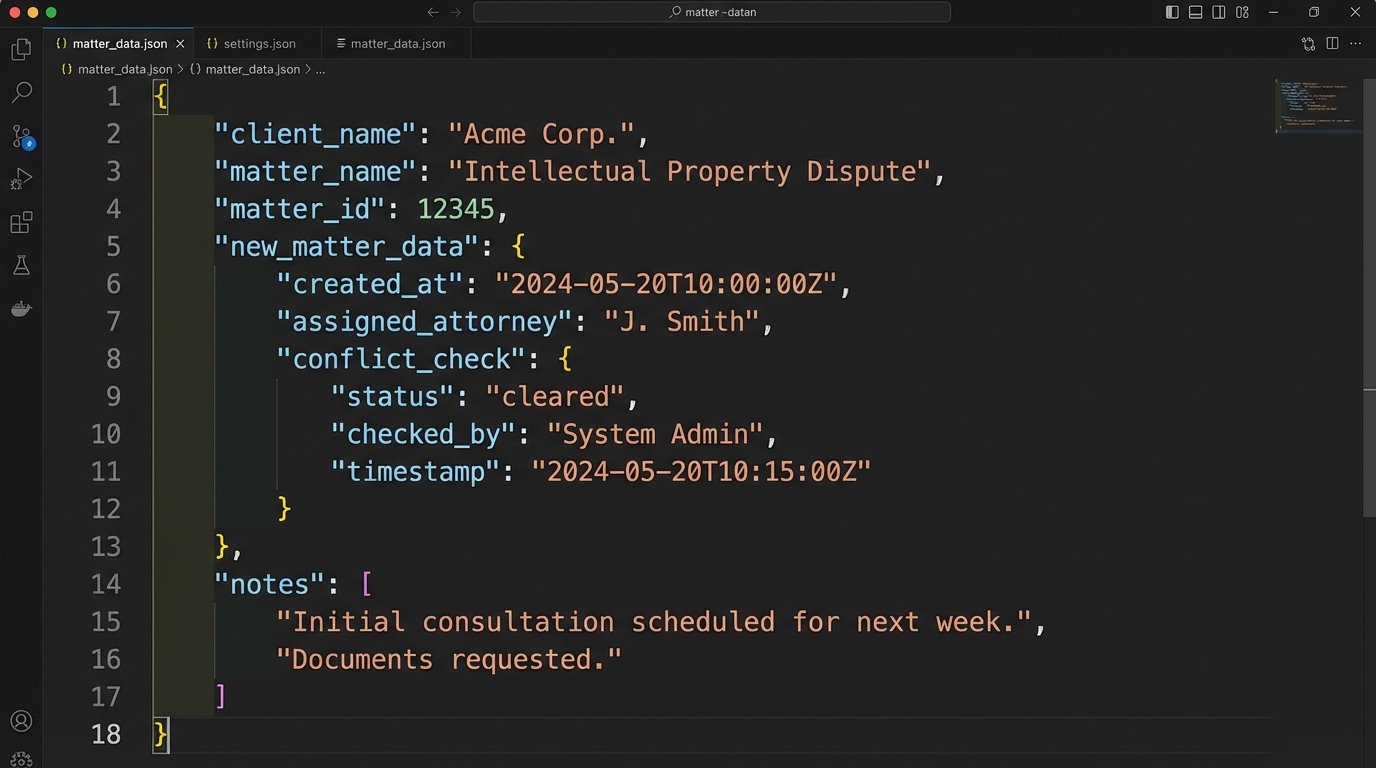
Here’s a simplified look at the JSON payload we structured for the new matter data. Forcing this structure was key to everything that followed.
{

  "client_name": "Apex Innovations Inc.",

  "matter_name": "Series B Funding Round",

  "matter_id": "AI-2024-051",

  "opening_partner": "j.smith",

  "practice_group": "Corporate",

  "conflict_check": {

    "status": "completed",

    "checked_against": [

      "TechCorp Ltd.",

      "FutureGadgets LLC"

    ],

    "cleared_by": "c.jones",

    "timestamp": "2024-05-15T14:30:00Z"

  }

}
This wasn’t just about speed. It was about control. We could now update a clause in a single master template, and that change would be instantly reflected in every document generated thereafter.
Phase 2: Re-engineering Matter Intake
With the success of the document generation pilot, we moved on to the firm-wide intake process. We replaced the email-and-spreadsheet disaster with a single, unified intake portal built using Retool. Partners or their assistants would now enter all required information into a guided, multi-step form.
This form had built-in validation. It would logic-check for properly formatted addresses, ensure required fields were populated, and even perform a preliminary conflicts search against a cached data set before submitting. Upon submission, the workflow engine would trigger the full, formal conflicts check, route the request for partner approval, and, only upon final approval, use the API bridge to create the matter in the CMS. No human re-keyed a single piece of data.
The transition was rough for some partners accustomed to firing off a quick email. This required a cultural shift, forcing structured behavior. The trade-off was clear: a few extra minutes of upfront effort from a partner saved hours of downstream administrative cleanup and reduced error rates to near zero.
Phase 3: Automating E-Billing Compliance
The final phase was to tackle the billing leaks. The firm’s timekeeping system had a decent API, which was a relief. We built a new workflow that ran nightly. It would pull all new time entries for clients with electronic billing requirements. A separate service would then check each entry against a database of that client’s specific billing codes and rules.
Any entry that failed validation (e.g., a vague narrative, incorrect task code, time entry exceeding a daily limit) was automatically flagged and routed back to the billing attorney or their paralegal for correction via an automated email notification. The entry was held back from the pre-bill until it was fixed. This system was essentially a firewall for bad billing data.
We were no longer waiting for the client’s system to tell us we made a mistake. We were catching our own errors, a process that felt like shoving a firehose of messy data through the needle of client compliance rules.
The Results: Measurable ROI and Scalable Operations
The impact of this phased automation strategy was tracked meticulously. We weren’t interested in vague claims of “improved efficiency.” We needed hard numbers to justify the investment and the operational disruption.
Quantified Performance Gains
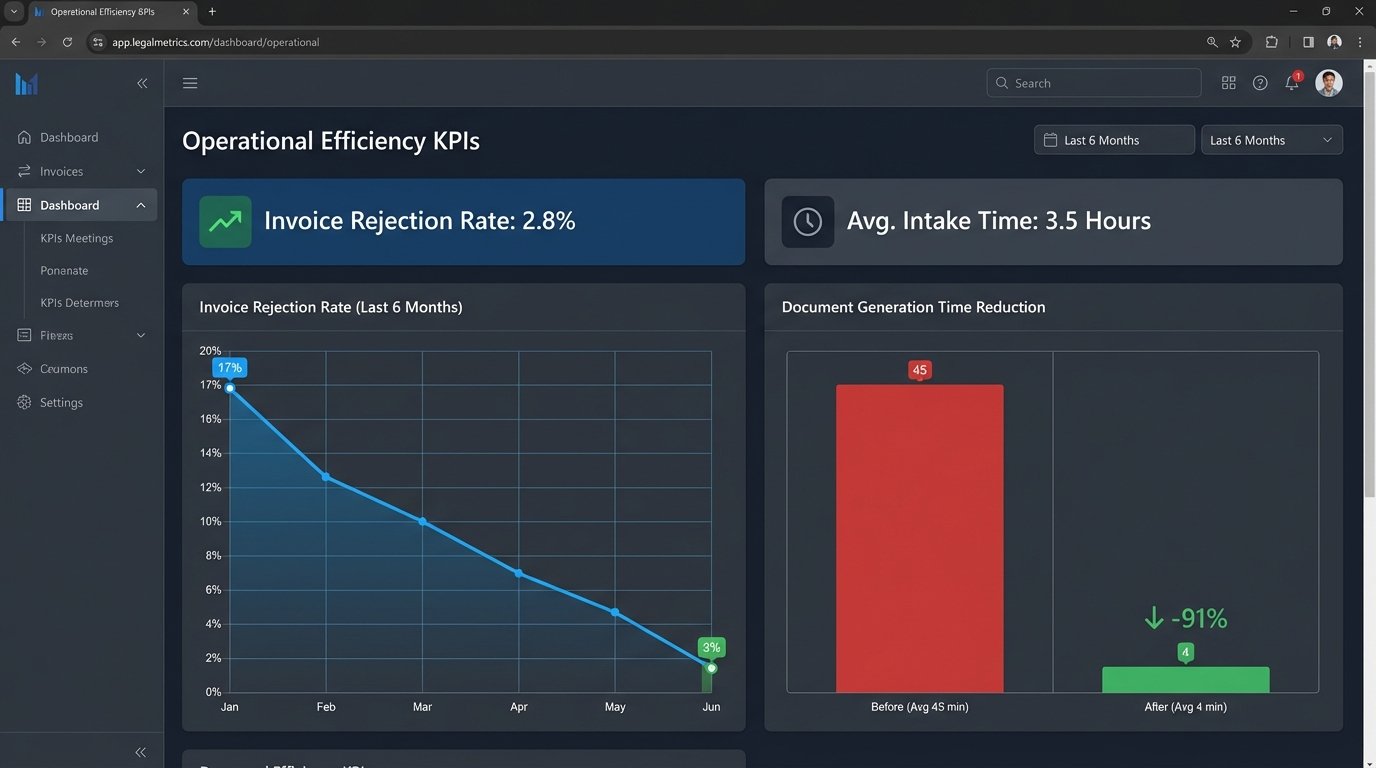
The data from the first six months post-implementation was stark.
- Document Generation Time: Reduced by 92%, from an average of 45 minutes to under 4 minutes for standard documents. This saved an estimated 20,000 paralegal hours annually across the firm.
- Matter Intake Cycle Time: Dropped from an average of 3 days to just under 4 hours for standard matters. Data entry errors were effectively eliminated.
- Invoice Rejection Rate: The first-pass rejection rate for e-billed invoices fell from over 15% to below 3%. This directly accelerated cash flow by an average of 12 days for those clients.
These weren’t marginal improvements. They represented a fundamental shift in the firm’s operational capacity.
The Strategic Impact
Beyond the direct time and cost savings, the automation platform provided a new level of operational agility. When the firm acquired a smaller, 30-attorney boutique, we were able to onboard their entire client and matter portfolio in a single weekend. The process, which previously would have taken months of manual data entry, was reduced to a series of data transformation scripts that fed our intake workflow.
The firm could now scale its operations without a linear increase in administrative staff. Profitability per partner, a key metric, saw a measurable increase because support staff were freed from repetitive tasks to focus on higher-value work. Risk was also significantly reduced. The centralized, automated systems ensured that processes were executed consistently across all offices and practice groups, minimizing the chances of human error inherent in manual workflows.
The legacy CMS is still there. It continues to be the system of record. But it is no longer the bottleneck. By building an intelligent layer around it, we gave the firm modern capabilities without the pain of a full-scale migration. We didn’t fix the old engine. We bolted on a turbocharger.