
Stop Drowning Your Agents in Noise
The entire real estate marketing automation industry is built on a flawed premise. The goal seems to be volume. Send more emails, more texts, more market reports. The logic is that if you blanket a lead database with enough low-effort communication, something will eventually stick. This is fundamentally broken. It treats a six-figure home purchase, an emotionally-charged life decision, with the same crude logic as a cart abandonment email for a pair of socks.
This approach doesn’t generate quality conversations. It generates unsubscribe requests and trains your leads to ignore you. Your most expensive asset, the agent’s time, gets wasted sifting through a mountain of low-intent responses generated by a system designed for noise, not signal. The objective isn’t to replace the human. The objective is to build a system that acts as a signal amplifier, forcing the agent’s attention onto the highest-intent leads at the exact moment they need a human expert.
Redefining “Personal Touch” as Data-Driven Relevance
Agents argue against automation because it lacks a “personal touch.” This is a failure of imagination, not a failure of technology. In a technical context, “personal touch” is simply data-driven relevance. A happy birthday email triggered by a date field in your CRM is not personal. It’s a database query with a mail merge field. An SMS that references the specific craftsman-style home they viewed three times yesterday and mentions the new price drop from the MLS feed, that has the *texture* of being personal.
The problem isn’t the automation. It’s the data. Most platforms operate in silos. Your website tracking script knows a lead is obsessing over a property, but your CRM is dumb to it. Your CRM knows an agent last called them three weeks ago, but the email platform is still firing off the generic “just checking in” sequence. The core architectural challenge is to break these silos and create a unified event stream that gives a complete picture of a lead’s behavior.
Without a centralized view, any attempt at personalization is just a guess. You’re firing blind.
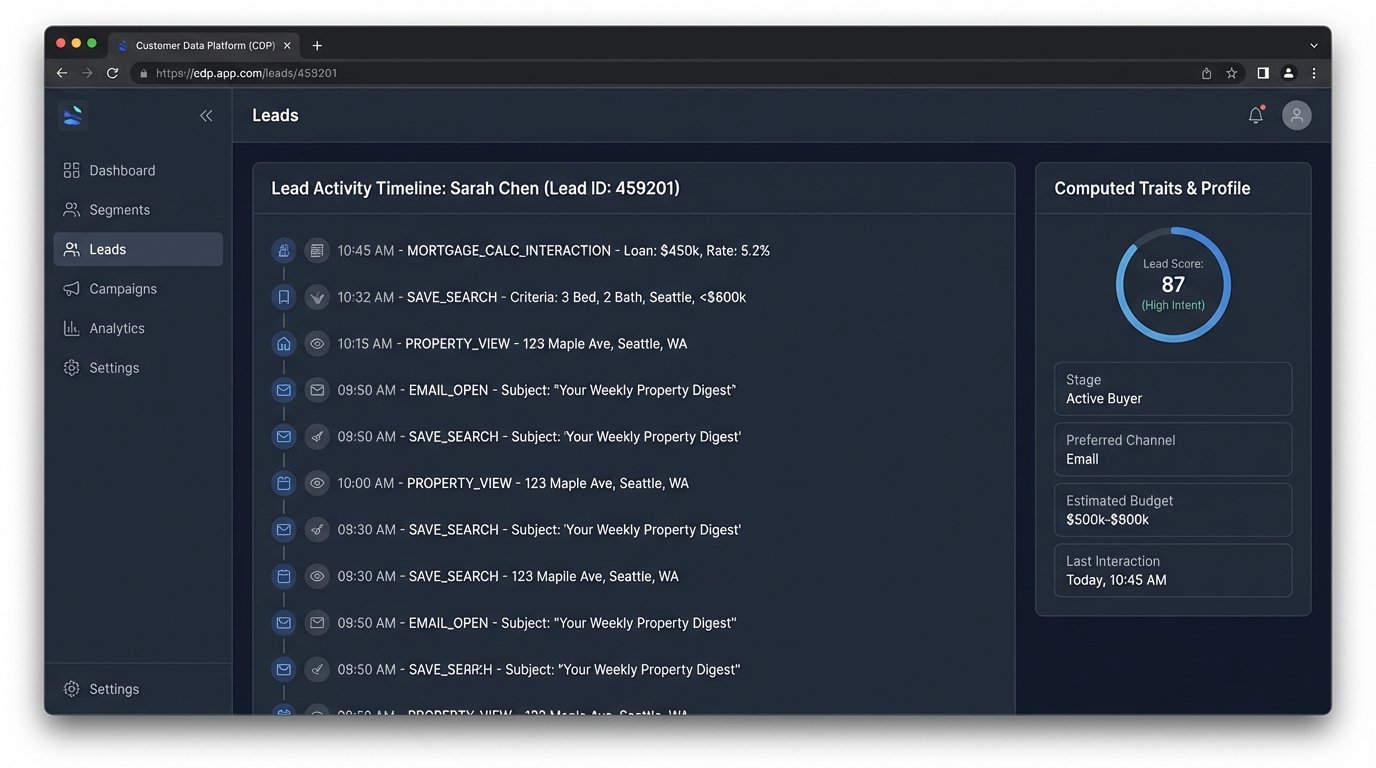
Isolating Signal from the Automated Noise Floor
Most lead nurturing campaigns are just noise. They are a low-level hum of activity designed to keep a brand “top of mind,” a concept that has diminishing returns with every generic email sent. We need to stop building systems that talk and start building systems that listen. A system that listens is configured to detect specific, high-intent actions, or what I call signals. The rest is just noise.
What qualifies as a signal? These are not passive events like an email open. They are active, self-qualifying behaviors from the lead:
- View Velocity: Viewing a single property more than twice in a 24-hour period.
- Financial Tooling: Interacting with a mortgage calculator on a listing page.
- Filter Specificity: Saving a property search with more than five filters, especially high-value ones like school districts or price minimums.
- Re-engagement: Returning to the website after a dormant period of 30 days or more.
These signals can be weighted and scored. A simple event-scoring script can ingest these behaviors from your data layer or CDP and update a lead score in the CRM via its API. This isn’t complex logic, but it requires connected systems to function.
# Pseudocode for a simple lead scoring function
def calculate_lead_score(events, current_score):
score_modifiers = {
"PROPERTY_VIEW": 1,
"SAVE_SEARCH": 10,
"MORTGAGE_CALC_INTERACTION": 15,
"PROPERTY_VIEW_REPEAT_24H": 20 # High-value signal
}
new_score = current_score
for event in events:
event_type = event.get("type")
if event_type in score_modifiers:
new_score += score_modifiers[event_type]
return new_score
# Usage:
# tracked_events = get_events_from_webhook("lead_123")
# crm_score = get_score_from_crm("lead_123")
# updated_score = calculate_lead_score(tracked_events, crm_score)
# update_crm_record("lead_123", {"lead_score": updated_score})
Scoring transforms a chaotic list of leads into a prioritized work queue. It lets the agent focus on the top 5% instead of guessing at the other 95%.
The Tripwire Architecture: Automation as a Human Alert System
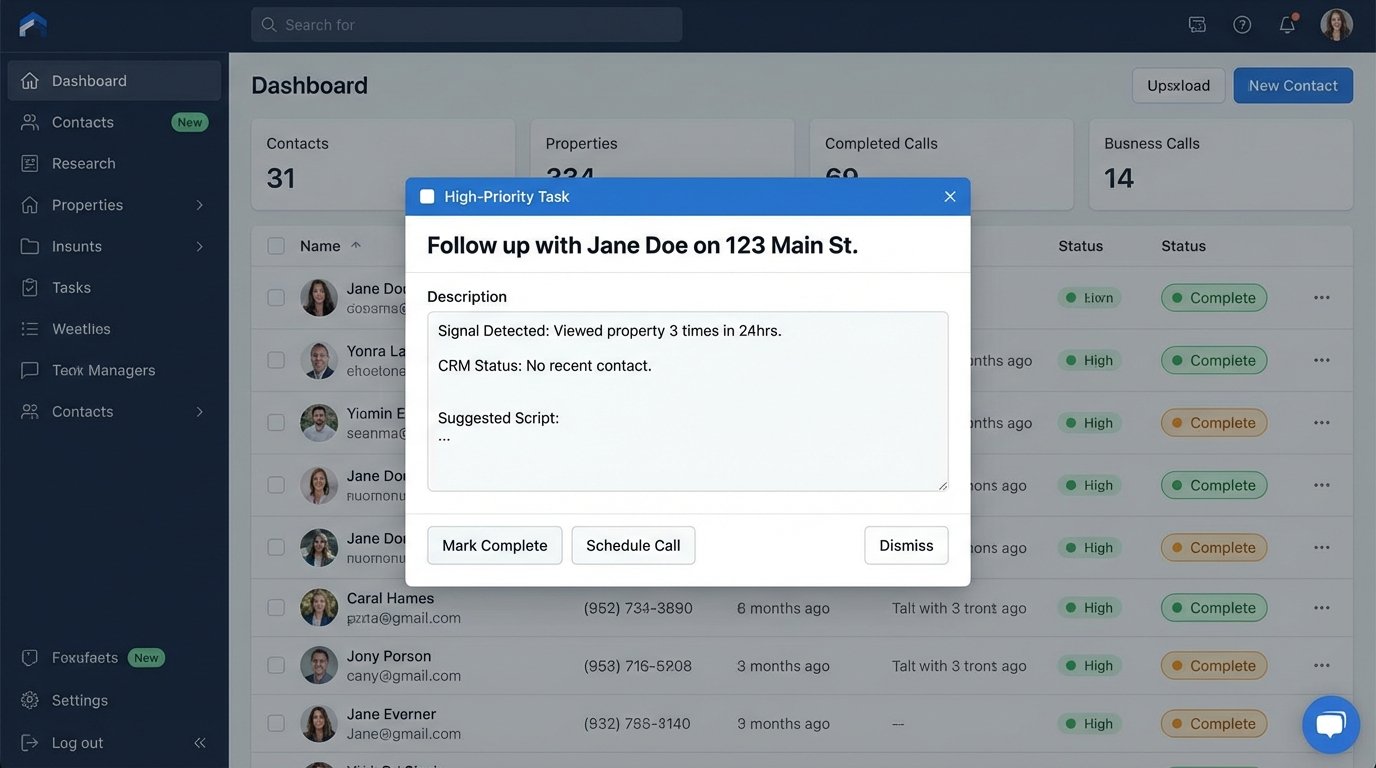
Forget long-term drip campaigns. I propose a model I call the “Tripwire Architecture.” The core principle is that automations should be short, sharp, and designed to end by triggering a mandatory, high-priority task for a human agent. The automation doesn’t nurture the lead. It identifies a critical moment and forces an expert into the conversation.
Consider this workflow. A lead views a property at 123 Main Street for the third time today. A tracking event fires. Instead of adding them to a generic “interested homebuyer” sequence, a webhook triggers a serverless function. This function executes a series of logic-checks in milliseconds. First, it queries the CRM API to see if an agent has spoken with this lead in the last 24 hours. If yes, the process aborts to prevent agent collision. Second, it hits the RESO Web API to confirm 123 Main Street is still active. If it’s pending, the process aborts.
If all checks pass, the function executes two actions. It injects a high-priority task directly into the agent’s CRM with the lead’s name, the property link, their viewing history, and a suggested script. Simultaneously, it sends one highly contextual SMS to the lead: “Just saw you were looking at 123 Main St again. It’s a great property. The sellers are reviewing offers this weekend. Have you had a chance to see it in person yet?”
The standard automation method is like a scheduled sprinkler system, watering the entire lawn regardless of need. It’s inefficient and wasteful. The tripwire model is a heat-seeking missile. It waits for a specific thermal signature and executes a single, precise strike.

This architecture redefines the purpose of automation. It shifts from being a low-grade agent replacement to a high-performance intelligence system for the agent. The machine handles the 24/7 monitoring, and the human executes the high-value, nuanced closing action.
Tooling for Reality, Not for a Sales Deck
This is not an off-the-shelf system you buy. You build it. The components are distinct and must be bridged together with custom logic. An event tracking platform like Segment or a well-structured Google Tag Manager data layer is non-negotiable. You need to capture user behavior cleanly at the source.
The integration layer is where most projects fail. A tool like Zapier or Make can handle simple tripwires, but they become sluggish and expensive with complex, multi-step logic checks. For a scalable system, you need an AWS Lambda or Google Cloud Function triggered by an API Gateway. This gives you the power to write proper code, manage environment variables securely, and handle errors with retry logic. Don’t underestimate the need for robust error handling. CRM APIs go down. MLS feeds send malformed data. Your integration logic has to be fault-tolerant.
Accessing data is another battle. Most CRM APIs are rate-limited. You cannot just hammer them with requests for every single event. You need to build in caching strategies and design your functions to be efficient with the number of API calls they make. Getting access to MLS data via the RESO Web API is its own special kind of hell, involving gatekeepers, inconsistent authentication methods, and data fields that vary wildly between associations. Building a data normalization layer just to make sense of the incoming property data is often a project in itself.
The Brutal Economics of Building It Right
A tripwire system is not cheap. The initial build requires developer hours to write the functions, configure the API endpoints, and normalize the data streams. It is far more expensive upfront than signing a contract for an all-in-one marketing platform that promises the world. Those platforms sell a dream of push-button simplicity, but they deliver a reality of generic, ineffective outreach.
The return on investment for a custom-built system is measured in conversion rates, not email open rates. You are engineering a system to increase the number of high-quality conversations. By focusing your agents’ finite time on leads who have explicitly signaled their intent, you reduce lead decay and increase the odds of closing a transaction. The math works out, but it requires patience and a budget for real engineering.
There is also a human cost. This system forces a process change. Agents must learn to trust the high-priority tasks that appear in their CRM. They must be trained to act on the data provided, rather than just working through a call list alphabetically. If the agents don’t adopt the workflow, the most elegant technical solution is worthless.
Automation Should Filter, Not Nurture
The debate over “automation versus personal touch” is a distraction. It’s the wrong argument. The real challenge is architecting systems that can competently filter signal from noise across a dozen disconnected data sources. We use automation to process the 99% of low-value, background activity. We do this to isolate the 1% of moments that absolutely demand a skilled human.
The goal is not to have the automation close the deal. The goal is to have the automation identify the lead who is ready to be closed. The best automation doesn’t replace your top agent. It builds a high-speed pipeline that feeds them pre-qualified, high-intent opportunities all day long.