
Stop Calling it ‘Personal Touch’. It’s an Inefficient System.
The real estate industry champions the idea of the “personal touch.” This is a euphemism for manual, repetitive, and error-prone work that doesn’t scale. Manually sending the same “checking in” email to 50 different leads is not a high-value activity. It’s a failure of process, a misallocation of a licensed professional’s time, and a direct path to letting high-intent leads go cold because you were busy copy-pasting text.
Your brain is not a database. It is a processor. Trying to use it for state management, remembering who you called three weeks ago and what their specific budget constraints were, is like using system RAM for long-term storage. The data is volatile, easily corrupted, and a single system crash, like a busy weekend, wipes the cache clean. The argument that this manual process builds better relationships is a fallacy built on a misunderstanding of what can and should be automated.
The Core Failure: Manual State Tracking
Every lead exists in a specific state: New, Contact Attempt 1, Contact Attempt 2, Nurturing, Unresponsive, Closed. A human managing this across dozens or hundreds of leads will inevitably drop the ball. A lead from a Zillow ad requires a different initial contact protocol than a referral. A lead who clicks a link in a market report email needs a different follow-up than one who ignores five straight messages.
Without a system, these state transitions are managed by memory and sticky notes. This is not a system. It’s chaos. The true cost isn’t just the missed opportunities. It’s the wasted ad spend that generated the lead in the first place. You paid for the click, for the form submission. Failing to work it with systematic rigor is like buying premium server hardware and then using it to host a static HTML page.
Architecting the Solution: A Centralized State Machine
The fix is to offload state management to a dedicated system that operates on pure logic. This is typically a CRM, but not the glorified rolodex most agents use it as. We must reframe the CRM as the central state machine for your entire lead generation pipeline. Platforms like Follow Up Boss, HubSpot, or even a heavily customized Pipedrive can serve this function. The tool is less important than the architecture.
The goal is to build an engine that automatically transitions a lead’s state based on triggers and timers. The agent is no longer responsible for remembering to follow up. The agent’s job is to respond when the system flags a lead as “human intervention required.” This fundamentally changes the agent’s role from a low-level task executor to a high-level exception handler.
Layer 1: The Ingestion and Triage Protocol
Your system is only as good as its inputs. Leads come from a dozen different sources: Zillow, your website, Realtor.com, manual entry. The first step is to pipe all these sources into a single ingestion point. The most reliable method is a webhook, which sends a structured data packet to your system the instant a lead is generated. Email parsing is a fallback, but it’s brittle and prone to breaking if the source email template changes.
A typical webhook payload from a website form might look like this. It’s just a simple JSON object containing the raw data.
{

  "lead_source": "Website Form A",

  "name": "John Doe",

  "email": "johndoe@example.com",

  "phone": "555-123-4567",

  "property_type_interest": "Single Family Home",

  "budget_max": "750000",

  "timestamp": "2023-10-27T10:00:00Z"

}
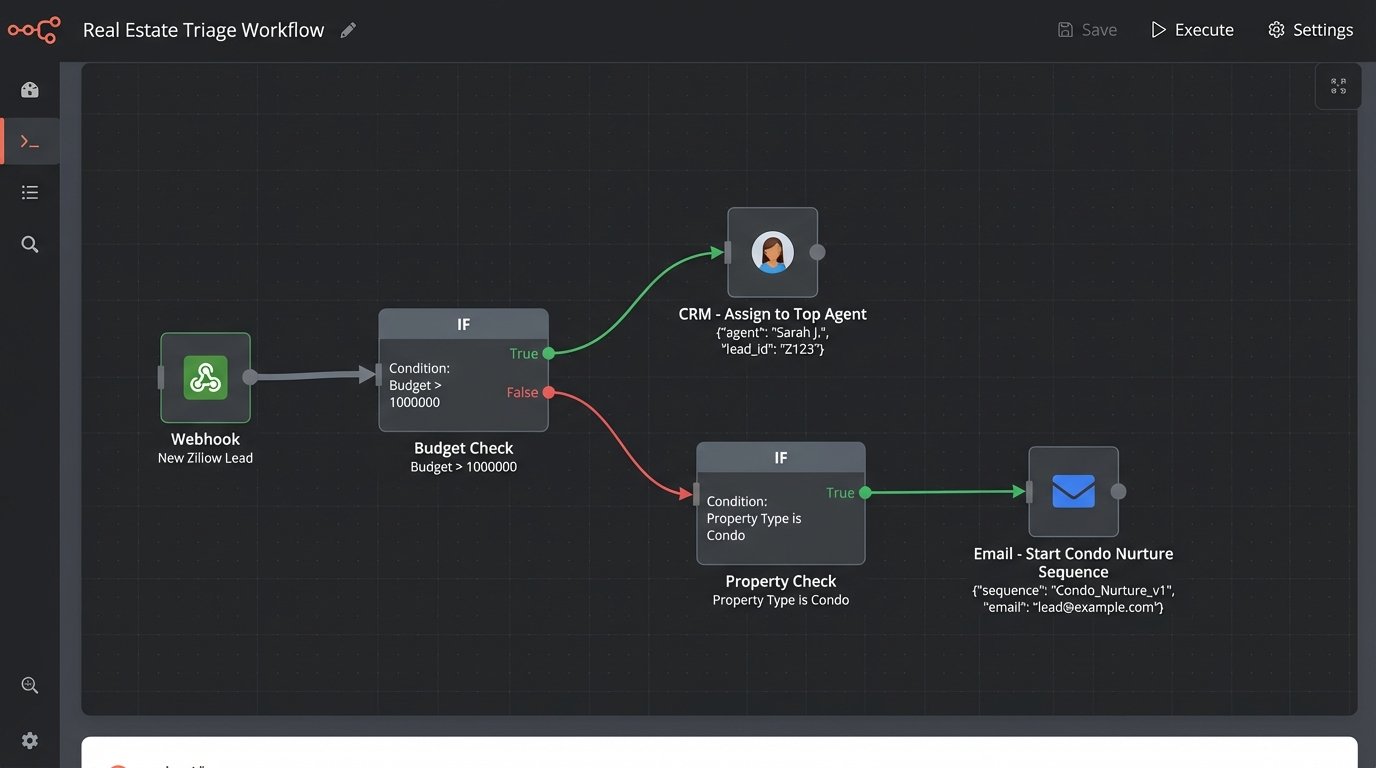
Once ingested, the first logic gate runs. This is triage. We can use simple rules to route and tag the lead. For example:
- IF `lead_source` contains “Zillow” AND `budget_max` > 1,000,000, THEN assign to “Agent Smith” AND add tag “High-Value-Lead”.
- IF `property_type_interest` is “Condo”, THEN add to “Condo Nurture Sequence”.
- IF `phone` is present, THEN initiate “SMS Drip Campaign 1”.
This isn’t complex. It’s just forcing a consistent process on inconsistent inputs.
Layer 2: The Logic-Driven Nurturing Engine
This is where the manual work is eliminated. Nurturing sequences are not just a series of timed emails. They are conditional workflows that react to the lead’s behavior. A well-built sequence feels personal because it’s relevant, not because a human clicked “send.”
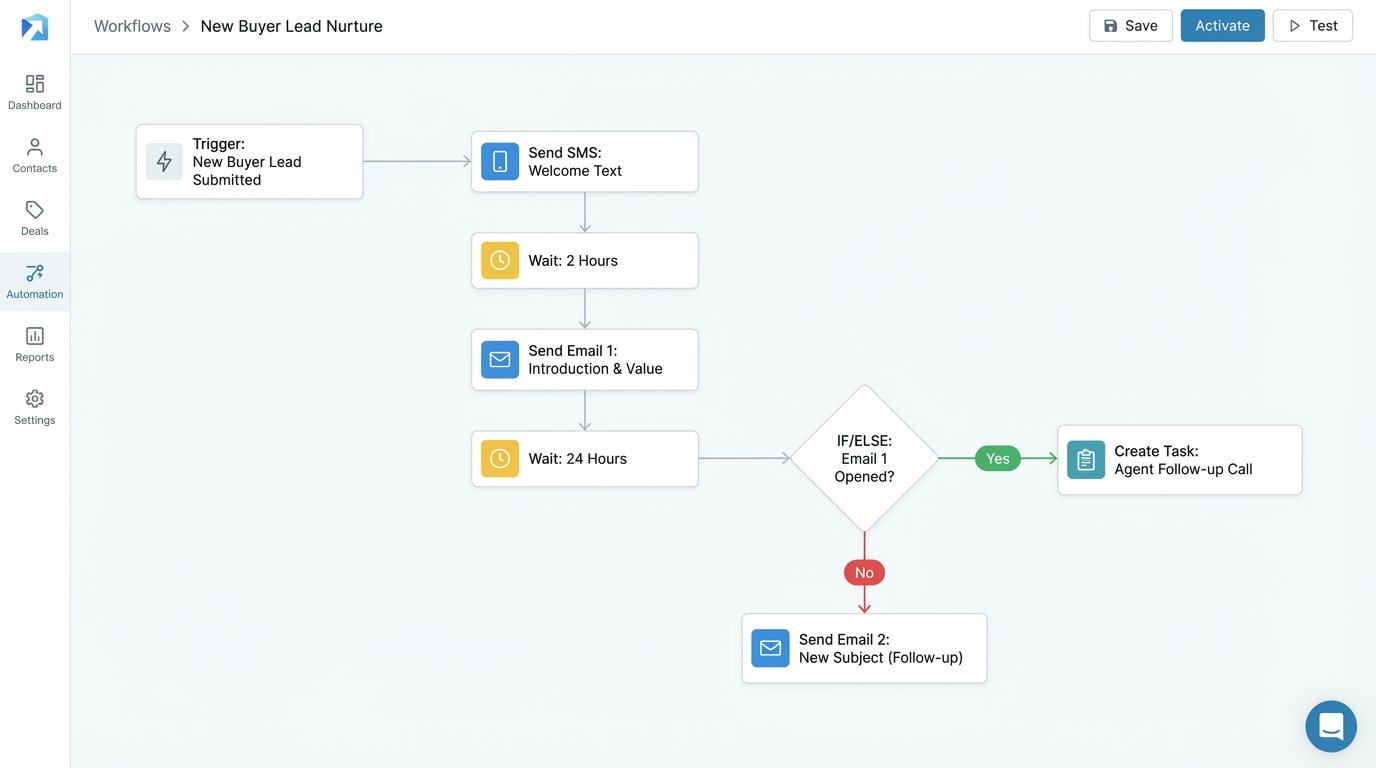
Consider a new buyer lead workflow:
- Time 0: Ingest lead. Assign owner. Send immediate SMS: “Got your request for properties in [City]. John here. Are you free for a quick call later today to review?”
- Time + 2 Hours: Send Email 1 with a pre-built search of listings matching their initial query. The subject line is direct: “Properties in [City] matching your criteria.”
- Time + 24 Hours: A task is automatically created in the CRM for the agent: “Call [Lead Name]”. The system doesn’t make the call, it just enforces the action.
- Time + 48 Hours (Conditional): IF Email 1 was not opened, THEN send Email 2 with a different subject line. IF Email 1 was opened but no links were clicked, THEN send a market report for the area.
The workflow branches based on data. This reactive logic is impossible to execute manually at scale. The agent only gets involved when the lead responds or when the system explicitly instructs them to make a call.
Friction Points and Operational Realities
Building this system is not a trivial undertaking. There are dependencies and costs that are often glossed over by software salespeople. Acknowledging them is critical for successful implementation.
Cost and Vendor Lock-In
These platforms are not cheap. You are buying into an ecosystem. A CRM, an SMS service like Twilio, an email delivery service, and potentially a Zapier or Make.com subscription to bridge gaps between systems all represent recurring monthly expenses. This is an operational cost that must be justified by increased efficiency and conversion rates. It is a wallet-drainer if not properly configured to produce ROI.
Configuration Complexity and Maintenance
The setup requires a technical mindset. You need to understand how to map data fields, configure conditional logic, and debug workflows when they inevitably fail. A poorly configured automation can create massive problems, like sending the wrong listings to a lead or failing to notify an agent of a new inquiry. The system requires periodic audits to ensure the logic remains sound and the integrations are not broken by an API update from a vendor.
API Limits and Data Integrity
Every system you connect to has an API with rate limits. You cannot just blast thousands of requests to enrich data or send messages. Your code or automation tool must respect these limits, backing off and retrying when a `429 Too Many Requests` status code is received. Furthermore, the entire structure depends on good data. If you get garbage phone numbers from a lead source, your expensive SMS automation is firing blanks. Data validation and cleansing steps at the point of ingestion are not optional.
Running automation without solid data validation is like building a skyscraper on a foundation of mud. The structure looks impressive from a distance, but the first real operational load causes a total, catastrophic collapse.
Measure Performance, Not Vanity
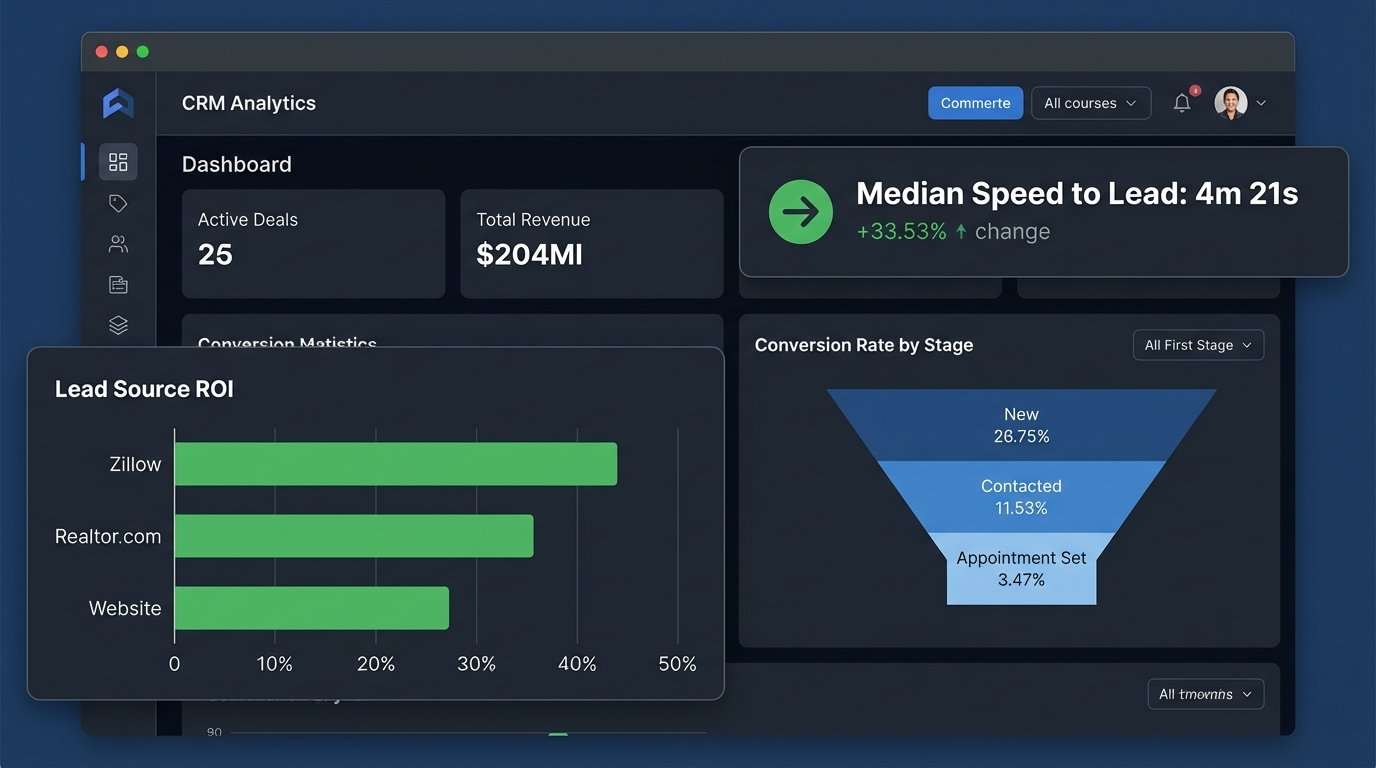
The value of automation is measured in concrete outcomes, not “engagement.” Stop tracking email open rates. It’s a notoriously unreliable metric, especially after Apple’s Mail Privacy Protection update. Focus on the metrics that directly map to revenue.
- Speed to Lead: What is the median time from lead creation to the first contact attempt? This should be under 5 minutes. Your automation dashboard should display this in real time.
- Lead Source ROI: Which lead source (Zillow, Website, Facebook Ads) has the highest conversion rate from lead to closed deal? Pipe your closing data back into the CRM to track this. Stop spending money on channels that produce low-intent leads.
- Conversion Rate by Stage: What percentage of leads move from “New” to “Contacted”? From “Contacted” to “Appointment Set”? A drop-off at a specific stage indicates a bottleneck or a failure in your nurturing logic for that stage.
These are the numbers that matter. They are diagnostics for the health of your lead generation machine.
The Agent Re-platformed: Operator, Not Executor
The end goal is not to replace the realtor. It is to augment them. An agent without automation is a single-threaded CPU trying to handle a multi-threaded workload. They can only process one task at a time, and the context switching between prospecting, showing homes, and writing offers is painfully slow and inefficient.
Automation provides the multi-threading. It handles the constant, low-level I/O operations of lead follow-up. This frees up the agent, the core processor, to focus on the tasks that require human intelligence: building rapport on a call, negotiating a contract, and solving a client’s unique problem. You stop being the person who sends the follow-up email and become the person who designs the system that sends it perfectly every time.