7 SMS Marketing Strategies Every Realtor Should Automate
Your CRM is bleeding leads. The primary cause is an over-reliance on email follow-ups that land in spam folders or get ignored entirely, netting a 15% open rate on a good day. SMS achieves a 98% open rate, often within three minutes. The math is not complex, but the execution requires stripping out manual processes that fail under pressure.
Automating SMS is not about spamming contacts with generic “Just Listed” messages. It is about creating event-driven triggers that deliver precise information at the exact moment of relevance. This requires direct integration with your data sources, typically your MLS feed and your client relationship management system. Anything less is just a digital flyer, and just as useless.
1. Instant New Listing Alerts for Segmented Buyers
The standard approach involves a marketing assistant manually exporting a list of buyers and blasting them an email about a new property. This is slow and untargeted. A proper automation triggers the moment a new listing with a status of Active hits the MLS, cross-references its attributes against buyer profiles in your CRM, and dispatches a targeted SMS.
The logic must be brutally efficient. The trigger is a webhook from your MLS provider or a polling function that checks for new ListingID entries every 60 seconds. The payload contains the core data: price, beds, baths, and square footage. Your automation script then queries your CRM for contacts whose saved search criteria match these attributes within a predefined tolerance, say +/- 10% on price and an exact match on bedroom count.
- Trigger: New MLS listing status change.
- Data Source: MLS API or webhook feed.
- Action: Query CRM for matching buyer profiles, then send a templated SMS via an API like Twilio.
- Failure Point: An out-of-sync database. If your CRM data is stale, you will text buyers about properties that do not match their needs, burning your credibility. Regular data integrity checks are not optional.
2. The Open House Reminder and Feedback Loop
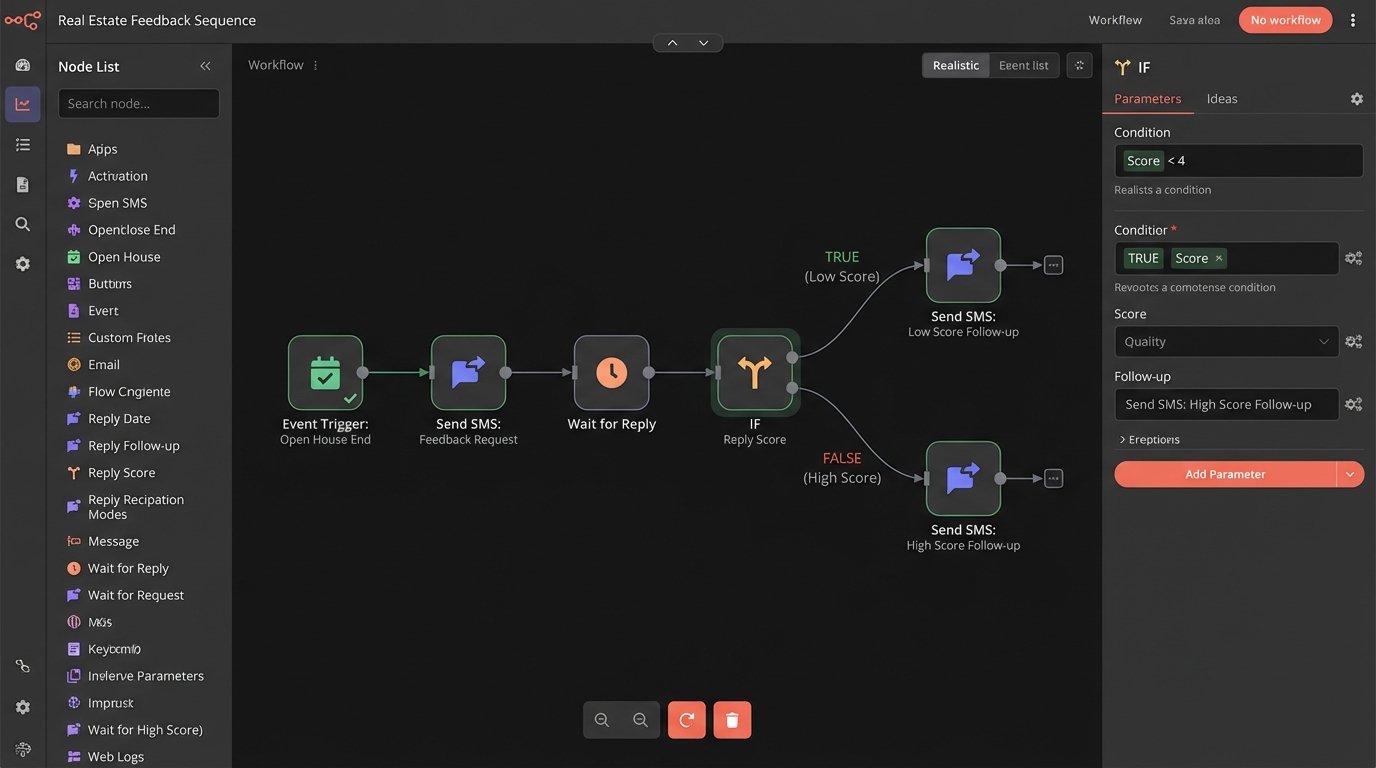
Getting people to an open house is one challenge. Extracting meaningful feedback from them is another. Automation bridges this gap by creating a two-part sequence. The first message is a simple reminder sent 24 hours before the event to everyone who RSVP’d or expressed interest. The second is a feedback request sent exactly one hour after the open house concludes.
This is not a simple “fire and forget” task. The system must tag attendees in the CRM, then initiate a timed workflow. The feedback request should not be an open-ended question. It should ask for a rating from 1 to 5. A response of 1-3 could trigger a follow-up asking “What could be improved?”, while a 4-5 could trigger a message asking “Are you considering an offer?”. This conditional logic separates serious buyers from casual browsers without you lifting a finger.
3. A Simple Lead Qualification Bot
A significant portion of inbound leads ask the same three questions: price, number of bedrooms, and address. Answering these manually is a time sink. A basic SMS bot can handle this initial triage. By configuring keyword triggers, you can provide instant answers and filter for intent.
The setup involves mapping keywords to specific data fields from the property listing. When an inbound SMS contains “price”, the system pulls the ListPrice field from the database for that PropertyID and responds. If it sees “address”, it sends the street address. The real work is in the fallback logic. If the message contains none of the keywords, it gets flagged for manual review and forwarded to the agent. This prevents the bot from failing clumsily on a nuanced question.
Here is a skeletal JSON-like structure for the bot’s logic. This is not executable code. It is a blueprint for the decision tree you would build in your automation platform.
{

  "incoming_sms": {

    "from": "+14155552671",

    "listing_context": "MLS-12345",

    "body": "How many beds and what is the price?"

  },

  "logic_flow": [

    {

      "condition": "body_contains('beds', 'bedrooms')",

      "action": "query_db('MLS-12345', 'bedrooms')",

      "response_template": "This property has {db_result} bedrooms."

    },

    {

      "condition": "body_contains('price', 'cost')",

      "action": "query_db('MLS-12345', 'price')",

      "response_template": "The current asking price is ${db_result}."

    },

    {

      "condition": "default_fallback",

      "action": "forward_to_agent('agent_email@domain.com')",

      "response_template": "An agent will contact you shortly to answer your question."

    }

  ]

}
This structure prevents you from building a brittle system that breaks when a lead uses slightly different phrasing.
4. Automated Post-Showing Follow-Up Sequence
A buyer’s interest cools rapidly after a showing. An automated SMS drip sequence maintains momentum. Immediately after a showing is logged as complete in your calendar or CRM, the first SMS is dispatched. It is a simple “Thanks for visiting 123 Main St.” message. This confirms you have their correct contact information and opens the communication channel.
Twenty-four hours later, a second message asks for specific feedback. Seventy-two hours later, a third can provide a link to similar properties. This sequence is not a sales pitch. It is a systematic process of engagement designed to keep your name at the top of their mind. Each message must be concise and offer some value, otherwise it is just noise.
5. “Just Sold” Notifications for Geographic Farming
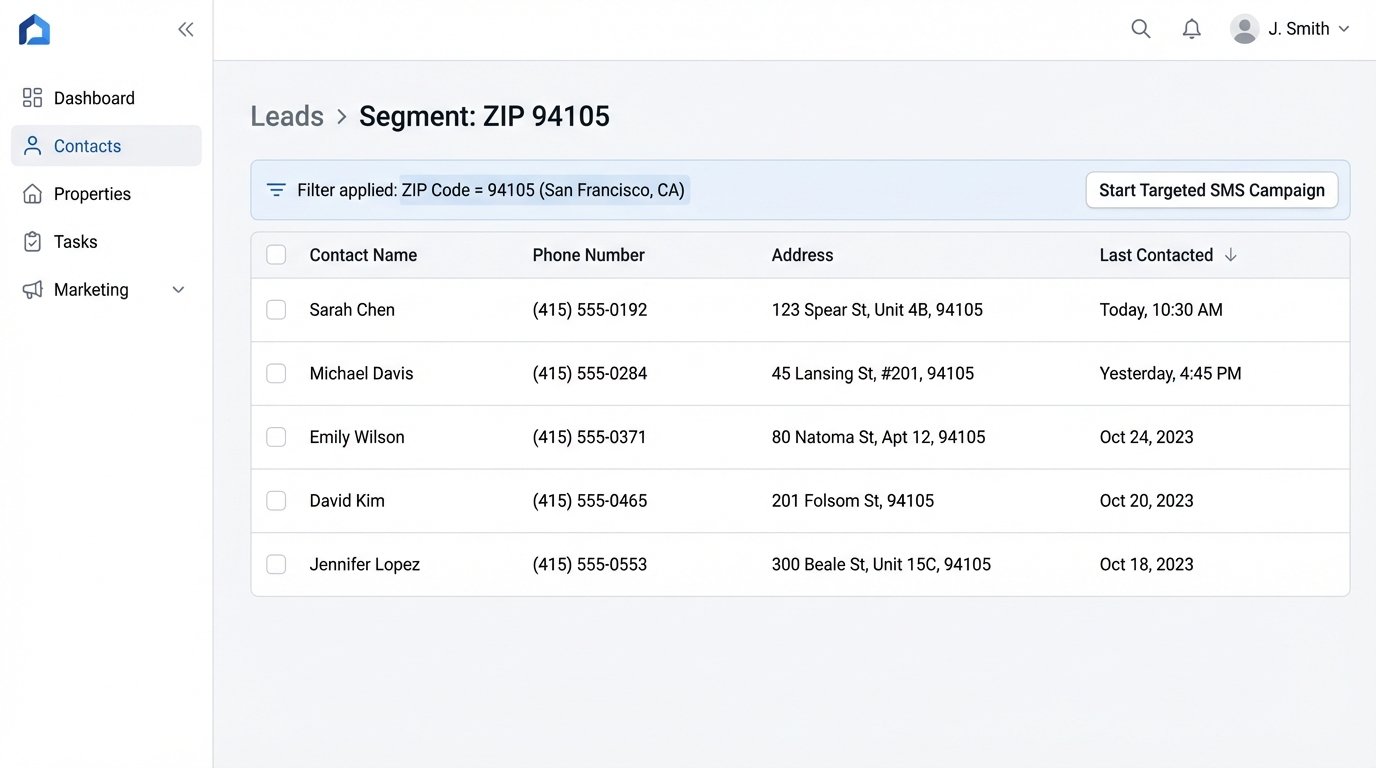
Sending postcards is an expensive, low-ROI method for geographic farming. An automated SMS system can target your existing contact list with surgical precision. When a property’s status changes to Sold, the system should trigger a workflow. This workflow identifies the property’s ZIP code or neighborhood boundary.
The script then queries your CRM for all contacts located within that same geographic area. A message is sent informing them a neighbor’s home has sold, which implicitly provides a market update and reinforces your position as an active agent in their area. This requires clean, structured address data in your CRM. Forcing a batch CSV import from an old MLS into a real-time CRM is like shoving a firehose of stale data through the needle-eye of an API. The pressure builds, records get corrupted, and eventually the whole pipe bursts.
6. The Annual “Home Anniversary” Touchpoint
The goal here is long-term relationship maintenance, not immediate lead generation. This is the easiest workflow to build but is often overlooked. The automation is based on a single date field in your CRM: the ClosingDate of a past transaction.
You configure a recurring annual trigger. On the anniversary of the closing date, the system sends a non-sales message like, “Happy 1st Home Anniversary! Hope you’re still enjoying the place.” This simple act keeps you connected to your past clients, who are the most valuable source of future referrals. The cost is negligible, but the long-term relationship value is significant. A failed automation here is usually due to poor date formatting in the source CRM, a trivial but common point of failure.
7. Price Reduction Alerts for Interested Parties
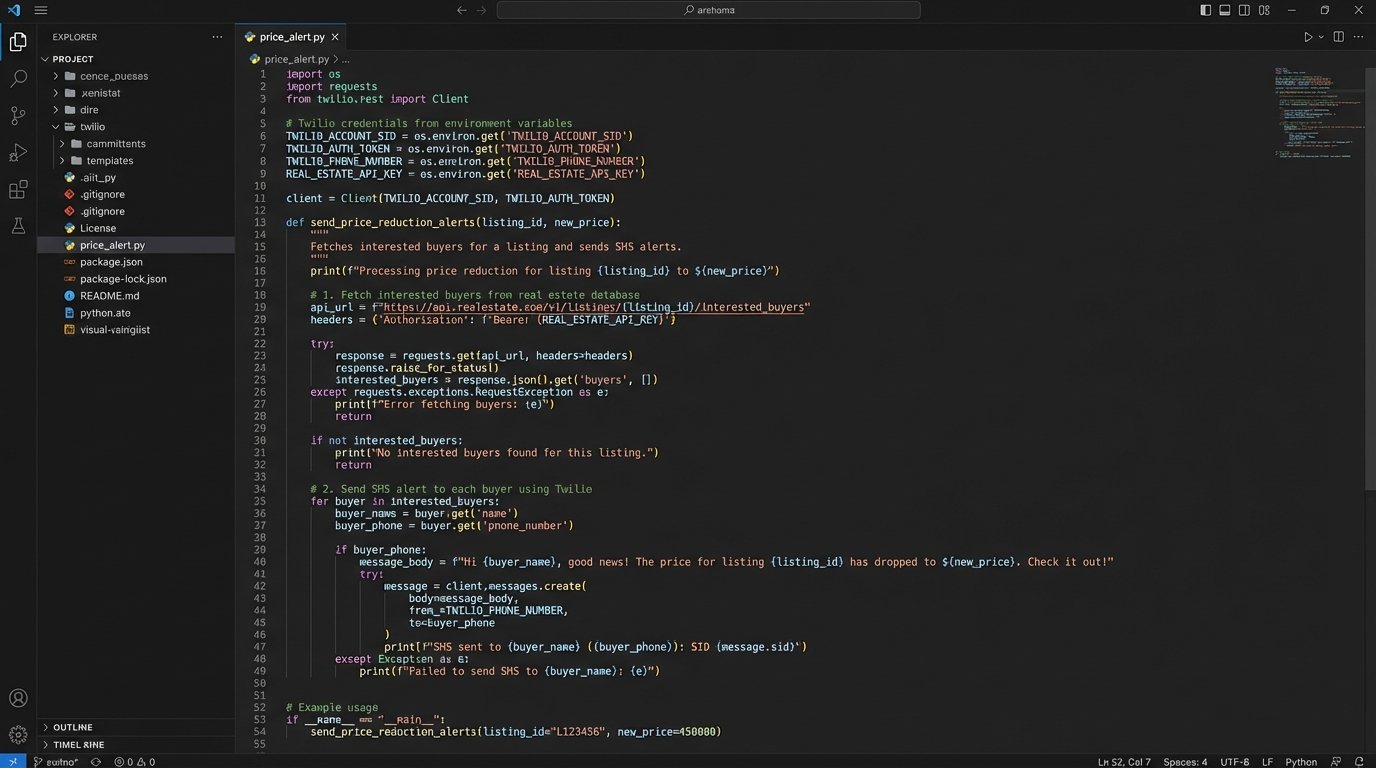
When a listing’s price is reduced, it is a critical event. Manually notifying every interested party is inefficient and prone to error. This automation links your MLS feed directly to a list of “interested” or “watched” contacts for a specific property within your CRM.
The trigger is a change in the ListPrice field for a given ListingID. When a price drop is detected, the workflow grabs the new price and the list of associated contacts. It then sends an immediate, no-frills SMS: “Price Update: 123 Main St is now listed at $450,000.” This creates urgency and can reactivate cold leads. The key is to ensure the “interested parties” list is managed meticulously. Sending this alert to the wrong people is a fast way to get your number blocked.
Each of these strategies requires an initial technical setup. You must authenticate APIs, map data fields, and write conditional logic. But once deployed, they operate with minimal human intervention. They force you to maintain clean data, which is a benefit in itself. Stop relying on manual, error-prone processes and build systems that execute with precision.