
The real estate industry treats SMS automation like a freshly minted intern. It’s given a list of numbers and a simple script, then told to dial for dollars. The result is a predictable dumpster fire of angry opt-outs, carrier-filtered messages, and leads who block your number before an agent even knows their name. The obsession with speed has completely eclipsed the need for intelligence.
Most agencies are just bolting a bulk SMS provider onto their CRM and calling it a strategy. It’s digital malpractice. The fundamental flaw is treating a text message like a miniature email blast. An SMS lands directly in a person’s most immediate digital space. Treating that intrusion with the nuance of a sledgehammer is a fast way to burn your entire lead pipeline to the ground.
The Broadcast Model is a Lead Incinerator
Let’s map out the common failure. An agent gets a new listing. They flip a switch in the CRM. The system dutifully queries a list of “potential buyers” and fires off a generic, context-blind message to 500 people. Maybe 1% respond positively. Another 5% opt out, permanently removing them from your pool. The other 94% either ignore it or get annoyed, associating your brand with spam.
This is a model built on brute force, not precision. It ignores client state entirely. The system has no memory. It doesn’t know that it texted the same person three days ago about a different property. It doesn’t know the client just spent an hour on your website looking at properties in a completely different neighborhood. The broadcast is a fire-and-forget weapon that mostly hits friendlies.
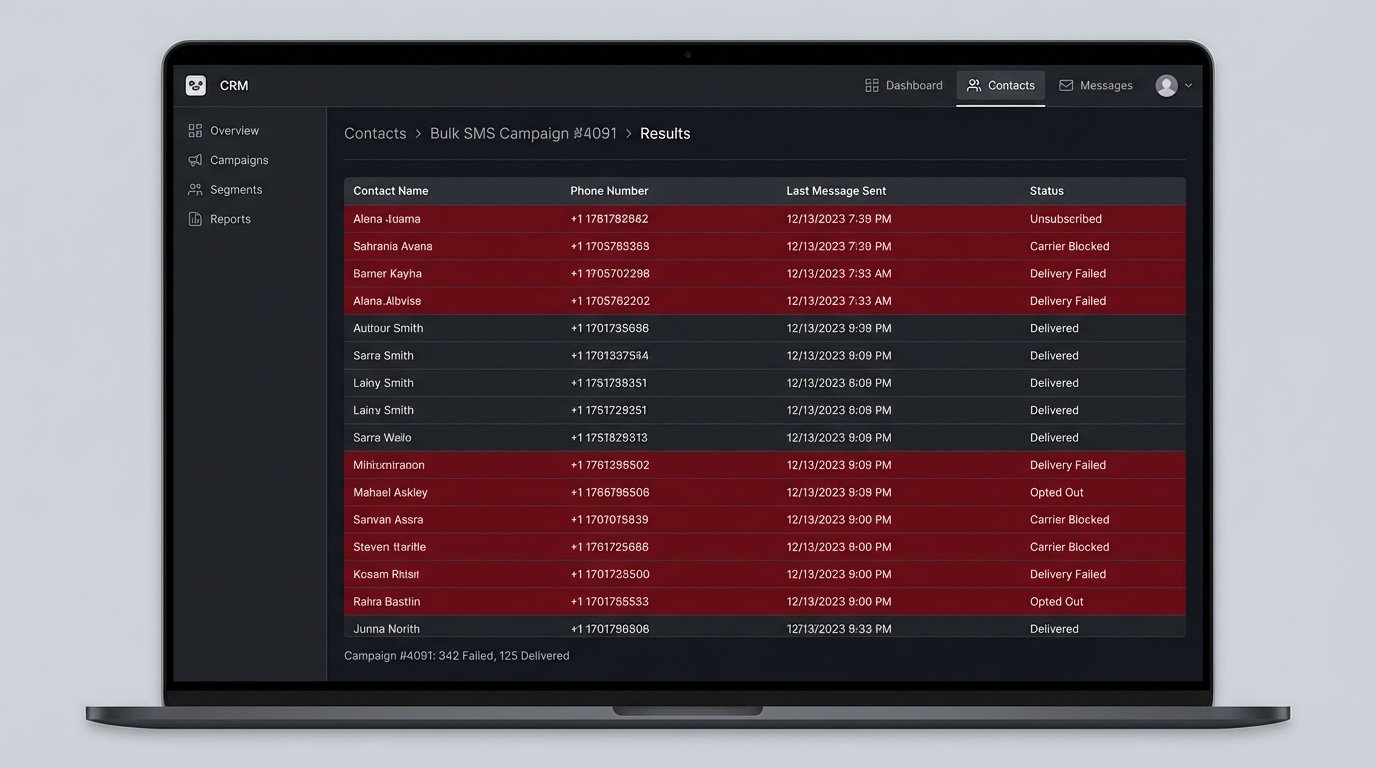
The technical debt from this approach piles up fast. Your SMS provider’s reputation tanks. Carriers like T-Mobile and AT&T use algorithmic filtering to block messages that look like spam. Your generic “New Listing Alert!” texts start getting flagged, and your delivery rates plummet. You’re now paying for messages that never even reach the destination. You’ve built a system that efficiently lights money on fire.
Compliance and Carrier Filtering Are Not Suggestions
The legal and technical barriers are real. A2P 10DLC registration is now table stakes for any legitimate business texting. Failure to properly register your brand and campaigns means your messages are either throttled into oblivion or blocked outright. This isn’t a bug. This is the new carrier ecosystem actively hunting for the kind of low-effort broadcasts that agencies think are clever.
Your automation logic must be smarter than the carrier filters. These filters analyze send frequency, URL shortener usage, message content, and opt-out rates. A system that sends identical messages to hundreds of recipients in a short burst is a massive red flag. You’re practically asking the carrier to shut you down. An intelligent system must introduce jitter, vary message templates, and respect sending windows.
Building a State-Aware SMS Architecture
The alternative is to stop thinking in broadcasts and start thinking in triggers. An SMS should be a reaction to a specific, meaningful event initiated by the client or a significant change in data they care about. The goal is not to send more messages. The goal is to send the correct message at the exact moment it provides value.
This requires an architecture that maintains state. Your system must know who it’s talking to, what’s been said, and what just happened. The conversation needs to be a logical progression, not a series of disconnected shouts into the void.
The Core Components of an Event-Driven System
A resilient system requires several distinct components that work in concert. Tightly coupling your CRM directly to an SMS API is fragile and shortsighted. We need to introduce layers of logic and buffering to handle the realities of unreliable networks and state management.
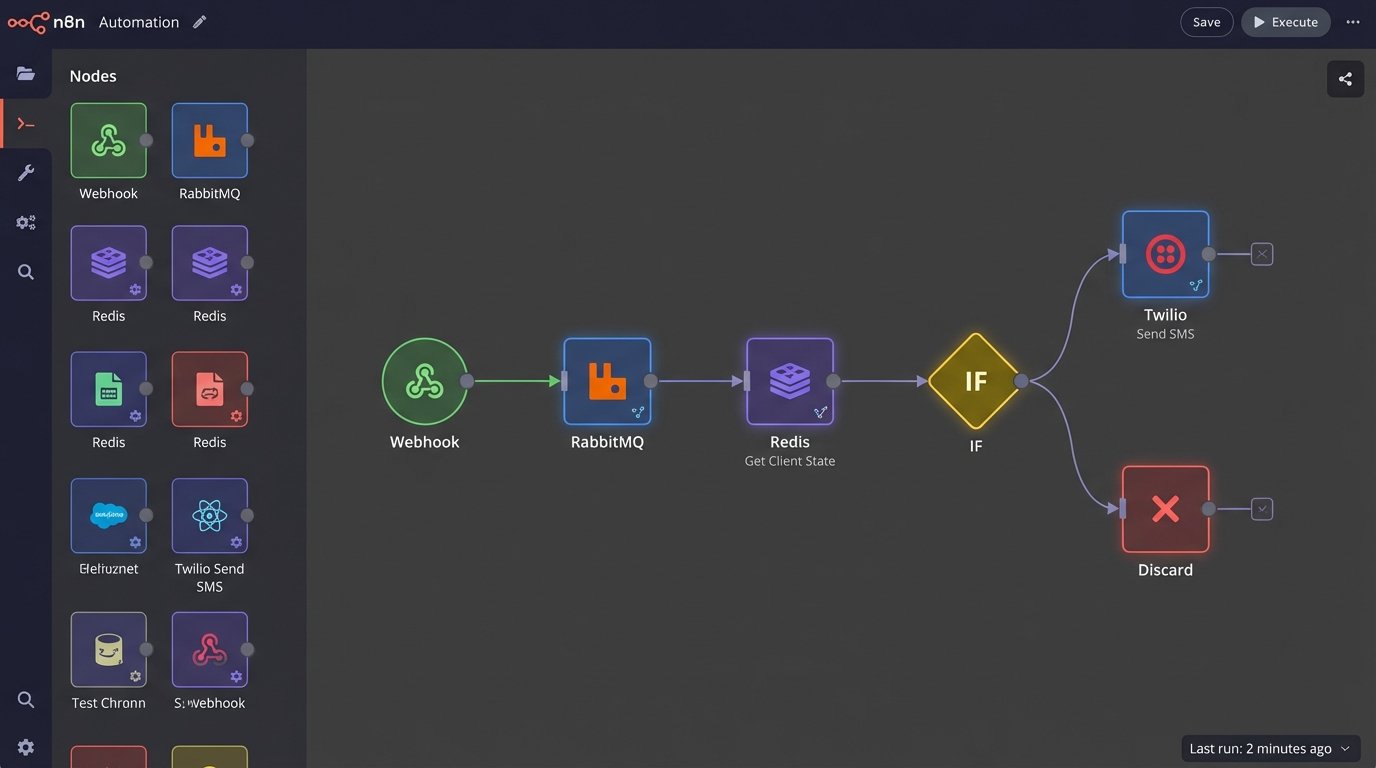
- Event Listeners: These are your digital tripwires. They could be webhooks from your website (e.g., a user favorites a property), a change data capture (CDC) process on your listings database, or even a scheduled job that polls an IDX feed for price drops on specific properties a client has shown interest in. The listener’s only job is to detect an event and capture the relevant payload.
- A Message Queue: Once an event is captured, it shouldn’t trigger an API call to Twilio directly. It should be pushed as a job onto a message queue like RabbitMQ or AWS SQS. This decouples the event source from the notification service. If your SMS provider’s API is down for 10 minutes, the events simply queue up. Once the API is back online, the queue is processed. No data is lost. This buffer is non-negotiable for a production system.
- A State Engine: This is the brain. Before a job is pulled from the queue and processed, it must be checked against a state store, typically a fast key-value database like Redis. The state engine answers critical questions. Have we texted this user in the last 24 hours? Have they already received this specific price drop notification? Did they reply “STOP” last week? If the answer to any of these checks is “do not send,” the job is discarded.
Only after an event has been captured, queued, and validated by the state engine should the system finally construct the message and make the API call to the SMS provider. This process adds milliseconds of latency but prevents catastrophic failures and maintains conversational context.
A Logic Check Before Firing
The code that processes the queue item is where the real intelligence lives. It’s not just a simple API call. It’s a function that synthesizes data from multiple sources to make a decision. It pulls the event data from the queue, fetches the client’s current state from Redis, and maybe even enriches it with data from the CRM before proceeding.
Here is a simplified Python representation of what that logic looks like. This isn’t about the specific Twilio syntax. It’s about the guard clauses you must put in place before you hit the send button.
import redis

import time
# Connect to a Redis instance to manage state
redis_client = redis.Redis(host='localhost', port=6379, db=0)
def should_send_sms(client_id, event_type):
"""
Logic-checks if a client should receive a text based on their state.
"""
# 1. Check for global opt-out
if redis_client.get(f"client:{client_id}:opt_out"):
print(f"Client {client_id} has opted out. Aborting.")
return False
# 2. Check for sending cooldown to prevent spamming
last_sent_timestamp = redis_client.get(f"client:{client_id}:last_sent")
if last_sent_timestamp:
if time.time() - float(last_sent_timestamp) < 86400: # 24-hour cooldown
print(f"Cooldown active for client {client_id}. Aborting.")
return False
# 3. Check for duplicate events
# Example: Don't send the same price drop alert twice
if event_type == "PRICE_DROP":
if redis_client.sismember(f"client:{client_id}:events_sent", event_type):
print(f"Duplicate event {event_type} for client {client_id}. Aborting.")
return False
return True
def process_sms_queue_job(job):
"""
Pulls a job from the queue and decides whether to send the SMS.
"""
client_id = job.get("client_id")
event = job.get("event")
event_type = event.get("type")
if should_send_sms(client_id, event_type):
# If all checks pass, then proceed to build and send the message
# message_body = f"Alert: Price drop for property {event['property_id']}..."
# send_actual_sms(client_id, message_body)
print(f"All checks passed. Sending {event_type} SMS to {client_id}.")
# Update state after sending
redis_client.set(f"client:{client_id}:last_sent", time.time())
redis_client.sadd(f"client:{client_id}:events_sent", event_type)
# If checks fail, the job is simply done. No SMS is sent.
This is a defensive posture. The system assumes it should *not* send a message, and it has to be proven otherwise. This is the complete inverse of the broadcast model, which assumes it should always send.
The Messy Reality of Data Synchronization
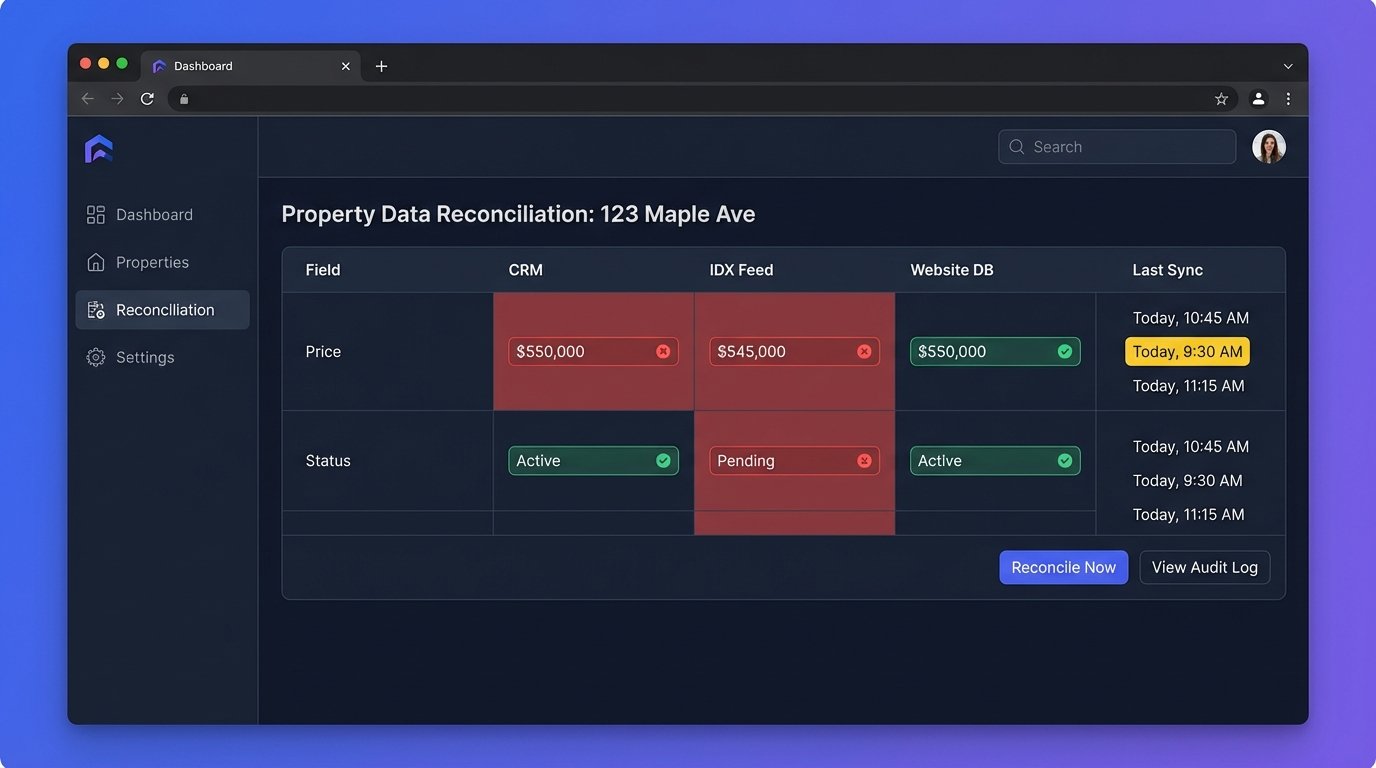
Building this architecture exposes the ugliest secret in real estate tech: data is a disaster. Your CRM, the MLS/IDX feed, and your website database are rarely in perfect sync. This automation system is only as good as the data that feeds it. A price drop event is useless if it's based on data that is 12 hours old and the property has already gone under contract.
Solving this requires a robust data pipeline to normalize and reconcile information from different sources before it can generate a trustworthy event. Trying to manage SMS state with a simple cron job that reads from a stale database is like trying to perform surgery with a sledgehammer. You'll make an impact, but you'll destroy the patient by sending inaccurate or late information, which erodes trust just as fast as spamming does.
The engineering effort to build this data reconciliation layer is significant. It's the unglamorous, backend-heavy work that no marketing department wants to pay for. But without it, your fancy event-driven notification system is just a faster way to deliver wrong information.
The Payoff Is Control, Not Volume
The argument for this architecture isn't that it will send thousands of brilliant texts. The argument is that it will stop your organization from sending thousands of stupid ones. It replaces a high-volume, low-impact broadcast cannon with a low-volume, high-impact surgical tool.
The metric for success changes. You stop measuring "messages sent" and start measuring "positive reply rate" or "agent-initiated conversations." The system becomes a tool that creates qualified, context-aware openings for your agents, rather than a firehose of noise they have to clean up after. Building it is harder. It requires actual engineering discipline. But it's the only approach that respects the client's attention and survives the technical realities of the modern SMS ecosystem.