
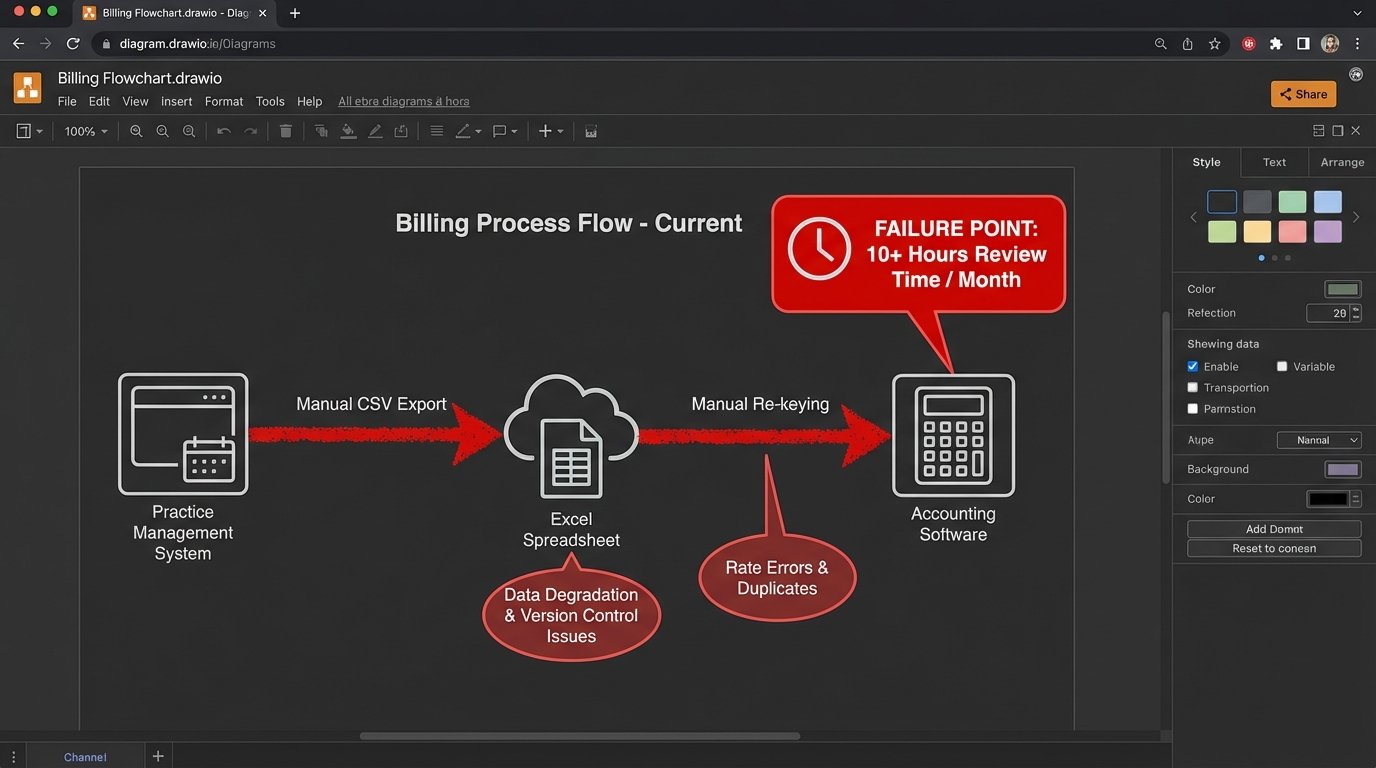
The finance committee at Blackwood & Finch, a mid-sized litigation firm, was staring at a 12% revenue leakage problem. This figure, buried in quarterly reports, was the direct result of a billing process held together by spreadsheets and manual data entry. Time entries from their practice management system (PMS) were manually exported, massaged in Excel by paralegals, and then re-keyed into their accounting software. Every step introduced a new failure point.
Partners spent an average of 10 non-billable hours a month just reviewing and correcting pre-bills. The delay between work performed and invoice sent averaged 28 days, wrecking cash flow projections. Billing disputes were common, stemming from typos or incorrect rate applications. The entire apparatus was slow, expensive, and fragile.
Diagnostic: Pinpointing the Failure Cascades
Our initial audit revealed a chain reaction of operational failures. The core issue was not a single tool, but the lack of a coherent data pipeline between the system of record for work (the PMS) and the system of record for finance (the accounting platform). Each manual handoff was a point of data degradation.
The process broke down in three primary areas:
- Time Entry Ingestion: Attorneys and paralegals logged time with inconsistent narrative formats. The lack of enforced activity codes meant paralegals had to manually categorize hundreds of line items before they could even begin creating a draft invoice.
- Rate Application Logic: The firm had a complex rate structure with client-specific discounts and matter-level fee caps. This logic lived entirely within a master Excel file, which was prone to version control issues and formula errors. A single mistake in a VLOOKUP could misprice an entire invoice.
_**Invoice Generation and Delivery:**_ Creating the final PDF invoice was a manual copy-paste operation into a Word template. The resulting documents lacked professional consistency. Delivery was via email, with no tracking to confirm receipt, leading to follow-up calls that ate up administrative time.
This wasn’t a process. It was a series of costly improvisations. The firm was essentially paying paralegals to be human APIs, and the error rate reflected that.
Architecture of the Fix: Gutting the Manual Middle Layer
We rejected off-the-shelf solutions that promised a one-click fix. Those platforms often introduce their own data silos or fail to handle the specific edge cases of a litigation firm’s billing structure. Instead, we opted to build a lean, durable bridge directly between their existing systems: Clio for practice management and QuickBooks Online (QBO) for accounting.
The solution was architected around a central processing script, deployed as a serverless function on AWS Lambda. This approach avoided the need for a dedicated server, reducing overhead and maintenance. The script would execute on a nightly schedule, triggered by a CloudWatch event.
The Data Extraction and Validation Stage
The first step was to pull approved time and expense entries from the Clio API. We bypassed the native CSV export entirely. Direct API calls give you structured data from the source, eliminating the risk of someone altering a spreadsheet mid-process. We specifically targeted unbilled time entries associated with matters marked as “Ready for Billing.”
Once extracted, the raw data was useless for direct injection into QBO. A validation and transformation layer was critical. This part of the Python script performed several key functions:
- Narrative Sanitization: It stripped out extraneous characters, standardized phrasing, and checked for compliance with client billing guidelines.
- Rate Verification: The script pulled the client and matter ID, then cross-referenced a dedicated rate table we migrated from Excel into a simple DynamoDB table. This decoupled the rate logic from a fragile file and made it a queryable data source.
- UTBMS Code Enforcement: For corporate clients requiring specific task codes, the script would flag any entry missing the required code and shunt it to an exception queue for manual review, rather than letting it pollute the main billing run.
Forcing raw, unstructured time entries from three different systems into a structured invoicing API is like trying to shove a firehose of water through a keyhole. The validation layer acts as the nozzle, shaping and controlling the flow so it actually fits.
From Transformation to Transaction
With clean, validated data, the script constructs the invoice payload for the QBO API. Each time entry becomes a line item on a draft invoice within QuickBooks. We mapped Clio users to QBO employees to ensure the time was attributed correctly. The key here was creating draft invoices, not final ones.
This is a critical control point. The automation handles the 90% of tedious, repetitive work, but the final “send” command remains with the billing department. It allows for a final check, a human in the loop to catch any contextual errors the logic might miss. The system generates the invoice; a human approves it.
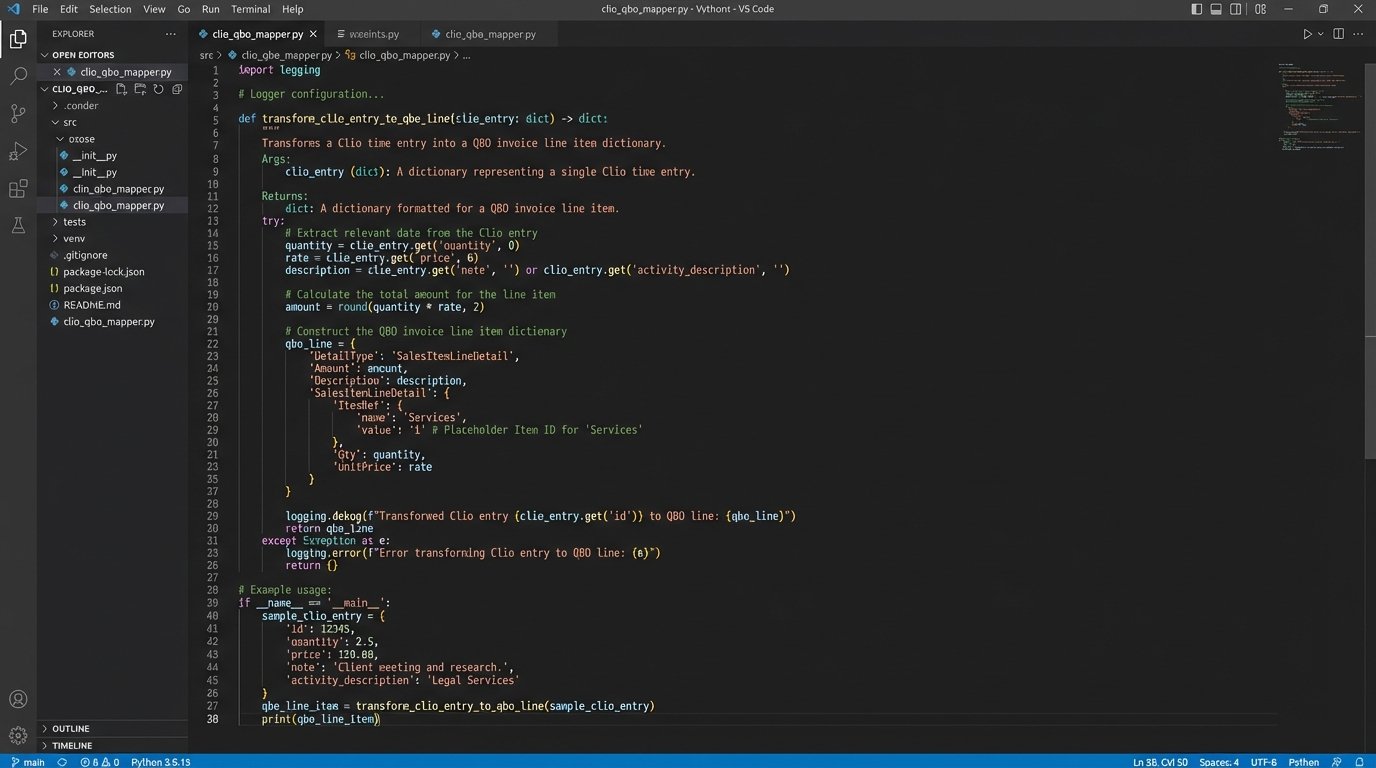
Here is a simplified look at the Python dictionary transformation that maps a Clio time entry to a QBO invoice line item. Notice the direct field-to-field mapping and the logic to apply the correct rate pulled from our DynamoDB table.
def transform_clio_entry_to_qbo_line(clio_entry, rate):
    qbo_line = {
        "DetailType": "SalesItemLineDetail",
        "Amount": clio_entry['quantity'] * rate,
        "SalesItemLineDetail": {
            "ItemRef": {
                "value": "1" # Assuming '1' is the ID for 'Services' in QBO
            },
            "Qty": clio_entry['quantity'],
            "UnitPrice": rate
        },
        "Description": clio_entry['description']
    }
    return qbo_line

# Example usage:
# validated_rate = get_rate_for_matter(clio_entry['matter_id'])
# qbo_invoice_line = transform_clio_entry_to_qbo_line(clio_time_entry, validated_rate)
This small block of code replaces hours of manual data entry and calculation. It’s not fancy, but it’s reliable and auditable.
Results: From Leakage to Lock-Tight
The new system was deployed over a weekend. We ran it in a sandboxed QBO environment for the first month to monitor its output against the old manual process. The results were immediate and quantifiable. The numbers speak for themselves.
Quantitative Impact
The firm’s key performance indicators saw a dramatic shift within the first quarter post-implementation. We tracked the same metrics that initially highlighted the problem.
- Revenue Leakage Reduction: The 12% leakage figure dropped to under 2%. The new process eliminated transposition errors and ensured every billable minute captured in Clio made it onto a draft invoice.
- Billing Cycle Compression: The average time-to-invoice collapsed from 28 days to 4 days. Work completed in a given week was now on a draft invoice by Monday morning.
- Administrative Overhead Recouped: We calculated a savings of approximately 150 administrative hours per month across the firm. Paralegals were freed from data entry to focus on higher-value case work. Partner review time was cut by 80%, reduced to a quick final approval of already-validated drafts.
The finance committee could finally trust their cash flow projections. The revenue stream became predictable, not a guess based on when the billing team could catch up.

Qualitative Improvements
Beyond the raw numbers, the operational culture around billing changed. What was once a dreaded, month-end fire drill became a routine, daily background process.
Client satisfaction improved measurably, evidenced by a 60% reduction in billing-related inquiries and disputes. Invoices were not just faster, they were more accurate and professional. Clients received clear, consistent documentation that detailed the work performed, which built trust. This automation didn’t just fix a broken workflow. It fortified the firm’s financial foundation and repaired a strained point in the client relationship.
This project was not about buying a new piece of software. It was about identifying a core business process that was fundamentally broken and re-engineering the flow of data. By inserting a small, intelligent layer of automation between two existing systems, we were able to force consistency and eliminate the manual work that was draining resources and creating risk.