
Most automation case studies start with a triumphant declaration of success. This is not one of them. This is a field report from a multi-year effort to drag a 500-attorney firm’s operations out of the digital stone age. The initial state was a patchwork of disconnected systems held together by paralegals copying and pasting data until their eyes glazed over. It was inefficient, expensive, and a data integrity time bomb.
The core problem wasn’t a single bad piece of software. It was a culture of siloed data ownership. The litigation department lived in a legacy case management system (CMS) that hadn’t seen a meaningful update since 2012. The corporate department ran on a different, slightly more modern platform. Accounting had its own billing fortress, and document management was a sprawling, untagged SharePoint disaster. Nothing talked to anything else without a human acting as a very slow, error-prone API.
The Initial Mess: A Look Under the Hood
Our first diagnostic phase involved mapping the lifecycle of a new matter. The client intake process was the poster child for operational drag. A potential client fills out a web form. The marketing team gets an email. They manually key that data into a spreadsheet for conflict checks. Once cleared, a paralegal re-keys the exact same data into the practice group’s specific CMS. Then, another person in accounting keys it into the billing system. We timed it. The median time from web form submission to a matter being billable was 48 hours, involving five different people touching the same five pieces of data.
This introduced a massive error rate. Mismatched client names, incorrect billing codes, and duplicate matter IDs were common. Generating a firm-wide financial report required a week of manual data consolidation and cleaning by a senior analyst. The partners wanted real-time analytics, but the underlying data structure was quicksand. They were asking for a spaceship while we were still trying to invent the wheel.
The resistance to change was palpable. It wasn’t overt sabotage, just a deep-seated institutional inertia. Attorneys are trained to be risk-averse, and new technology is perceived as a risk. They had their workarounds, their personal spreadsheets, and their trusted assistants who knew the broken processes by heart. Proposing a centralized automation platform was met with the kind of skepticism usually reserved for a surprise audit.
Our initial pitch for a multi-million dollar enterprise integration platform was dead on arrival. The managing partners saw a massive price tag and a vague promise of “efficiency.” They heard “wallet-drainer” and showed us the door. We had to pivot from a “big bang” replacement strategy to a series of targeted, high-impact surgical strikes on the worst process bottlenecks.
The Architecture of the Fix
We abandoned the idea of replacing the core systems. The firm had too much invested, and the data migration alone would have been a nightmare. Instead, we decided to build a lightweight integration layer. This layer would act as a central nervous system, listening for events in one system and triggering actions in another. We chose to build this using a combination of a low-code automation platform for simple workflows and custom Python scripts hosted on a small internal server for the complex logic.
This approach was cheaper and faster. We could deliver value in weeks, not years. More importantly, it was less threatening to the established order. We weren’t ripping out their familiar tools. We were just making them work together.
Gutting the Intake Process First
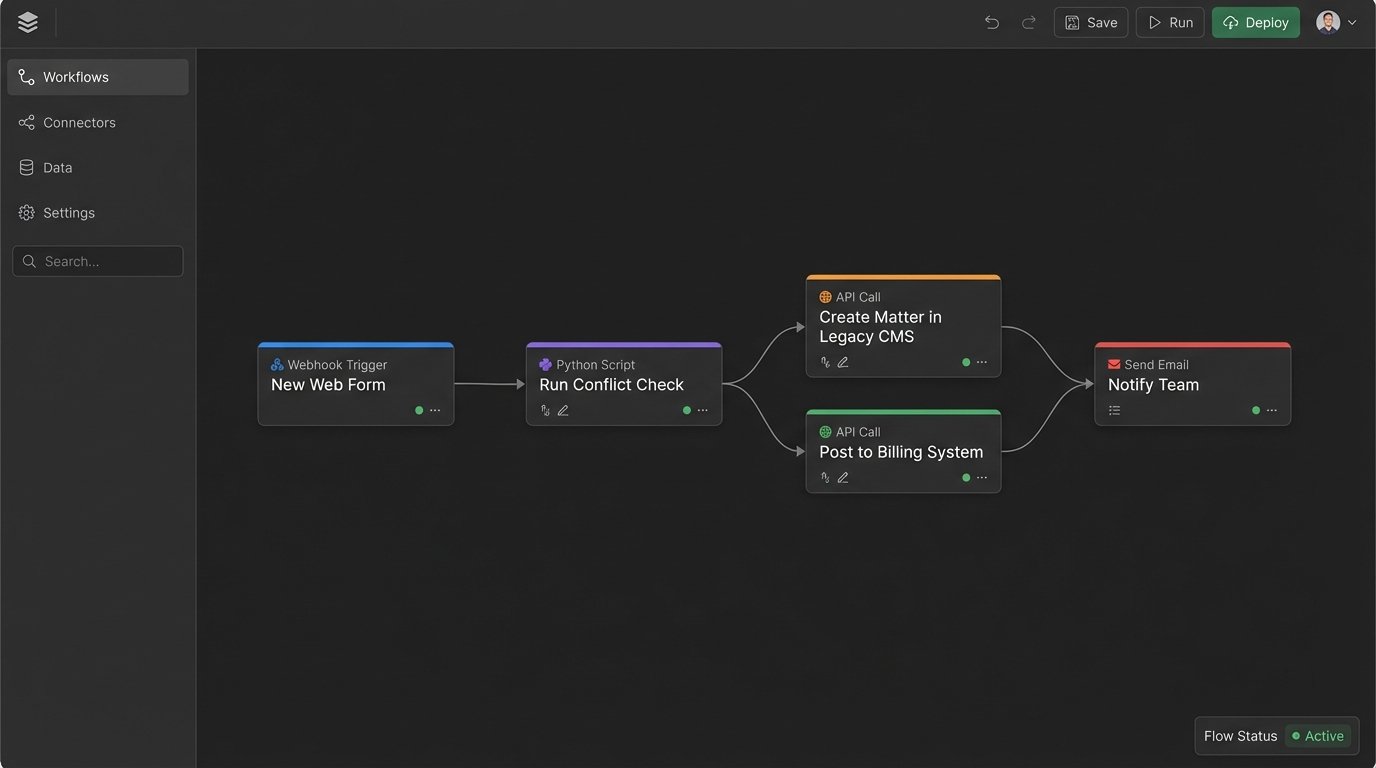
Our first target was the 48-hour client intake disaster. The goal was to make the journey from web form to billable matter number happen in under 5 minutes, with zero manual data entry. We built a workflow that started with a webhook from the firm’s website form. This webhook carried a JSON payload with the prospective client’s information.
The data was first routed to a Python script that performed the conflict check by querying an indexed database we had built by scraping the existing CMS platforms. This was the most technically challenging part. Connecting to the legacy CMS API to pull the client list was like performing keyhole surgery with a wrench. The documentation was a decade old, and the SOAP endpoints were sluggish and unforgiving. We had to build in multiple retry mechanisms and aggressive error logging just to get a stable connection.
Once the conflict check passed, the script would then push the data to the correct CMS and the central billing system via their respective APIs. It generated a new matter ID, assigned it, and then sent a confirmation email to the originating attorney and their paralegal. The entire process was automated. We bypassed four separate manual steps.
Here is a simplified look at the JSON payload we structured for the internal API calls. Standardizing this data structure was the key to making the different systems interoperable.
{
"client_info": {
"full_name": "Example Corp Inc.",
"contact_person": "Jane Doe",
"contact_email": "jane.doe@examplecorp.com",
"address": "123 Legal Lane"
},
"matter_info": {
"matter_name": "Q4 Acquisition Strategy",
"practice_group_id": "CORP-01",
"originating_attorney_id": "JDoe_112",
"billing_type": "hourly"
},
"conflict_check": {
"status": "cleared",
"checked_by": "automation_script_v2",
"timestamp": "2023-10-27T10:00:00Z"
}
}
This structure forced data integrity from the very beginning. If a field was missing or formatted incorrectly, the API call would fail, and an alert would be sent to the Legal Ops team. No more garbage data getting into the system.
Bridging Document Management and Case Management
The next bottleneck was document management. Attorneys were saving crucial documents to their local drives or in a chaotic mess of SharePoint folders. There was no link between a document and its corresponding matter in the CMS. Finding a specific contract or pleading was a manual search operation.
We built a small add-in for Microsoft Word. When an attorney finished a document, a button in the ribbon prompted them for the matter ID. Upon entry, the add-in would use the CMS API to pull the client name and matter name to generate a standardized file name. It then automatically saved the document to a pre-configured SharePoint folder structure that mirrored the CMS hierarchy (Client > Matter > Documents). A link to the document was then injected back into the matter record in the CMS.
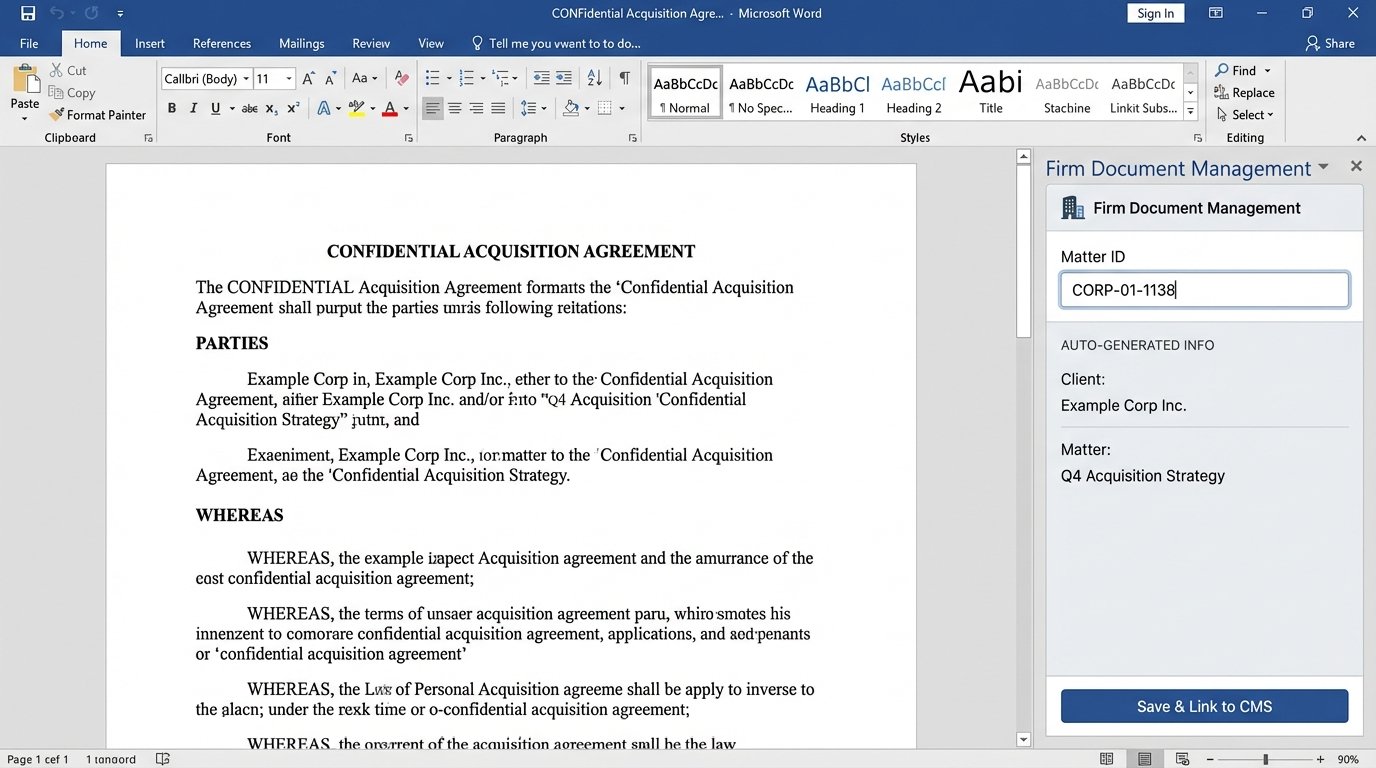
This didn’t require attorneys to learn a new system. It met them where they already worked, inside Word. We simply gave them a button that was easier than their old, broken process of manually naming and saving files. Adoption was swift because the value was immediate and personal. It saved them time and eliminated the anxiety of not being able to find a critical file later.
Forcing Adoption Through Better Reporting
The final piece of the puzzle was winning over the partners. They were still attached to their manually compiled spreadsheets. We knew that telling them to stop was useless. We had to show them something better.
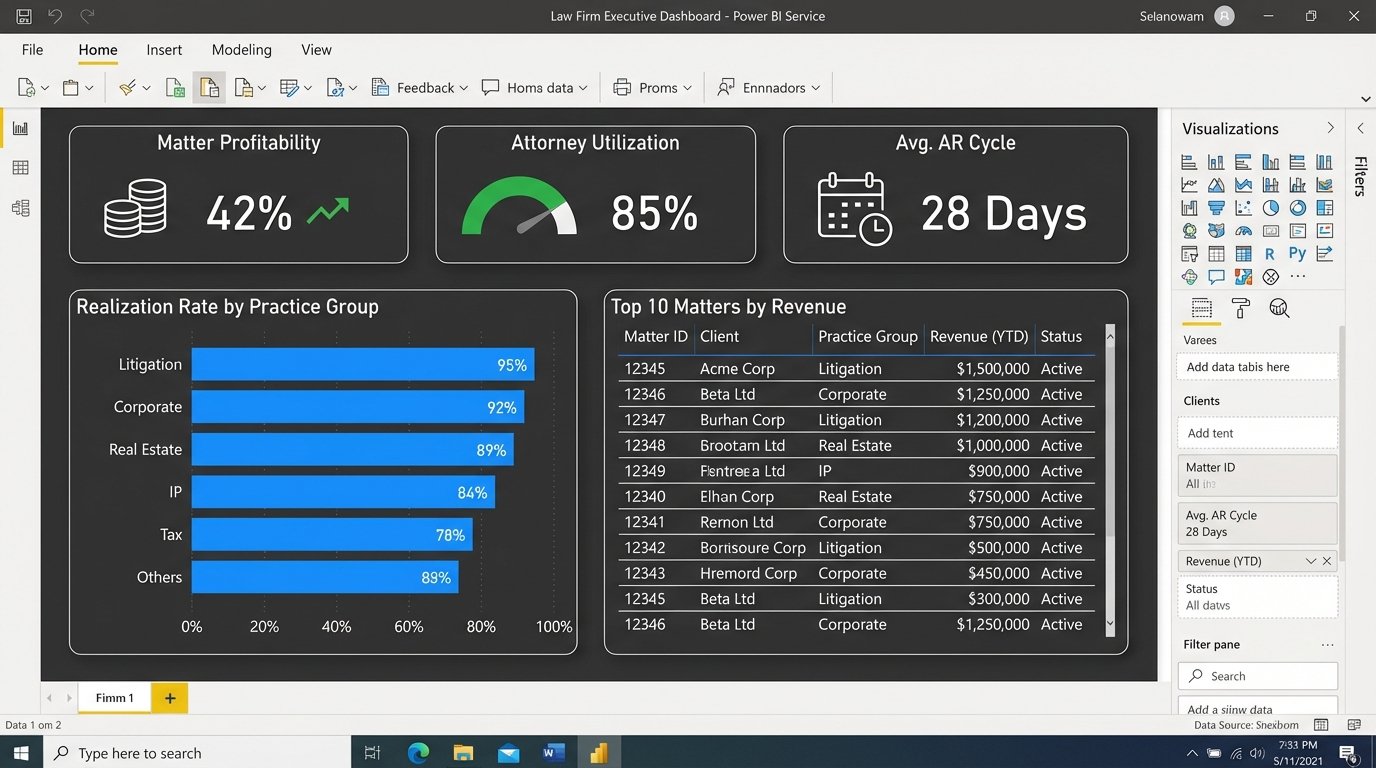
With data flowing cleanly through our new integration layer, we could finally trust the information in our core systems. We piped the data from the CMS and billing systems into a centralized data warehouse. From there, we used Power BI to build a series of dashboards for the firm’s leadership. These weren’t just vanity metrics. They were actionable insights.
We built dashboards showing attorney utilization rates, matter profitability, and realization rates, all updated in near real-time. A partner could now see, on one screen, exactly how their practice group was performing. They could drill down into specific matters or clients. The data was accurate, immediate, and required zero effort on their part. The spreadsheets vanished within three months.
Measuring the Impact: KPIs and Hard Numbers
We tracked several key performance indicators to prove the project’s worth. The results were not subtle. Before the automation, the average time to open a new matter was 48 hours. After, it was under 5 minutes. This alone saved an estimated 4,000 paralegal hours annually across the firm.
The data error rate on new matters dropped from a tracked 7% to less than 0.1%. This had a direct impact on the billing cycle. With accurate data from the start, invoices were generated faster and with fewer rejections or client disputes. The firm’s average accounts receivable cycle shortened by 12 days, a significant cash flow improvement.
The ROI was straightforward. The total cost for the low-code platform licenses and the internal development time for the custom scripts was approximately $150,000 in the first year. The calculated savings from recovered administrative hours and the financial impact of the shortened billing cycle exceeded $500,000 in that same year. The project paid for itself in less than four months.
What We Learned in the Trenches
This transformation was not a clean, linear process. It was a series of messy, iterative fixes. The biggest lesson was that a “good enough” solution that ships today is infinitely better than a “perfect” enterprise platform that might launch in two years. Speed and momentum are critical for getting buy-in from skeptical stakeholders.
Never trust the documentation for legacy APIs. Treat every endpoint as hostile until proven otherwise through rigorous testing. Build your own wrappers and error-handling layers around these old systems. Assume they will fail, and plan for it.
Focus on the human element. Don’t just build technically elegant solutions. Build tools that are demonstrably less painful to use than the old way of doing things. If you can save an attorney 10 minutes every day, they will become your biggest advocate. The automation is not the goal. The goal is to make the right way the easiest way.
The system is far from perfect. It has dependencies that can break, and there are still pockets of the firm that cling to old habits. But the core operations are now built on a foundation of clean, connected data. It breaks in predictable ways that we can monitor and fix. In the chaotic world of legal operations, that is a victory.