
The core problem with manual invoicing isn’t the hours your billing department burns clicking through a practice management system. The real issue is revenue leakage. Every vague time entry, every uncaptured expense, and every delayed invoice is a direct hit to the firm’s cash flow. Automation isn’t about convenience. It’s a structural fix for a broken financial process that consistently leaves money on the table.
Most firms patch this problem with more staff, creating a human validation layer that introduces its own set of errors and bottlenecks. This approach fails to address the root cause: inconsistent and unstructured data capture at the point of entry. Trying to force unstructured billing narratives from ten different timekeepers into a rigid invoicing system is like trying to push gravel through a coffee filter. The valuable stuff gets stuck, and what comes out is a mess.
Gutting the Data Capture Process
Everything starts with time and expense entries. The “garbage in, garbage out” principle is absolute here. You cannot build a stable automation pipeline on top of a foundation of manually typed, non-standardized time entries. The initial engineering effort must focus on forcing structure at the source, not attempting to clean up the mess downstream.
We start by bridging the systems attorneys already use. This means direct API integrations with their calendars, email clients, and document management systems. The goal is to present the timekeeper with pre-populated activity drafts. An entry should be automatically generated when a calendar event labeled “Deposition: Smith v. Jones” concludes. The attorney’s only job is to confirm the duration and add a narrative if necessary, not to create the entry from scratch.
Enforcing Data Integrity at the Source
Passive time capture tools are a good start, but they still require a validation layer. This is where you inject business logic directly into the time entry interface. Before an entry is even submitted to the pre-billing system, it must pass a series of client-specific checks. For example, if a client’s outside counsel guidelines (OCGs) forbid block billing, the system should reject any time entry that contains more than one distinct activity.
These checks are not suggestions. They are hard gates. A timekeeper attempting to submit a non-compliant entry receives an immediate, specific error message explaining the rule they violated. This forces compliance at the point of creation, eliminating the back-and-forth between the billing department and the attorney days or weeks later. It also shifts the burden of OCG compliance from the billing specialist to the timekeeper, who has the actual context of the work performed.
Building a Configurable Rules Engine
Once you have a stream of clean, structured data, the next component is a rules engine to process it. This is the core of the billing automation system. It’s a set of programmable logic that applies discounts, validates UTBMS codes, checks for rate caps, and enforces any number of client-specific billing requirements. This cannot be a black-box feature within your practice management software. You need direct control over the logic.
A properly architected rules engine is built on a foundation of configurable objects, not hard-coded scripts. Each client’s OCGs are translated into a JSON or XML configuration file. This allows a legal operations analyst, not a developer, to update billing rules when a client sends a revised set of guidelines. The engine simply ingests the new configuration file on its next run.
Here is a simplified JSON object defining two rules for a specific client. One flags block billing for manual review, and the other automatically adjusts partner rates that exceed a negotiated cap. This configuration-driven approach separates the logic from the code, making the system adaptable without constant developer intervention.
{

  "clientId": "ACME-CORP-1138",

  "billingRules": [

    {

      "ruleId": "NO_BLOCK_BILLING",

      "action": "FLAG_FOR_REVIEW",

      "params": {

        "maxActivitiesPerEntry": 1,

        "rejectionMessage": "Entry rejected. Client ACME Corp does not permit block billing."

      }

    },

    {

      "ruleId": "PARTNER_RATE_CAP",

      "action": "ADJUST_RATE",

      "params": {

        "maxRate": 950.00,

        "timekeeperLevel": "Partner",

        "adjustmentMemo": "Rate adjusted from [originalRate] to 950.00 to comply with client rate agreement."

      }

    }

  ]

}
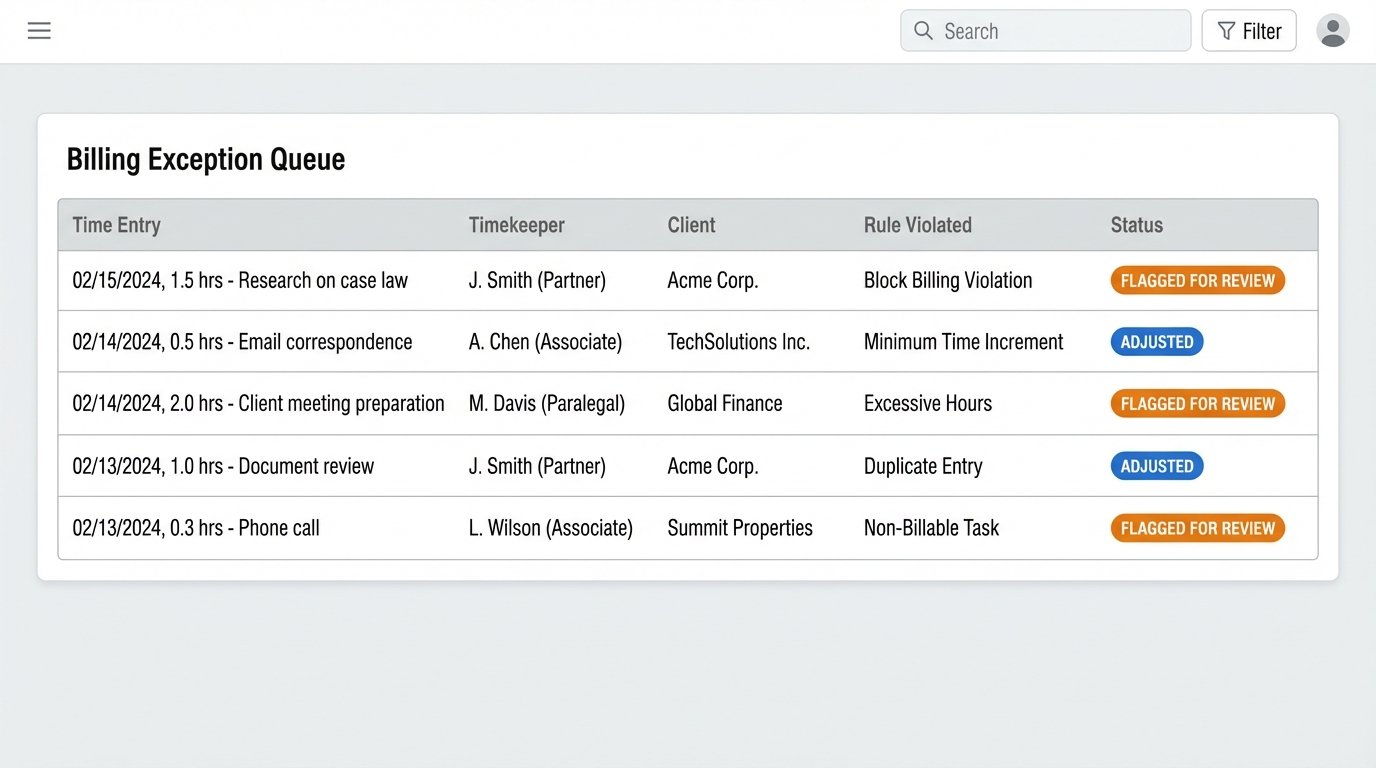
This engine runs against all approved time and expense entries for a given billing cycle. It processes each line item, applies the relevant rules, and generates a clean, pre-billed dataset. Entries that pass all automated checks are ready for invoice generation. Entries that are flagged or adjusted are routed to an exception queue for human review.
Automating Invoice Generation and Delivery
The output of the rules engine is a validated dataset, primed for invoice creation. The generation step should use a templating engine like Handlebars or Liquid, which can dynamically construct invoice PDFs based on client-specific branding and layout requirements. This avoids the brittle process of using fixed templates that break when a client requests a minor format change.
Each template is mapped to a client or matter. The system queries the pre-billed data, injects it into the appropriate template, and renders the final invoice. This process should be fully automated and triggered by the successful completion of the rules engine run. The result is a batch of draft invoices, ready for final review by a partner or billing manager.
Bypassing Manual E-Billing Submissions
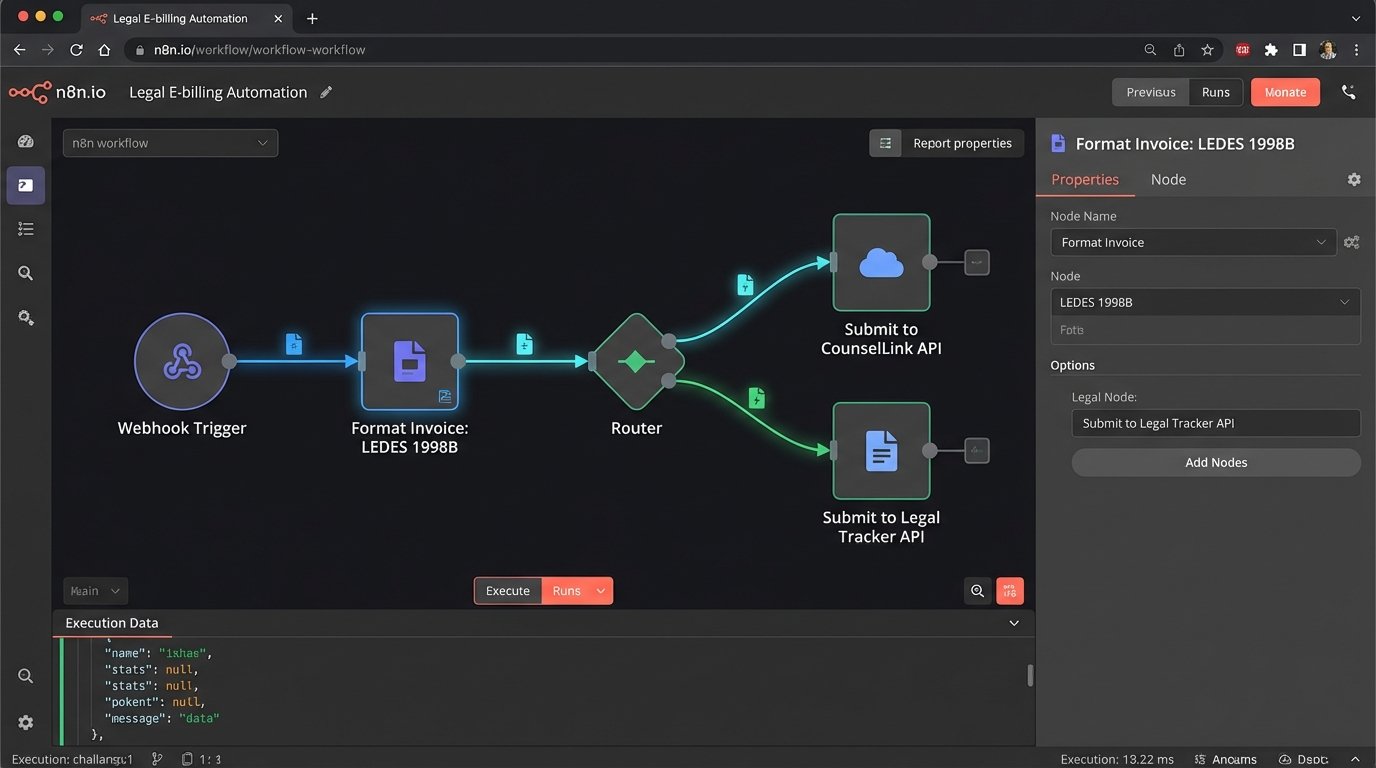
The single biggest bottleneck in the final stage of invoicing is submitting invoices to third-party e-billing portals. Each portal has its own unique interface, login credentials, and file format requirements. This is a wallet-drainer of a task perfectly suited for automation. We bypass this manual drudgery by building direct API integrations with the major e-billing vendors like Legal Tracker, CounselLink, and C-Track.
For each invoice, the system identifies the required e-billing platform and formats the invoice data into the correct LEDES 1998B or XML format. It then uses the platform’s API to submit the invoice directly, without human intervention. The submission status, including any rejections or requests for more information, is pulled back via the API and displayed on an internal dashboard. This closes the loop and turns a multi-day manual process into a background task that runs in minutes.
Exception Handling and Audit Trails
No automation system is flawless. An API endpoint will go down. A client will provide contradictory billing rules. The key to a resilient system is not preventing all errors but gracefully managing them when they occur. Every step of the billing process, from time entry to e-billing submission, must be logged immutably.
When the rules engine flags an entry or the e-billing submission fails, the system must not simply halt. It should create a ticket in an exception queue. This queue is a worklist for the billing department, presented on a dashboard that shows the invoice, the specific error, and a link to the relevant logs. The specialist can then correct the underlying data or manually override the rule, with their action also being logged for audit purposes.
An audit trail is non-negotiable. You must be able to reconstruct the entire lifecycle of any line item on any invoice. This includes the original time entry, every rule that was applied to it, any adjustments made, the user who approved it, and the exact time it was submitted to the client. When a client disputes a charge six months later, you need to be able to produce this record in seconds.
The Financial Argument for Engineering Investment
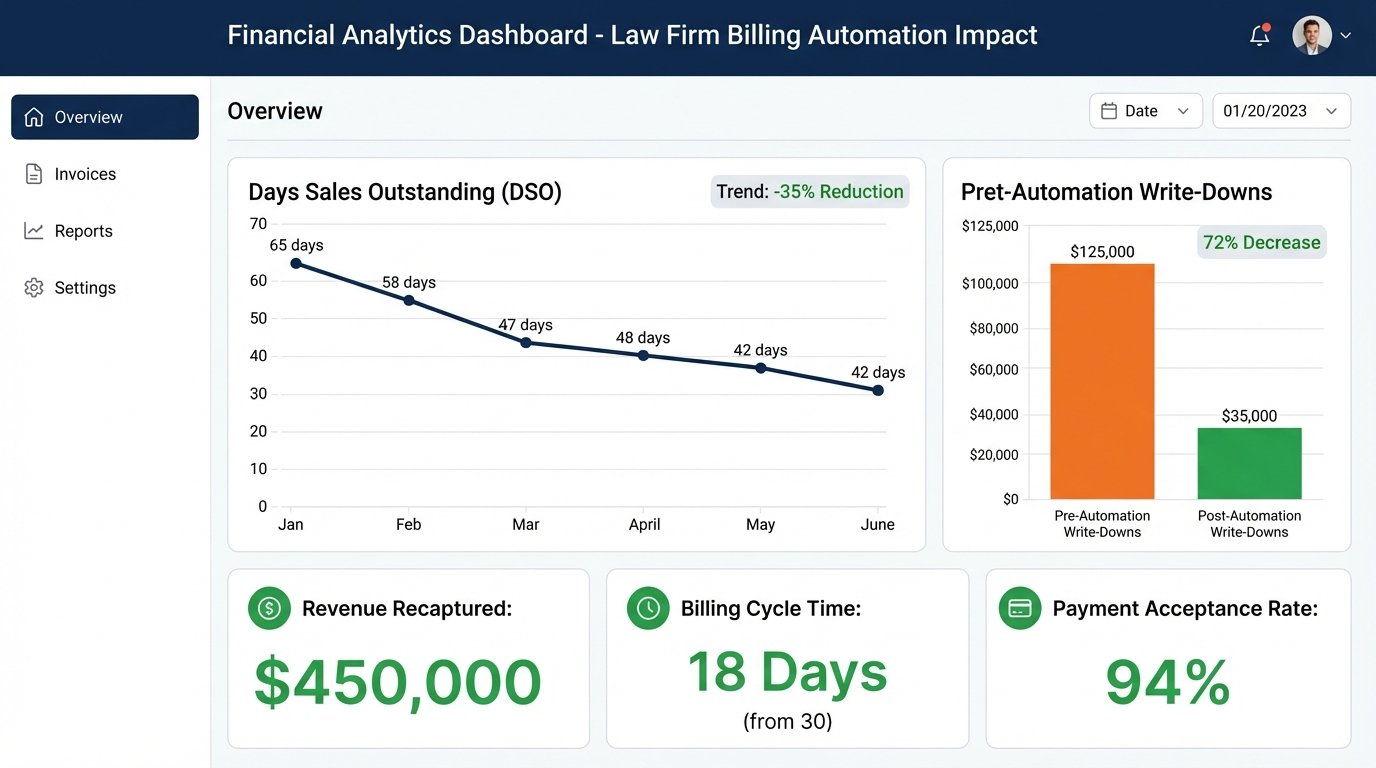
The pushback is always the cost. Building this infrastructure requires developer resources and a significant initial investment. The counterargument is simple math. Calculate the firm’s average Days Sales Outstanding (DSO). Calculate the annual revenue lost to write-downs from non-compliant billing entries. The cost of building a robust automation platform is almost always dwarfed by the value of plugging these chronic revenue leaks and accelerating cash collection.
Reducing DSO by even 10 days can have a massive impact on the firm’s operating cash flow. Eliminating just half of the billing-related write-downs drops money directly to the bottom line. This isn’t an IT expense. It’s a financial strategy executed through code. A firm that continues to rely on manual billing processes is signaling that it’s comfortable with operational inefficiency and predictable revenue loss.
The transition requires a shift in mindset. The billing department is not just an administrative function. It is the final stage of the firm’s revenue-generating engine. Investing in the automation of that engine isn’t an optional upgrade. It is a mandatory requirement for any law firm that intends to operate as a serious, data-driven business.