Most client communication is a fire-fighting exercise. An agitated client calls or emails, a paralegal scrambles to find the case file, and a reactive, often incomplete, update is given. This manual, interrupt-driven process is not a client service model. It is a system bottleneck that creates operational drag and degrades client trust with every missed call.
Firms cling to the idea of a “personal touch,” believing a sporadic, unscheduled phone call from an attorney is the gold standard. This is a fallacy. Inconsistent, high-effort communication is inferior to predictable, automated information delivery. A client left in the dark for three weeks does not care how “personal” the eventual apology call is. They care that they were ignored.
The objective is not to replace attorneys with bots. The objective is to engineer a communication pipeline that offloads the repetitive, low-value status updates. This frees up human capital for high-value, strategic conversations. We are moving the task from a human’s to-do list to a server’s cron job.
Deconstructing the Manual Process Failure
The core failure of manual communication is its dependency on human memory and availability, two notoriously unreliable resources in a busy law practice. An attorney intends to call a client back but gets pulled into an emergency hearing. A paralegal promises an email update but gets buried in discovery requests. The result is a broken promise.
These are not individual failings. They are symptoms of a failed system architecture.
Automated systems operate on triggers, not intentions. When a case status is updated in the practice management system from “Discovery” to “Mediation Scheduled,” a webhook fires. This is not a suggestion. It is a deterministic event that initiates a pre-defined workflow. The system does not forget or get distracted. It executes.
This process also forces data hygiene. Manual updates often rely on memory or hastily written notes, leading to incorrect information being relayed. An automated system pulls data directly from the single source of truth, your case management platform. It injects the specific case number, the correct date for the next hearing, and the proper name of the assigned paralegal. Data integrity is enforced by the machine.
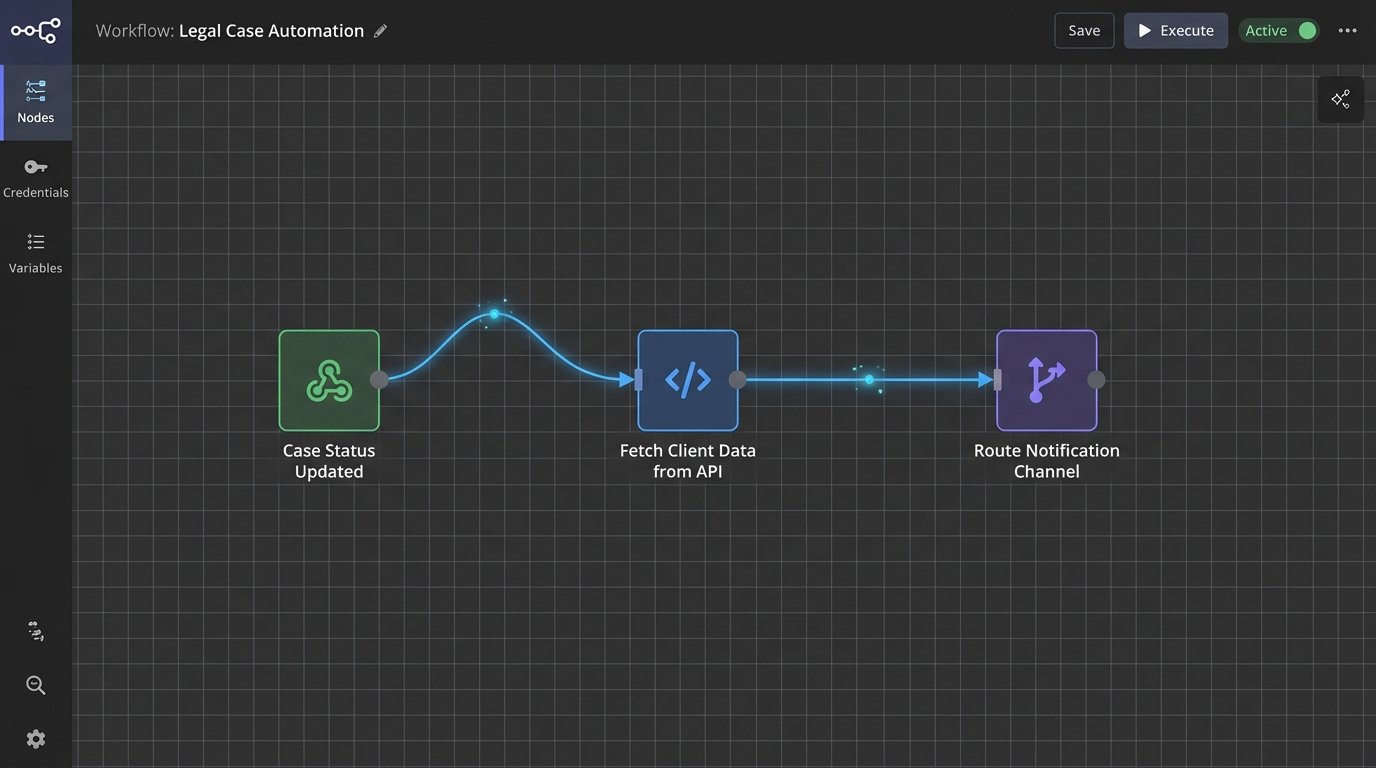
Architecting a Trigger-Based Communication Flow
Building an effective automation is not about buying an off-the-shelf tool and hoping for the best. It requires mapping the client journey and identifying key event triggers within your existing systems. These triggers are the nerve endings of your automated communication engine.
Common triggers include:
- Case Status Change: A new document is filed, a court date is set, or a settlement offer is received.
- Document Upload: A client uploads a requested medical record or financial statement to the portal.
- Date-Based Events: An upcoming deadline, a court appearance reminder, or a statute of limitations warning.
- Client Inaction: A form sent two weeks ago remains unsigned, triggering a reminder sequence.
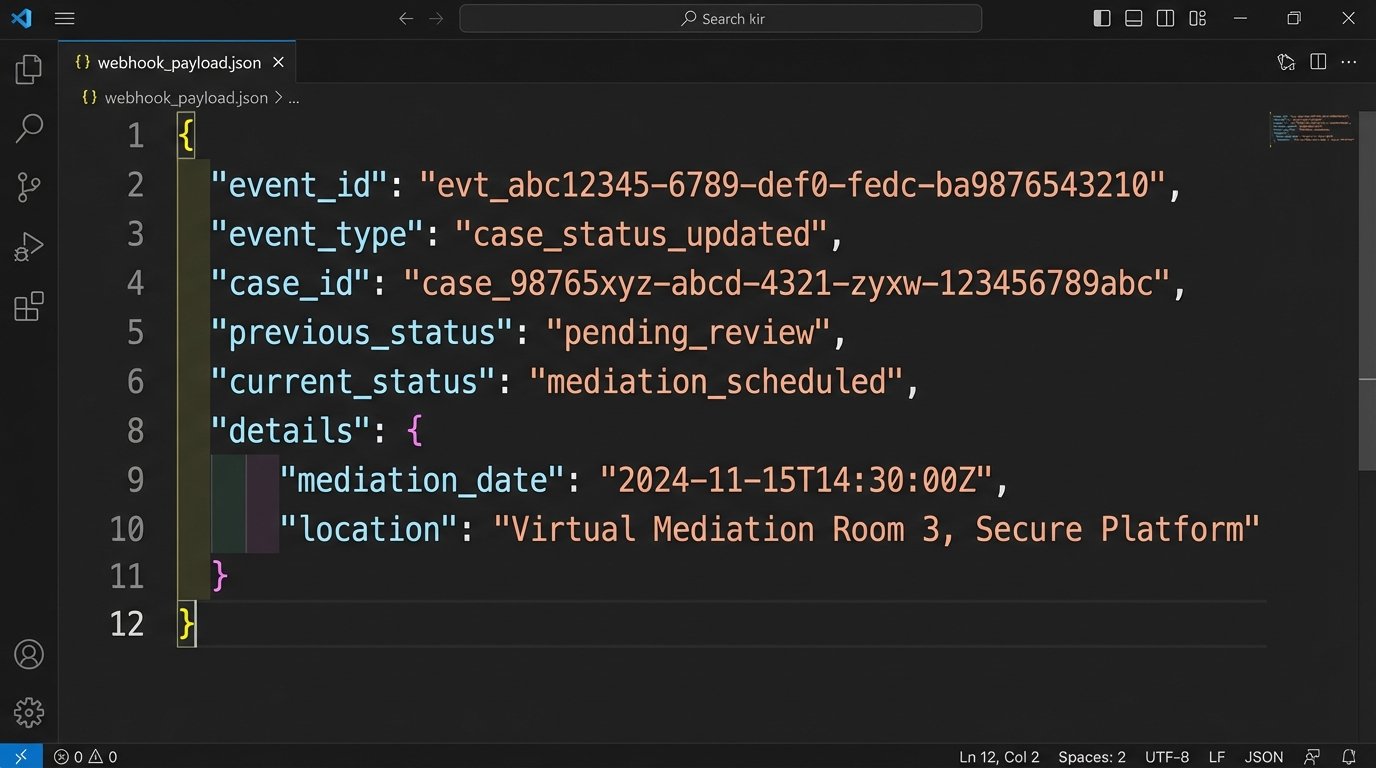
Once a trigger fires, it sends a payload of data, typically in JSON format, to an endpoint. This payload contains the context needed to build a useful message. It is the raw material. The next step is to run this data through a logic engine.
Conditional Logic: The System’s Brain
A blind, one-size-fits-all notification is just sophisticated spam. Effective automation requires conditional logic to route and customize messages. This is where you inject the nuance that mimics, and often improves upon, human decision-making.
For example, a “Document Received” trigger should not always send the same message. The logic should first check the document type. `IF document_type = ‘Signed Retainer’ THEN send ‘Welcome’ sequence. ELSE IF document_type = ‘Medical Records’ THEN send ‘Confirmation of Receipt and Review’ message.` This prevents a new client from getting a sterile, irrelevant confirmation message.
This same logic applies to the delivery channel. An urgent request for a signature on a time-sensitive offer should be dispatched via SMS for immediacy. A detailed monthly case summary is better suited for email, where formatting and attachments are supported. A notification that new discovery documents are available for review should direct the client to the secure portal. The system, not a human, should make these routing decisions based on predefined rules.
This isn’t about building a sentient AI. It is about shoving raw data through a series of logical gates. It is brute-force efficiency.
The API: Your Greatest Asset and Biggest Liability
The entire automation architecture hinges on the quality and reliability of your practice management system’s API. This is the bridge between your data and your logic engine. Unfortunately, many legal tech APIs are sluggish, poorly documented, and have restrictive rate limits. They were often bolted on as an afterthought, not designed as the core of a modern, interconnected system.
Before you build anything, you must stress-test the API. What is the average response time for a case data query? Does the webhook system provide real-time updates, or is it a batch process that runs every hour? Many firms invest in automation platforms only to discover their core data source is a black box that can’t be reliably queried.
Here is a simplified example of a JSON payload from a case status change webhook. This is the data your system has to work with.
{

  "event_id": "evt_1J5xQzLzdLgZ3f2g",

  "event_type": "case.status.updated",

  "timestamp": "2023-10-27T10:00:00Z",

  "data": {

    "case_id": "PC2023-0145",

    "client_id": "CUST-8812",

    "previous_status": "Discovery",

    "current_status": "MediationScheduled",

    "details": {

      "mediation_date": "2023-11-15",

      "mediation_time": "09:00:00PST",

      "location": "123 Court St, Suite 400"

    }

  }

}
Your logic engine must parse this payload. It extracts `case_id`, `client_id`, and the `details` object to construct a message like: “Update on Case PC2023-0145: Your mediation has been scheduled for November 15, 2023, at 9:00 AM. Location: 123 Court St, Suite 400. You will receive a separate prep call invitation.” This is precise, data-driven, and requires zero manual effort per event.
Preempting Inbound Noise: The Information Heartbeat
The primary goal of communication automation is not to answer every client question. It is to create an environment where fewer questions need to be asked. This is achieved by establishing a predictable “information heartbeat.” Regular, automated check-ins, even when there is no major update, prevent the client from feeling like their case has fallen into a black hole.
Consider a personal injury case in the long, quiet phase of litigation. A simple, automated message sent every 30 days can prevent dozens of inbound “just checking in” calls. “This is your monthly automated update for Case PC2023-0145. Your case is currently in the discovery phase. We are awaiting responses from the opposing counsel. No action is needed from you at this time. We will notify you immediately of any significant developments.”
This message contains almost no new information. Its value is not in its content but in its existence. It signals that the system is working, the case is active, and the client has not been forgotten. It replaces client anxiety with managed expectations. Every “just checking in” call you prevent is pure operational overhead removed from your staff’s plate.
This is the difference between proactive system design and reactive human behavior.
Planning for Failure and Monitoring
An automation that fails silently is more dangerous than no automation at all. If your system stops sending court reminders because an API key expired, you have created a massive liability. Building a robust system means architecting for failure from day one.
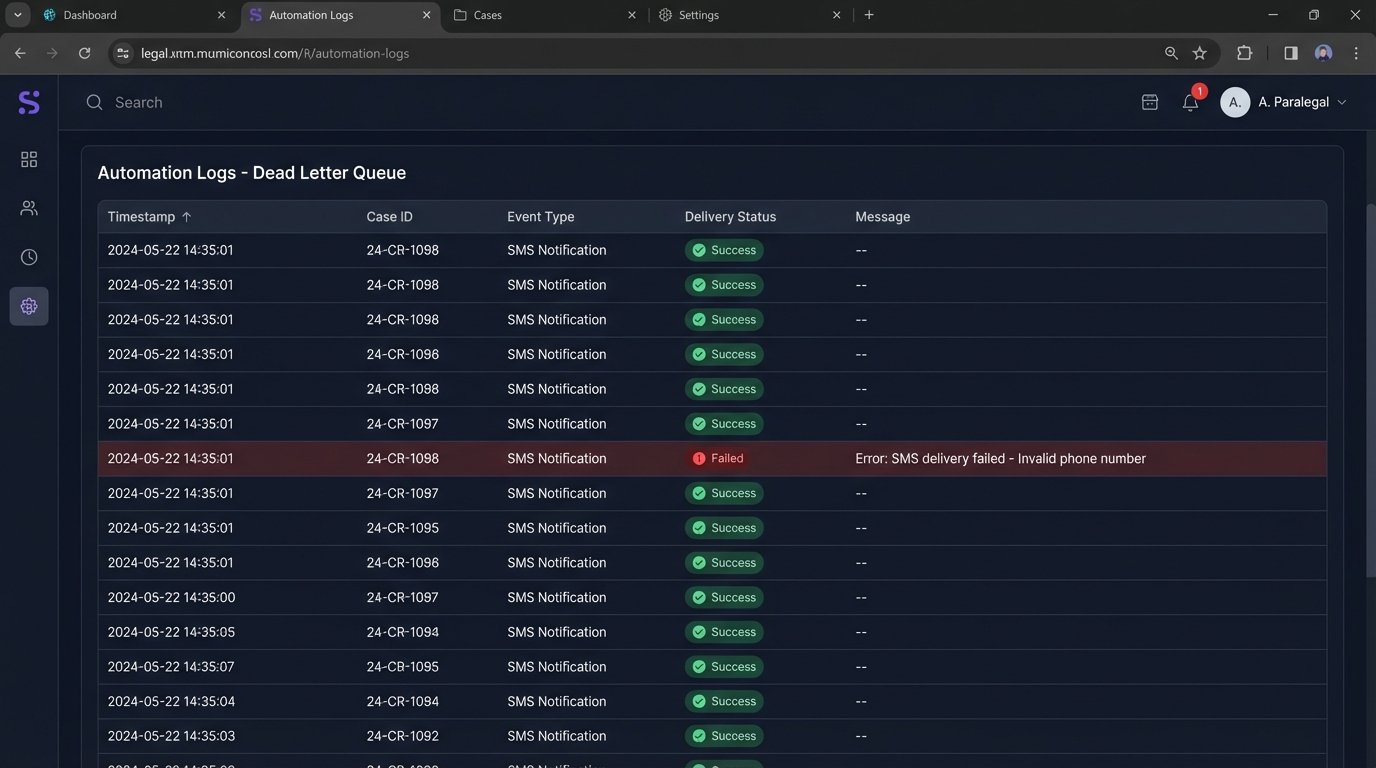
Your system requires aggressive monitoring and error handling. Every API call should be logged. Every sent message should have its delivery status tracked. When a message fails to send because of a bad phone number or a downed SMS gateway, it must not simply vanish. It needs to be routed to a dead letter queue.
A paralegal should be assigned to check this queue daily. They can then manually intervene, correct the bad data, or contact the client through an alternative channel. The automation handles the 99% of successful cases, while humans manage the 1% of exceptions. This is a proper division of labor.
Without this monitoring and recovery layer, you are flying blind. You are trusting a complex chain of systems to work perfectly forever, which is a bet no experienced engineer would ever take.
The resistance to this shift is understandable but ultimately futile. It is rooted in a false belief that manual processes equate to better service. The reality is that manual processes do not scale. They break down under pressure, leading to the very communication failures that erode client trust.
Treating client communication as an engineering problem is not dehumanizing. It is a strategic necessity. It forces firms to define their service promises, map their workflows, and build systems that execute on those promises consistently and reliably. The choice is simple. You can continue to employ attorneys and paralegals as glorified switchboard operators, or you can build a system that allows them to do the high-value legal work they were trained for.