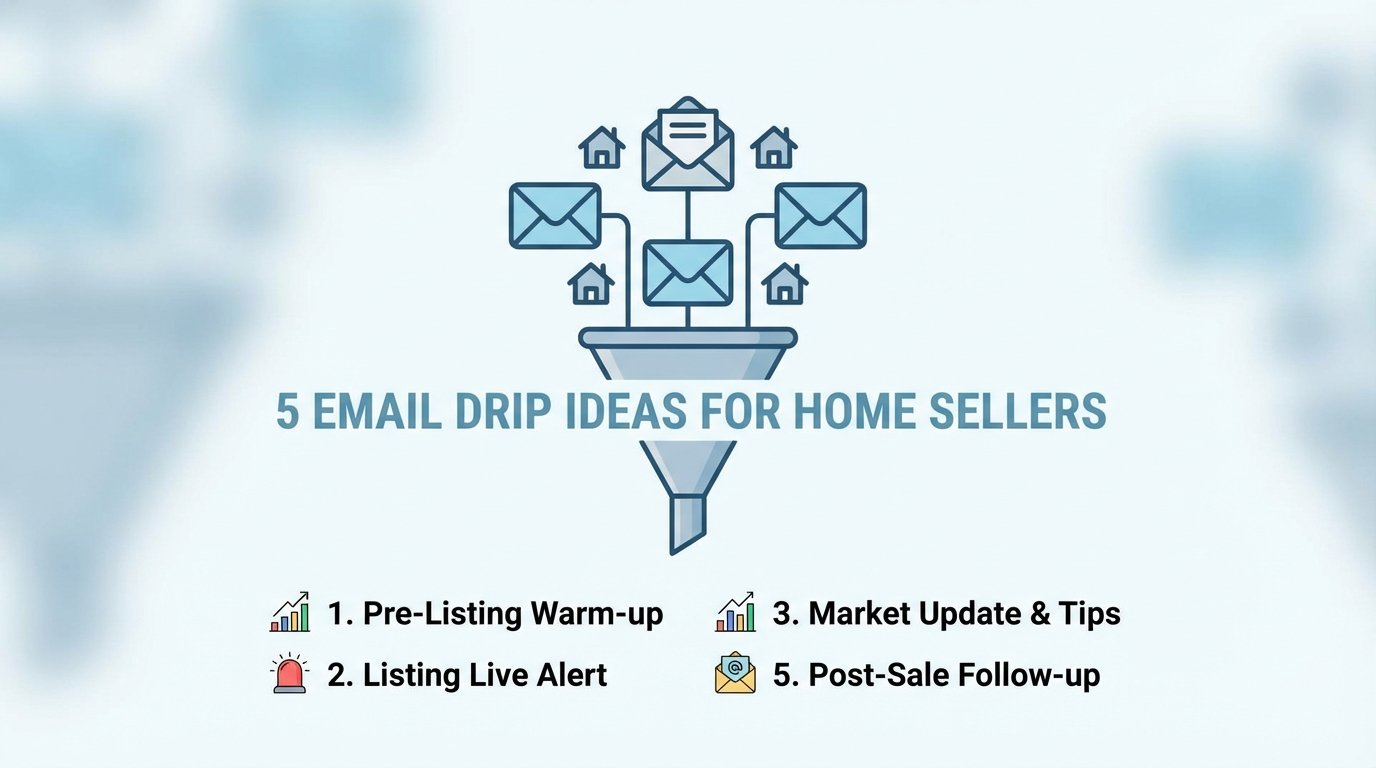
Most agent CRMs offer pre-built email drips that are functionally useless. They operate on a fixed timer and ignore the single most important factor for converting a seller lead: context. A lead who just requested a home valuation and one who has been passively browsing for six months require fundamentally different communication. Sending them the same five “introductory” emails is just a structured way to burn leads.
The goal is not to “drip”. The goal is to build event-driven sequences that react to lead behavior and market data. We are building simple state machines, not a glorified egg timer. What follows are five architectures that bypass the default CRM garbage and inject relevance into the process. Each assumes you have API access to an MLS data feed and a marketing automation platform that supports webhooks and dynamic content.
1. The Pre-Listing Market Analysis Sequence
This is the first point of contact after a lead fills out a “What’s my home worth?” form. The objective is to deliver immediate, tangible value while simultaneously qualifying the lead’s intent. The standard approach of just sending a “Thanks, I’ll be in touch” email is a complete waste of the initial engagement.
Technical Logic
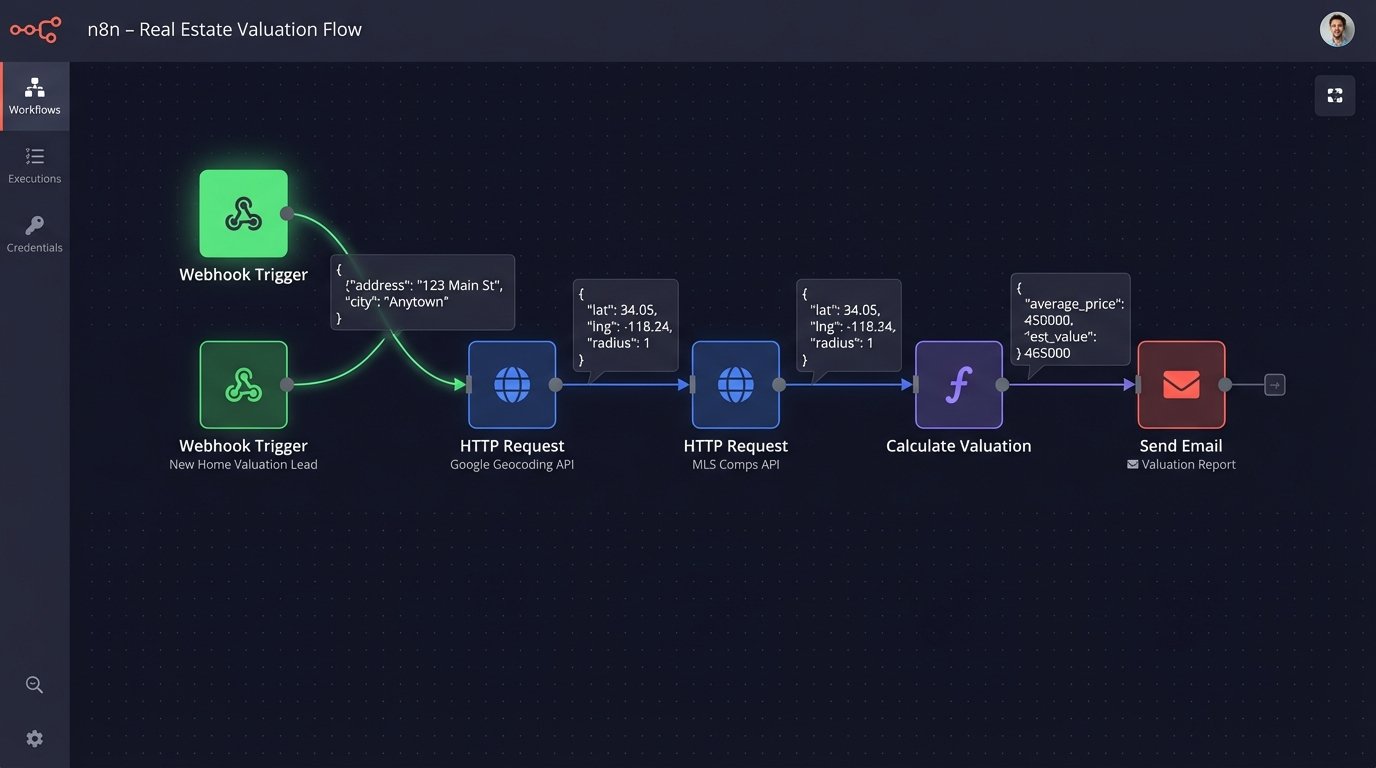
The sequence trigger is a form submission webhook. The payload should contain the lead’s property address. The first action is not to email, but to validate. Pass the address through a validation and standardization service like the Google Geocoding API or SmartyStreets to correct for typos and format it for MLS queries. An invalid address immediately shunts the lead into a manual review queue.
Once validated, the core logic executes. Your backend service queries the MLS API for comparable sold properties within the last 90-180 days in a 0.5-mile radius. You’ll need to filter by property characteristics like square footage (+/- 15%), bed/bath count, and year built. The script then calculates the average price per square foot from the valid comps and applies it to the lead’s property to generate a rough valuation range.
This computed data, along with a list of the 3-5 best comps, is injected as dynamic content into the first email template. The email presents the valuation range, shows the actual properties used to calculate it, and explicitly states the limitations of an automated report. This entire process, from form submission to email delivery, should execute in under 60 seconds.
This is your first, best chance to prove you’re not just another agent who bought a list.
Failure Points
The primary point of failure is bad data. If the MLS query returns zero valid comps, the logic must fork. Instead of sending a broken report, the sequence should trigger a different email. This “no-data” template explains that automated tools failed because the property is unique and that a manual analysis is required. It then notifies the agent to build a real CMA. This prevents you from looking incompetent and creates a legitimate reason for a direct phone call.
API rate limits are the other silent killer. A cheap Zillow API key will buckle under moderate traffic. A direct RETS or RESO Web API feed from the local MLS board is more reliable but requires significantly more development to parse the raw data. Choose your poison: wallet drain or development timeline.
2. The “Competition” Alert Sequence
Long-term nurture leads are often ignored until they finally raise their hand. This sequence keeps them engaged by providing market intelligence relevant to their specific address. Instead of sending generic newsletters, you send them targeted alerts about new listings in their immediate vicinity. You are framing the agent as a source of market data, not just a salesperson.
Technical Logic
This is not a time-based drip. It is a fully event-driven system triggered by changes in the MLS. You need a daily cron job that polls the MLS for new listings within the geographic boundaries of your target neighborhoods or zip codes. For each lead tagged with a specific area, the system checks if a new listing has appeared since the last run.
To execute this, each long-term lead in your CRM needs to be tagged with a geofence parameter, typically a zip code or a polygon of lat/long coordinates defining a subdivision. The cron script queries the MLS for `new_listings` with a `list_date` of today within those geofences. When a match is found, the system pulls the new listing’s details and injects them into a pre-built email template.
The email content is direct. It shows the new listing’s address, price, photos, and key stats. The subject line is something like, “New Competition on Your Street”. This immediately frames the information as relevant to their own home’s potential value.
You’re turning MLS data into a personalized intelligence briefing.
Data Management
Avoid spamming. A lead does not need to see the same new listing five times. You need a simple persistence layer, like a Redis cache or a database table, to track which listings have been sent to which contacts (`contact_id`, `listing_id`). Before sending an alert, the logic must check this cache. If the pair exists, the send is skipped. This prevents re-sends if the cron job is run multiple times or if data syncs are delayed.
The system’s intelligence comes from the quality of your geofencing. A simple zip code is blunt. A more precise implementation allows an agent to draw a polygon on a map and tag leads within that boundary. This requires storing GIS data and running spatial queries, which is more complex but yields far more relevant results. Tying this system to your agent’s front-end website, where a user can define their own alert area, is the next logical step.
3. The Post-Showing Feedback Automation
Agents spend an absurd amount of time chasing down feedback from buyer’s agents after a showing. This sequence automates the initial request and the subsequent nagging. Its goal is to get structured feedback into the CRM that the listing agent can then use to have a data-driven conversation with the seller about price or condition.
Technical Logic
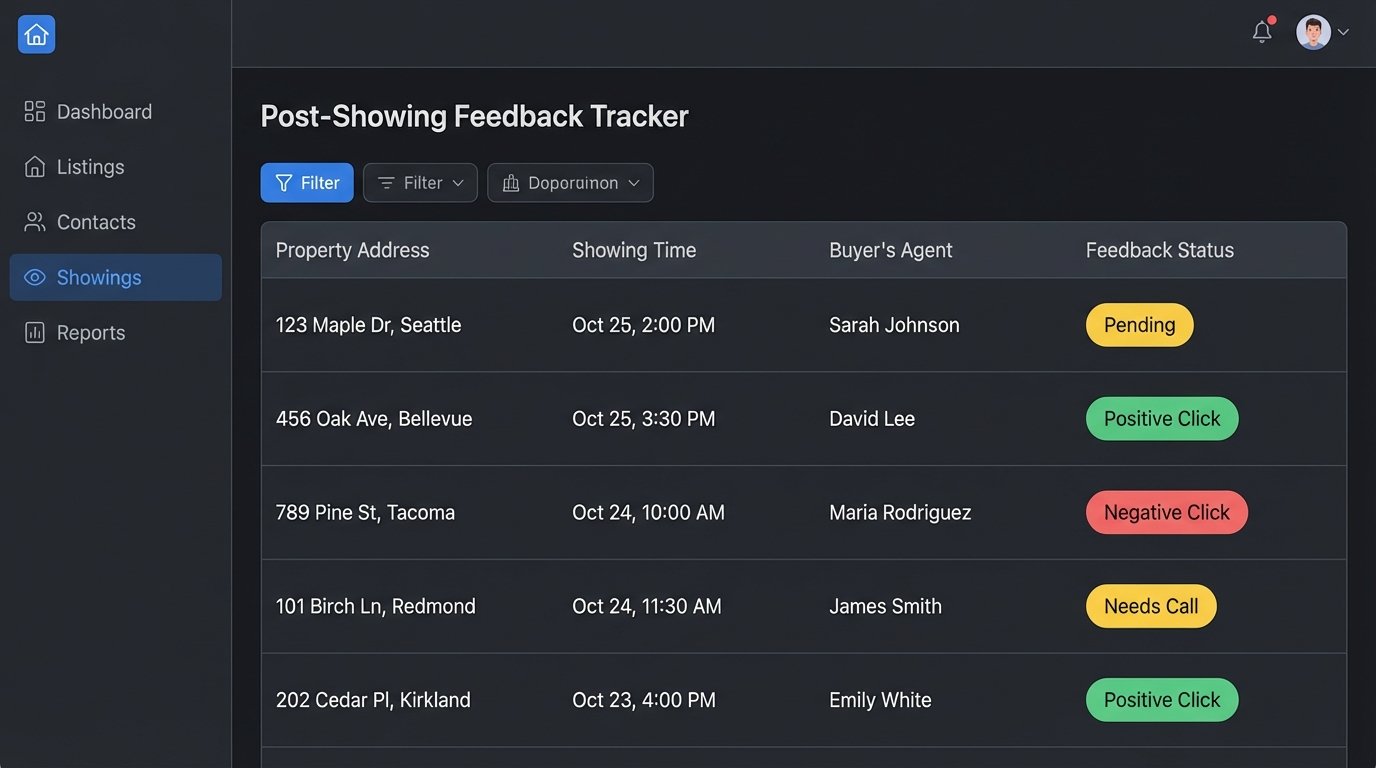
The trigger is manual. The listing agent clicks a “Start Post-Showing Sequence” button on the contact record of the buyer’s agent in the CRM. This initiates a short, timed sequence. The first email goes out two hours after the showing time, which should be a required field for the trigger.
The email contains two critical components. First, it uses merge tags to pull in the property address and showing time (`{{property_address}}`, `{{showing_time}}`). Second, it includes simple, one-click feedback links. These are not links to a form. They are tracked URLs with query parameters that write data back to the CRM via a webhook receiver. For example:
- `https://api.yourdomain.com/feedback?rating=good&contact_id=123&listing_id=456`
- `https://api.yourdomain.com/feedback?rating=bad&contact_id=123&listing_id=456`
When the buyer’s agent clicks a link, the webhook updates a custom field on their contact record in the CRM. This action also serves as the goal for the automation sequence, immediately stopping any further follow-up emails. If no link is clicked within 24 hours, a second, more direct email is sent. If there is still no response after 48 hours, a final email is sent and a task is created for the listing agent to make a phone call.
The entire operation is about reducing friction to get a single data point.
Trying to engineer this without a tight, bidirectional sync between your email platform and CRM is like shoving a firehose through a needle. The data pressure builds up until something breaks, and you end up with feedback in your email system that never makes it to the agent who needs it.
4. The Price Reduction Urgency Sequence
A price reduction is a key event in a listing’s lifecycle. This sequence ensures that every lead who has previously shown interest in the property is notified instantly. This is about manufacturing urgency and prompting a second look from previously hesitant buyers or re-engaging cold seller leads by showing market movement.
Technical Logic
Like the competition alert, this is an event-driven system. It requires a script that monitors specific MLS listings for a change in the `price` field. The pool of monitored listings should be dynamically generated based on lead activity: properties they’ve favorited on your website, properties they’ve had a showing for, or even the property from their initial “home valuation” request.
A cron job runs periodically, perhaps every four hours, to check the current price of these monitored listings against a stored value. Polling too frequently is a fast way to get your API key suspended. When the script detects a `current_price` lower than the `stored_price`, it triggers the automation.
The logic then calculates the difference both as a raw number and a percentage. Both values are critical for the email copy. “Price reduced by $25,000” is good. “Price on 123 Main St just dropped by $25,000 (5%)” is better. The email should be lean, focused entirely on the price drop, and include a clear call-to-action to view the listing or schedule a new showing.
You are weaponizing a data point to create an emotional response.
5. The Expired Listing Cold Outreach
This is the most technically demanding sequence to execute correctly. It involves targeting homeowners whose listings have expired or been withdrawn from the market. The margin for error is zero, as you are contacting frustrated sellers with an unsolicited offer of service. Generic spam will be ignored or flagged.
Technical Logic
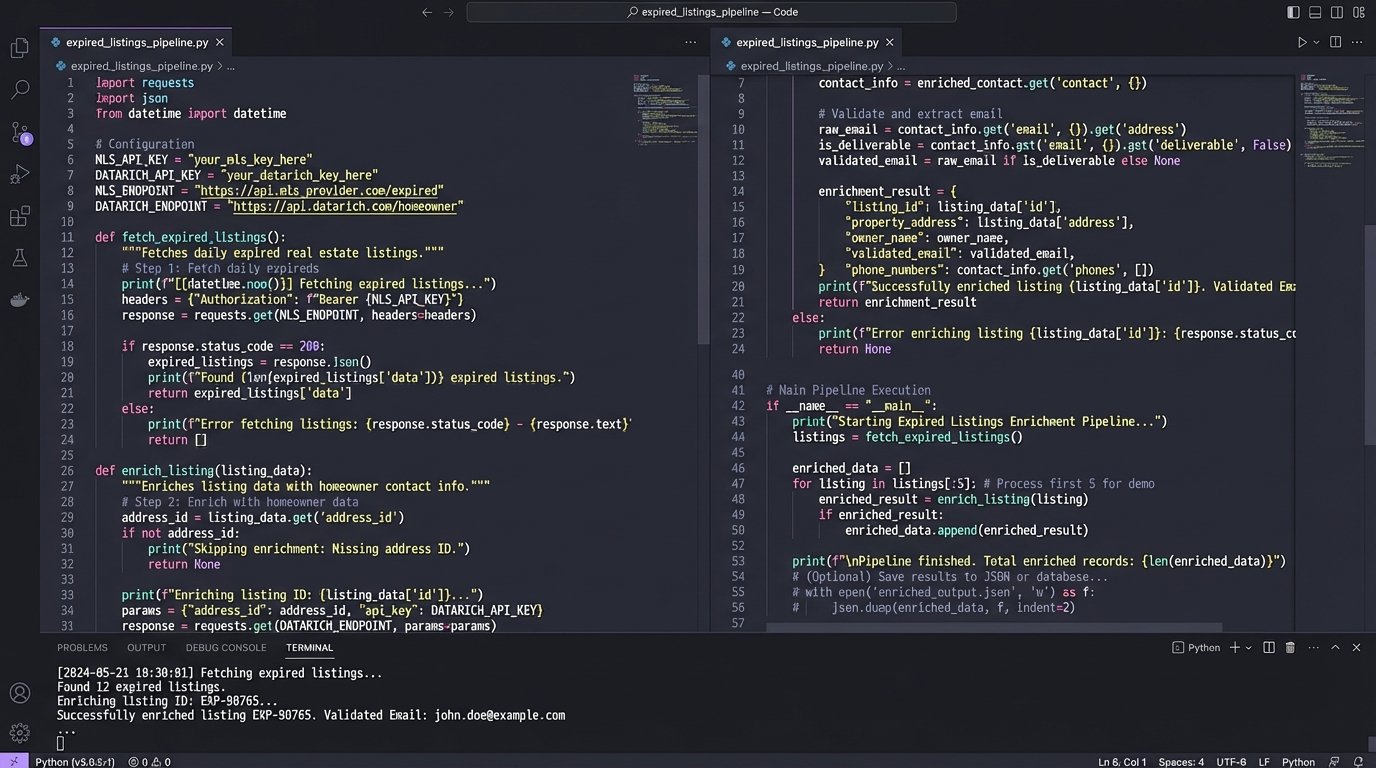
The first step is data acquisition. You need a reliable source for expired listing data, which can come from a third-party data provider’s API (like REDX) or by parsing it directly from the MLS if the terms of service allow. The script ingests this data daily, including the property address, previous list price, photos, and the original listing agent’s information.
Next comes data enrichment. You need to find the homeowner’s contact information, which requires another API call to a service like BeenVerified or a similar provider. This is where costs begin to mount. Once you have a potential email address, you must validate it using a service like ZeroBounce before it ever touches your email sending platform. Sending to a high number of invalid addresses will destroy your domain’s reputation.
The email sequence itself must be hyper-personalized. The first email has to prove you’ve done your homework. It should reference the property address, the fact that it was recently on the market, and one specific positive attribute you can pull from the old listing description or photos. The sequence then proceeds over 7-10 days with a mix of market stats, case studies, and gentle prompts for a no-pressure consultation.
Deliverability is the primary constraint. This entire operation must be run from a separate domain that is properly warmed up for cold outreach. Your main corporate domain should never be used for this. You need pristine SPF, DKIM, and DMARC records, and you must monitor your sender reputation scores daily. A single mistake can get your entire sending infrastructure blacklisted.
This isn’t a simple drip. It’s a full-scale cold outreach machine that requires constant monitoring and list hygiene.