
Stop Asking the Wrong Question
The debate between custom integration and off-the-shelf connectors is a false choice sold by vendors and perpetuated by agencies. For real estate brokerages, the question is never a simple binary. The real question is about control. Specifically, where in your data pipeline do you need absolute, granular control, and where can you afford to let a third-party tool handle the grunt work? Choosing one path exclusively is a blueprint for failure, either through a drained budget or a crippled, inflexible tech stack.
We are told to pick between building a solution from scratch or buying a subscription to a platform like Zapier or Make. The first path promises perfect alignment with business logic but hides a massive maintenance burden. The second promises speed and simplicity but delivers rigidity and opaque failure points. Both narratives are flawed because they assume your entire operation has a uniform need for automation. It doesn’t.
The Off-the-Shelf Promise and its Unspoken Price
Platforms like Zapier are powerful for simple, linear tasks. They excel at connecting well-documented, mainstream APIs. Need to push a new Facebook Lead Ad contact into your Follow Up Boss CRM? Fine. The connector exists, the authentication is straightforward, and the data mapping is visual. You can build that connection in under ten minutes and feel productive.
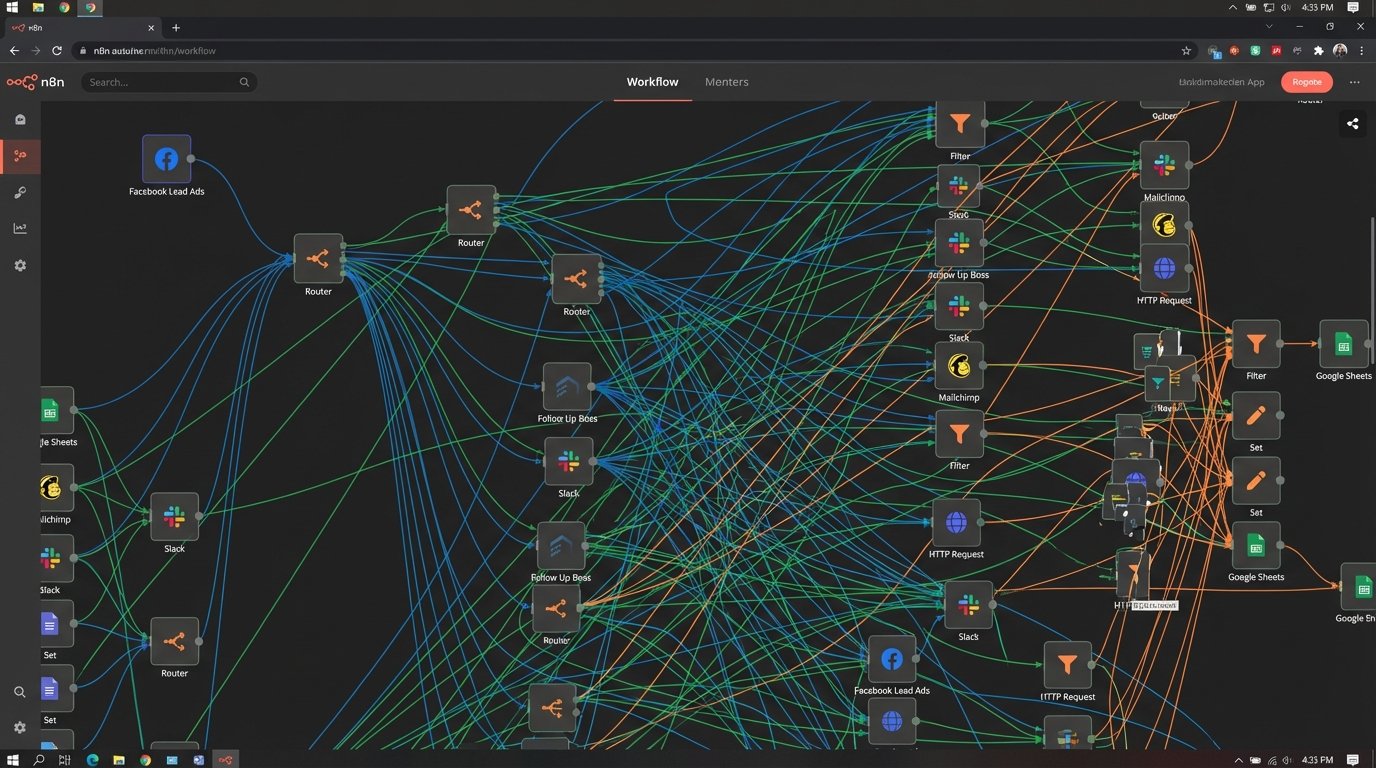
The problem emerges when you scale or introduce complexity. Your brokerage runs on more than just “if this, then that.” It runs on conditional logic. What if the new lead has a specific zip code? It needs to be routed to a different agent and added to a specific email sequence in Mailchimp. What if the lead source is Zillow but the property inquiry is over $2 million? It needs to be flagged as high-priority, and a notification must be sent to a private Slack channel.
Trying to build this multi-step, conditional logic in a visual builder becomes a tangled mess. You start chaining automations together, creating dependencies that are impossible to debug when something breaks. Worse, you start hitting operational limits. These platforms meter everything: tasks, execution time, and API calls. A sudden influx of leads from a hot new listing can throttle your entire system or present you with a surprise bill that negates the platform’s cost-effectiveness.
The data integrity issues are also significant. These tools are designed for mass compatibility, so they often strip or truncate non-standard data fields. You lose fidelity. A custom field you meticulously set up in your web form might not map correctly to your CRM, forcing manual data entry and defeating the purpose of the automation. It’s like trying to push a firehose of unique business data through the needle of a standardized connector.
The Siren Song of a Custom Build
Faced with the limitations of off-the-shelf tools, the impulse is to swing the pendulum to the other extreme: a fully custom solution. An engineering team can build a direct integration between your lead sources and your CRM. The code will execute your specific business rules perfectly. The system will be fast, efficient, and tailored to your exact needs.
This approach works, until it doesn’t. The day Zillow deprecates v2 of their API and moves to v3, your custom integration breaks. The day your CRM provider changes an authentication method, your lead flow stops dead. Now you are on the hook for emergency development work. The total cost of ownership for a custom build isn’t the upfront development price. It is the perpetual maintenance, the monitoring, and the dependency on the developer who wrote the original code.
A custom solution also locks you into a specific architecture. If you decide to switch CRMs in two years, you have to rewrite the entire integration. The code that was once a perfect solution becomes a liability, a piece of technical debt that hinders business agility. You built a precision-engineered part for a car you might not be driving next year.
Let’s look at a simple custom script. You could write a Python script to poll an IDX feed for new listings and push them into a database. This seems simple enough.
import requests

import json

import time
API_KEY = 'YOUR_IDX_API_KEY'
ENDPOINT = 'https://api.idxprovider.com/v1/listings'
HEADERS = {'Authorization': f'Bearer {API_KEY}'}
def get_new_listings():
# In a real scenario, you'd track the timestamp of the last fetch
params = {'since': '2023-10-26T10:00:00Z'}
try:
response = requests.get(ENDPOINT, headers=HEADERS, params=params)
response.raise_for_status() # This will raise an HTTPError for bad responses
listings = response.json()
for listing in listings.get('data', []):
process_listing(listing)
except requests.exceptions.RequestException as e:
print(f"API call failed: {e}")
def process_listing(listing_data):
# Logic to insert or update the listing in your local database
# This is where the custom business logic lives
print(f"Processing listing ID: {listing_data.get('id')}")
if __name__ == '__main__':
while True:
get_new_listings()
time.sleep(300) # Poll every 5 minutes
This script works. But it needs a server to run on. It needs error handling, logging, and monitoring. You have to manage credentials securely. When the IDX provider’s API goes down, your script needs a retry mechanism with exponential backoff. The simple script quickly balloons into a complex application requiring active management.

A Third Way: The Hybrid Logic Core
The most resilient and cost-effective architecture is a hybrid model. This model isolates your unique business logic into a small, lightweight, custom-built “core” and outsources all the commodity connectivity to off-the-shelf tools. This gives you the best of both worlds: complete control over what makes your business unique, and low-cost, no-maintenance connections for everything else.
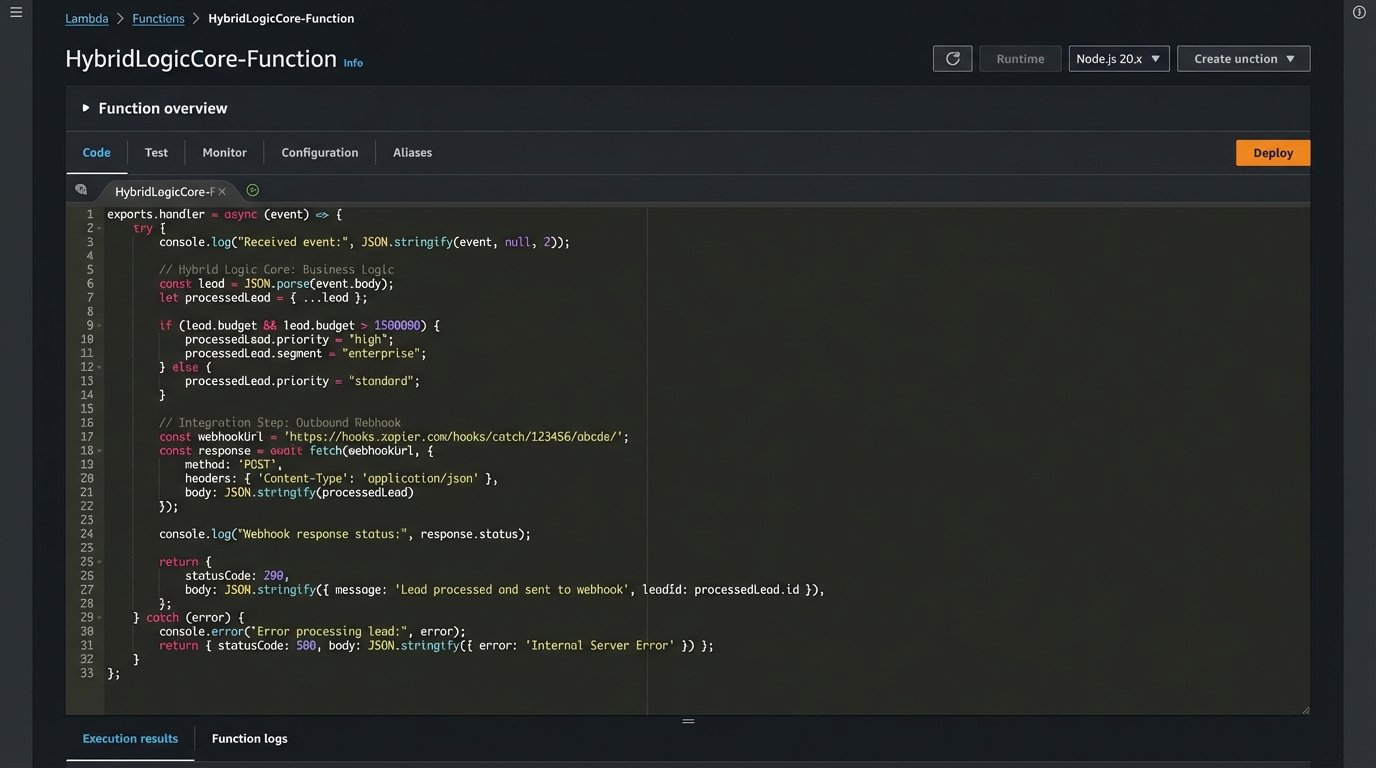
The core of this system is typically a serverless function, like an AWS Lambda or Google Cloud Function. This function acts as a central routing hub. It is the only piece of custom code you need to maintain. All your lead sources, whether from an API, a webhook, or a form submission, are pointed to this single function endpoint.
This function does not connect directly to your end-point applications. Instead, it performs three critical tasks:
- Data Validation and Enrichment: The function first validates the incoming data. Is the phone number format correct? Is the email address valid? Then, it enriches the data based on your proprietary rules. It can query an internal database to check for duplicate contacts, add an “AgentMatch” tag based on zip code, or flag a lead based on property value. This is your secret sauce.
- Logic Branching: Based on the enriched data, the function decides where the information needs to go. This is where you execute the complex conditional logic that is so clumsy in visual builders. If a lead is high-value, it branches to one path. If it’s a rental inquiry, it branches to another.
- Delegation to Commodity Connectors: After the logic is applied, the function’s only job is to format a simple JSON payload and make an outbound webhook call to an off-the-shelf platform like Make or Zapier. It triggers a workflow that handles the final, simple task of pushing the data into the CRM, a spreadsheet, or a Slack channel.
The beauty of this architecture is its resilience and flexibility. If your CRM’s API changes, you don’t touch your core logic function. You just update the simple, final step in your Zapier workflow. The vendor is responsible for maintaining that final connection. If you want to switch CRMs, you point the webhook to a new workflow. Your core business logic remains untouched, stable, and secure.
An Example Hybrid Flow in Practice
Let’s map this out. A new lead submits a form on your website.
The web form’s action is a POST request to your AWS Lambda function’s API Gateway URL.
The Lambda function, written in Python or Node.js, receives the JSON payload. It immediately performs your custom logic. It checks the lead’s requested budget. If the budget is over $1.5 million, it adds a `{“priority”: “high”, “tier”: “A”}` key-value pair to the JSON. It also queries your internal agent database and adds an `{“assigned_agent_id”: “123”}` key.
Now the function makes a decision. Because the priority is high, it makes two simultaneous outbound calls:
- A POST request to a Zapier webhook URL. This Zap is configured to do one thing: take the incoming JSON and create a new contact in Follow Up Boss. All the fields are already perfectly formatted.
- A second POST request to a different workflow on a platform like Pipedream. This workflow is connected to Twilio and immediately sends an SMS to the assigned agent with the lead’s details.
You have maintained full control over the most critical part of the process, the lead qualification and routing, in a piece of code you own. The high-maintenance, brittle work of authenticating and posting to third-party APIs is handled by platforms built for that exact purpose. You have effectively separated your business logic from your integration mechanics.
Rethinking the Integration Stack
This hybrid approach forces a more disciplined way of thinking about automation. Instead of asking “Can Zapier connect to my MLS feed?”, you should be asking “What is the unique logical operation I need to perform on my MLS data?”. Once you identify that core operation, you build a small function to execute it. Everything else, the inputs and outputs, can be bridged with off-the-shelf tools.
This model is not free. It requires access to a developer who can write and deploy a simple serverless function. But the cost is fractional compared to building and maintaining a full end-to-end custom integration. The operational expenditure is minimal, as serverless platforms charge pennies for millions of executions. The result is a system that is anti-fragile, scalable, and adaptable to the inevitable changes in your software stack.
The integration dilemma for realtors is not about choosing a tool. It is about architecting a workflow. By building a small, custom logic core and surrounding it with disposable, off-the-shelf connectors, you can create a system that is both powerful and maintainable. It puts the control back where it belongs: with the brokerage, not the software vendors.