
The Delusion of Direct Replacement
The conversation about chatbots replacing real estate assistants is fundamentally flawed. It presupposes a 1:1 replacement, where a single AI model supplants a human. This is a marketing narrative, not an engineering reality. The actual job of a real estate assistant is a chaotic bundle of asynchronous tasks, ranging from data entry to client hand-holding. A chatbot can’t manage a physical lockbox or calm down a panicked first-time buyer.
The real question is not one of replacement, but of dissection. We need to strip the assistant’s workflow down to its component parts and identify which functions are ripe for automation. Some tasks are just simple, repetitive logic gates that a human should not be touching in the first place. Others require a level of social and physical nuance that current models can’t even begin to simulate. Believing a single LLM can do it all is a failure to understand the problem domain.
Gutting the Workflow: The Low-Hanging Fruit
Before we talk about sophisticated AI, let’s talk about the grunt work. A significant portion of an assistant’s day is consumed by tasks that are little more than data transport and rule-based decision making. These are the first functions to be isolated and automated. Forcing a human to perform these is an inefficient use of salary and a direct path to burnout.
Lead Triage and Qualification
An incoming lead from Zillow or a brokerage website is not a complex entity. It is a data packet containing a name, contact information, and a text string of intent. The initial human interaction often follows a simple script to determine budget, timeline, and seriousness. This is a prime target for an LLM-powered classification engine. The goal is to sort the signal from the noise before a human invests any time.
We can pipe the lead’s initial message into a model with a prompt engineered to extract key entities. Is the person pre-approved? Are they just browsing? Do they have a property to sell? The model’s job is to parse the unstructured text and return a structured JSON object. This object then dictates the next step in the funnel, whether it’s immediate agent notification or entry into a drip campaign.
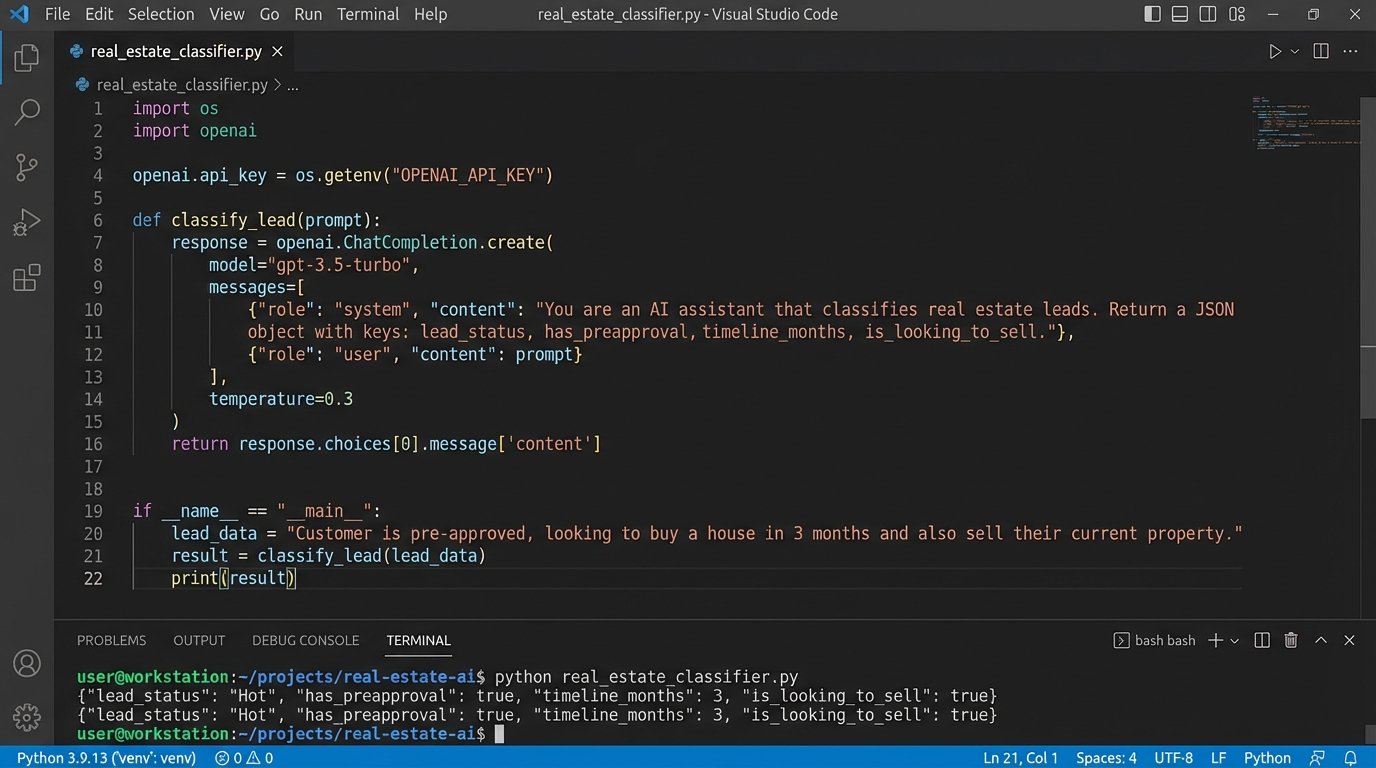
This isn’t about having a conversation. It’s about data extraction. Here is a trivial example of how you might force this with a function-calling model.
# This is a conceptual Python example using a hypothetical library

# It is not production code.
import openai
def classify_real_estate_lead(message_text):
"""
Uses OpenAI's API to classify a lead's intent and extract key info.
"""
client = openai.OpenAI() # Assumes API key is set in environment variables
try:
response = client.chat.completions.create(
model="gpt-4-turbo",
messages=[
{"role": "system", "content": "You are a real estate lead qualification system. Extract information from the user's message into a structured format."},
{"role": "user", "content": message_text}
],
tools=[
{
"type": "function",
"function": {
"name": "log_lead_data",
"description": "Logs extracted lead information to the CRM.",
"parameters": {
"type": "object",
"properties": {
"lead_status": {"type": "string", "enum": ["Hot", "Warm", "Cold"], "description": "The urgency of the lead."},
"has_preapproval": {"type": "boolean", "description": "Does the lead claim to have mortgage pre-approval?"},
"timeline_months": {"type": "integer", "description": "The lead's buying timeline in months."},
"is_looking_to_sell": {"type": "boolean", "description": "Does the lead also have a property to sell?"}
},
"required": ["lead_status"]
}
}
}
],
tool_choice={"type": "function", "function": {"name": "log_lead_data"}}
)
# In a real app, you would parse the tool_calls object here
# and execute the logic. For this example, we just return it.
tool_call_arguments = response.choices[0].message.tool_calls[0].function.arguments
return tool_call_arguments
except Exception as e:
# Proper error logging would happen here
return f"API call failed: {str(e)}"
# Example Usage
lead_message = "Hi, I saw your listing on 123 Main St. My wife and I are pre-approved and looking to buy in the next 3 months. We also need to sell our current condo."
classified_data = classify_real_estate_lead(lead_message)
print(classified_data)
# Expected output would be a JSON string like:
# '{"lead_status": "Hot", "has_preapproval": true, "timeline_months": 3, "is_looking_to_sell": true}'
This completely bypasses the need for an assistant to ask those initial five questions. The agent now only engages with leads that the system has flagged as “Hot” and pre-qualified. The rest are handled by other automated systems.
Scheduling and Calendar Gymnastics
Coordinating schedules between an agent, a buyer, and a seller’s agent is a high-friction, low-value task. It is a storm of emails and text messages to find a 30-minute slot. This entire process can and should be offloaded to a dedicated scheduling service like Calendly, connected via API. The assistant’s role here is nullified.
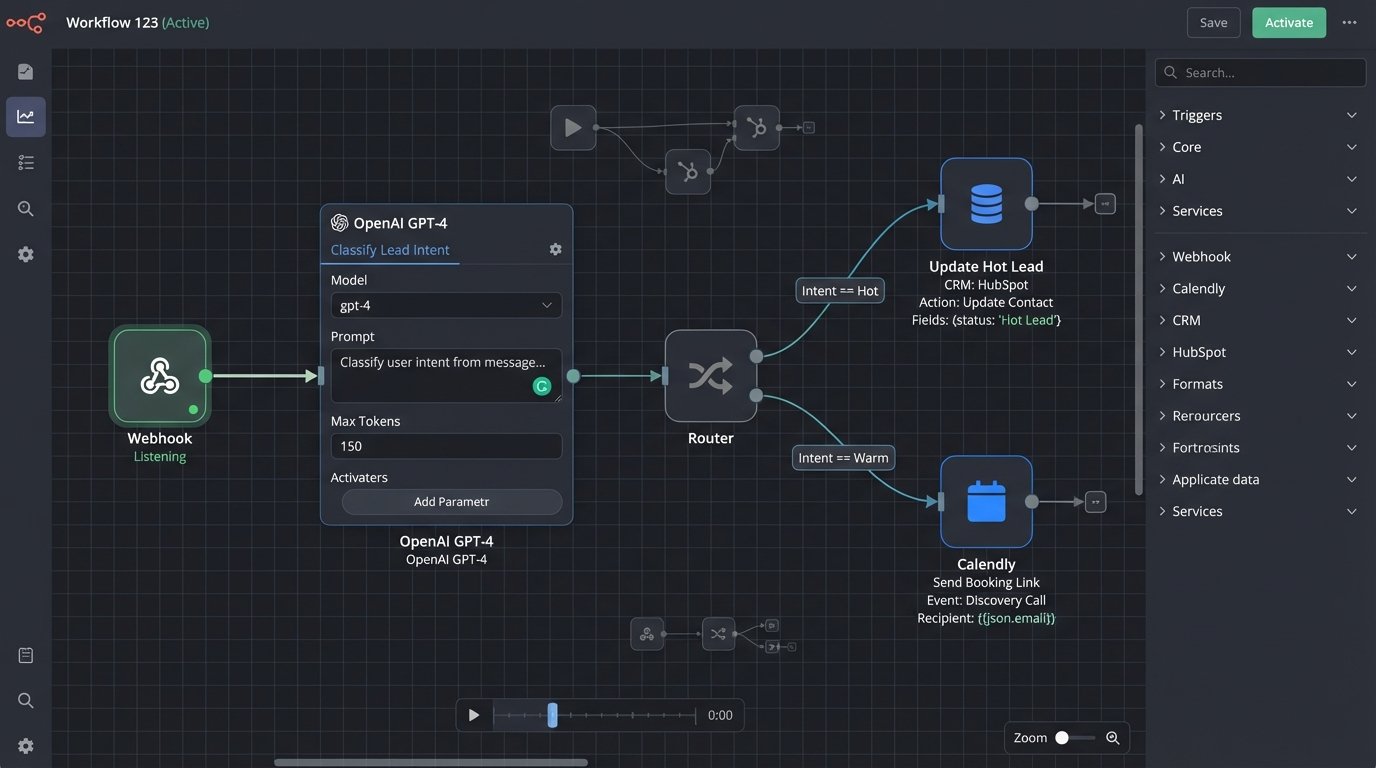
When a lead is qualified, the automation sequence doesn’t just notify the agent. It sends the lead a direct link to the agent’s calendar to book a call or showing. The system can be configured with rules for buffer times, showing durations, and travel time between properties. This is a solved problem. Any brokerage still paying a human to manually manage an agent’s calendar is burning money.
The MLS Data Grind
A huge time sink for assistants is pulling property data, running comps, and preparing reports from the Multiple Listing Service (MLS). MLS systems are notoriously fragmented, with antiquated interfaces and inconsistent APIs where they exist at all. This is where automation gets gritty. It often requires a combination of direct API access if available, or brittle web scraping if not.
The process involves fetching raw property data, cleaning it, standardizing fields, and injecting it into a report template. This task is repetitive and error-prone. Building a reliable data pipeline to ingest MLS data is a significant upfront investment. It requires robust error handling for when the source website changes its layout or an API endpoint goes down. But once built, it runs 24/7 with zero marginal cost. Trying to get clean data from multiple MLS feeds feels like trying to shove a firehose through a needle. It’s messy and requires a lot of engineering to filter and normalize before it’s usable.
Where the Machine Fails: High-Touch and High-Friction
The hype cycle around AI ignores the messy reality of human interaction and the physical world. A language model has no concept of a client’s body language during a showing or the political capital needed to get a concession from a difficult appraiser. These are not edge cases; they are the core of the real estate transaction.

The Human API: Negotiation and Empathy
A real estate transaction is an emotional and financial pressure cooker. The assistant often acts as a buffer, an empathetic listener, and a trusted advisor. They read between the lines of an email and sense hesitation in a client’s voice. This is a form of data processing that current AI cannot perform. A chatbot can’t build rapport or trust over weeks of interaction.
Negotiating inspection repairs or navigating a low appraisal requires human intuition. It involves knowing when to push, when to concede, and how to frame an argument to multiple stakeholders with competing interests. An LLM can generate negotiation scripts, but it cannot execute them in a live, dynamic conversation. It lacks the situational awareness to pivot its strategy in real time based on the other party’s emotional state.
Physical World Constraints
A significant part of the assistant’s job involves interacting with the physical world. They meet contractors for repair quotes, prepare a house for a showing, manage keys, and run documents across town for wet signatures. A chatbot cannot do this. Until we have general-purpose robotics integrated with these AI systems, there will always be a hard requirement for a human to bridge the gap between the digital and physical realms.
This is a hard, physical boundary for automation. You can automate the scheduling of the contractor, but you can’t automate the act of letting them into the property and verifying the work was completed correctly. The logistics chain in real estate is deeply tied to physical locations, and this will insulate the core of the assistant role for the foreseeable future.
The Real Future: The Assistant as an Automation Operator
The logical evolution is not replacement, but a redefinition of the assistant’s role. The assistant of the future will not be a data-entry clerk but an operator of a sophisticated automation suite. Their value will shift from performing repetitive tasks to managing, maintaining, and improving the systems that perform those tasks.
Architecting the “Cyborg” Assistant
Think of the agent and their assistant as a command center. They have a dashboard that provides a unified view of all automated processes. One module shows lead qualification status. Another tracks the automated scheduling of showings. A third monitors the MLS data pipeline for errors. The assistant’s job is to orchestrate these tools.
This architecture is a collection of specialized bots, not a single monolithic AI. A lead qualification bot using GPT-4. A scheduling bot built on Calendly’s API. A data-scraping bot running on a headless browser. Each tool is chosen for its specific function. The human operator bridges the gaps between them and handles the exceptions the machines cannot. This approach is more resilient and effective than trying to force one “master AI” to do everything. Bolting a massive, general-purpose LLM onto a workflow that needs specific, reliable tools is like strapping a jet engine to a bicycle. It’s spectacular for a moment, then it disintegrates.
Exception Handling as a Core Function
No automation is perfect. APIs fail. A lead’s message might be too ambiguous for the LLM to classify. A scraper might break after a website update. The primary role of the human operator becomes exception handling. When an automated process fails, it creates a ticket that the human assistant triages. Their job is to solve the immediate problem and then provide feedback to improve the system.
For example, if the lead classification bot incorrectly labels a hot lead as cold, the assistant manually corrects the classification in the CRM. They then take the problematic lead message and use it to fine-tune the classification model’s prompt or training data. They are no longer just using the system; they are actively training and maintaining it. This creates a feedback loop that makes the automation more effective over time.
Final Logic Check
The idea of a chatbot fully replacing a human real estate assistant is a simplistic fantasy. The role is not a single function but a messy collection of digital, social, and physical tasks. The path forward is not replacement; it is amputation. We will surgically remove the repetitive, automatable tasks from the human’s workflow and relegate them to specialized bots.
This elevates the human assistant from a performer of tasks to an operator of systems. Their value will be in their ability to manage the automation, handle the complex exceptions, and provide the critical human element of empathy and negotiation that machines cannot replicate. The job is not disappearing. It is evolving into a more technical, higher-value role.