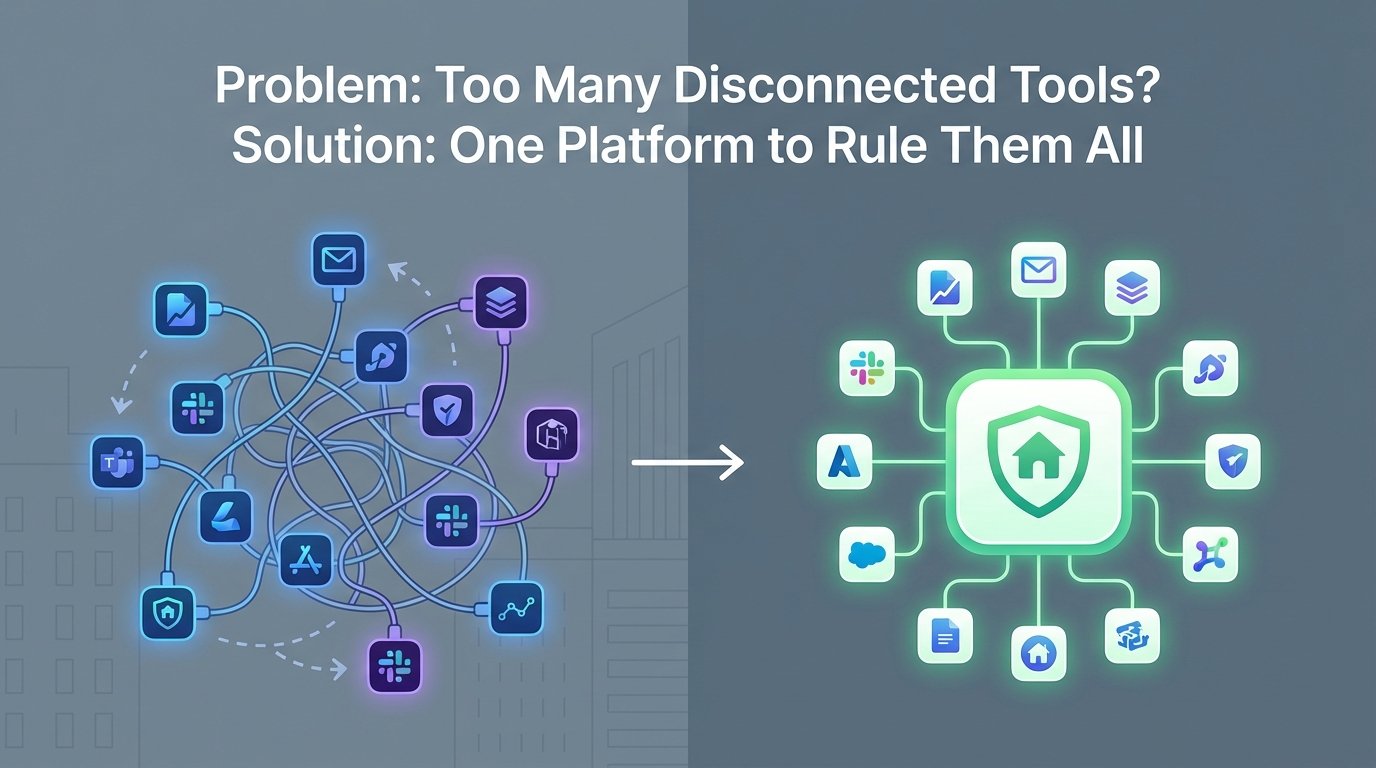
The Data Fragmentation Hellscape in Real Estate Tech
Every real estate operation starts with a simple stack. A CRM for contacts, maybe a dedicated portal for MLS listings, and an email tool. Then compliance demands a transaction management system. Marketing wants to inject leads from a dozen different ad platforms. Before long, you are not managing a business. You are managing a fragile web of brittle API connections and data sync jobs that fail silently at 2 AM.
The core problem is schema drift. Your CRM’s “Contact” object has a different structure than your marketing platform’s “Subscriber” object, which is entirely alien to the “Buyer” entity in your transaction system. Each system is its own isolated database with its own rules, and you are left to force them to communicate.
Siloed Systems: The Technical Debt You Inherited
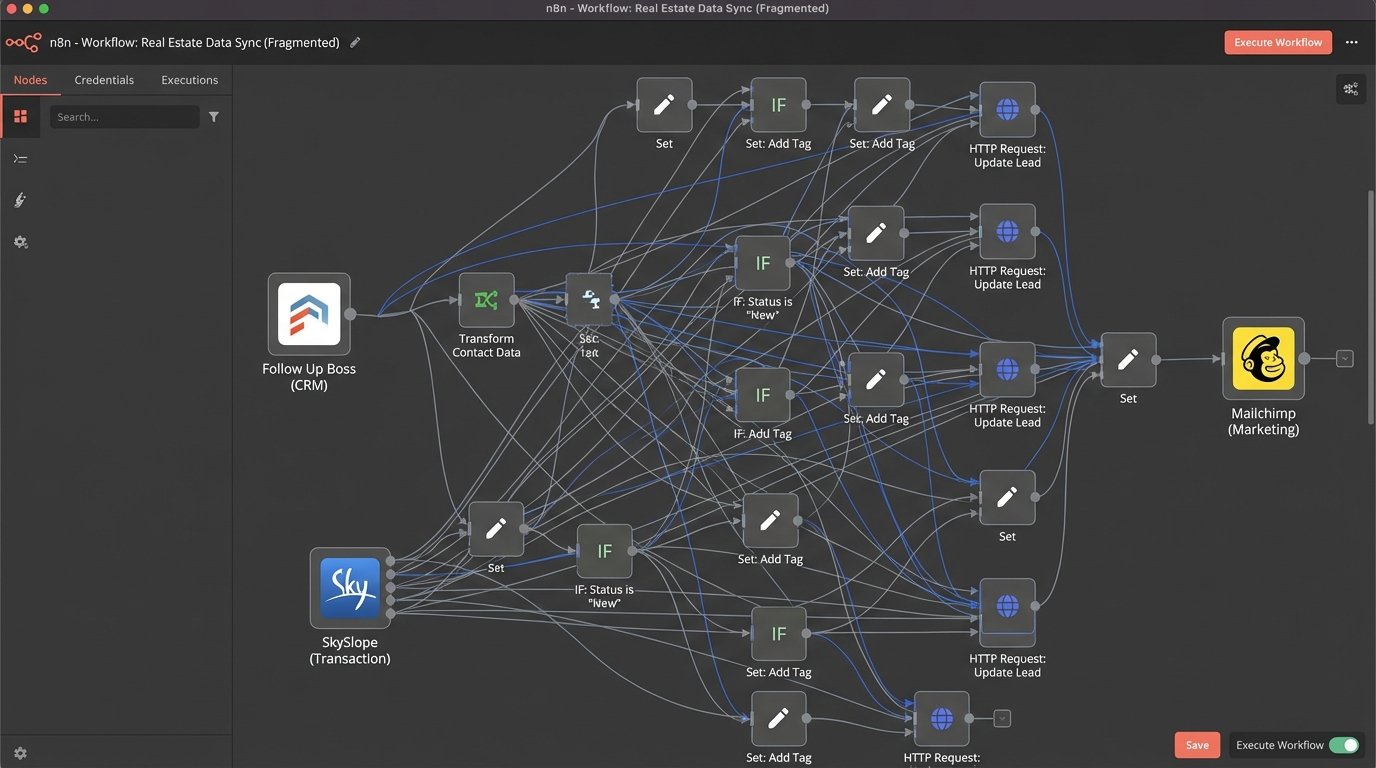
The standard brokerage tech stack is a collection of specialized tools, each chosen for being best-in-class at one specific function. You might have Follow Up Boss for lead management, SkySlope for transactions, and Mailchimp for email campaigns. Individually, they work. Collectively, they create data islands. An agent updates a contact’s phone number in the CRM, but that change never propagates to the transaction system, leading to a frantic call about missed closing documents.
This isn’t a failure of the tools. It is a failure of architecture. These systems were never designed to form a cohesive unit. Each maintains its own state, its own audit log, and its own concept of a “lead” or “deal.” The operational drag from this friction is immense, manifesting as manual data entry and cross-referencing that bleeds agent productivity dry.
API Stitching and the Zapier Tax
The typical patch for this architectural mess is a middleware connector like Zapier or a set of custom-coded AWS Lambda functions. You build brittle, point-to-point integrations. When a new lead is created in System A, a webhook fires to trigger an action in System B. This works for simple workflows but collapses under the weight of real-world complexity. What happens when an API endpoint changes without warning? Or when you hit a rate limit during your peak lead flow? Your automation halts.
You end up paying what I call the “Zapier Tax.” This is the direct monthly cost of the service plus the indirect cost of constant monitoring, debugging failed “zaps,” and the inherent latency introduced by routing every critical business event through a third-party cloud. Trying to build a reliable, high-volume operation on this foundation is like building a skyscraper with duct tape and hope. It’s a liability, not an asset.
Architecting a Central Nervous System, Not Just Another Database
The fix is not another tool. It is a fundamental shift in architecture. You need to build or adopt a platform that acts as a central nervous system for your entire operation. This system’s primary job is to establish a single source of truth for your core business entities: Contacts, Properties, and Transactions. All other tools become peripheral limbs, acting on commands from the core and feeding sensory data back into it.
The Unified Data Model: A Single Source of Truth
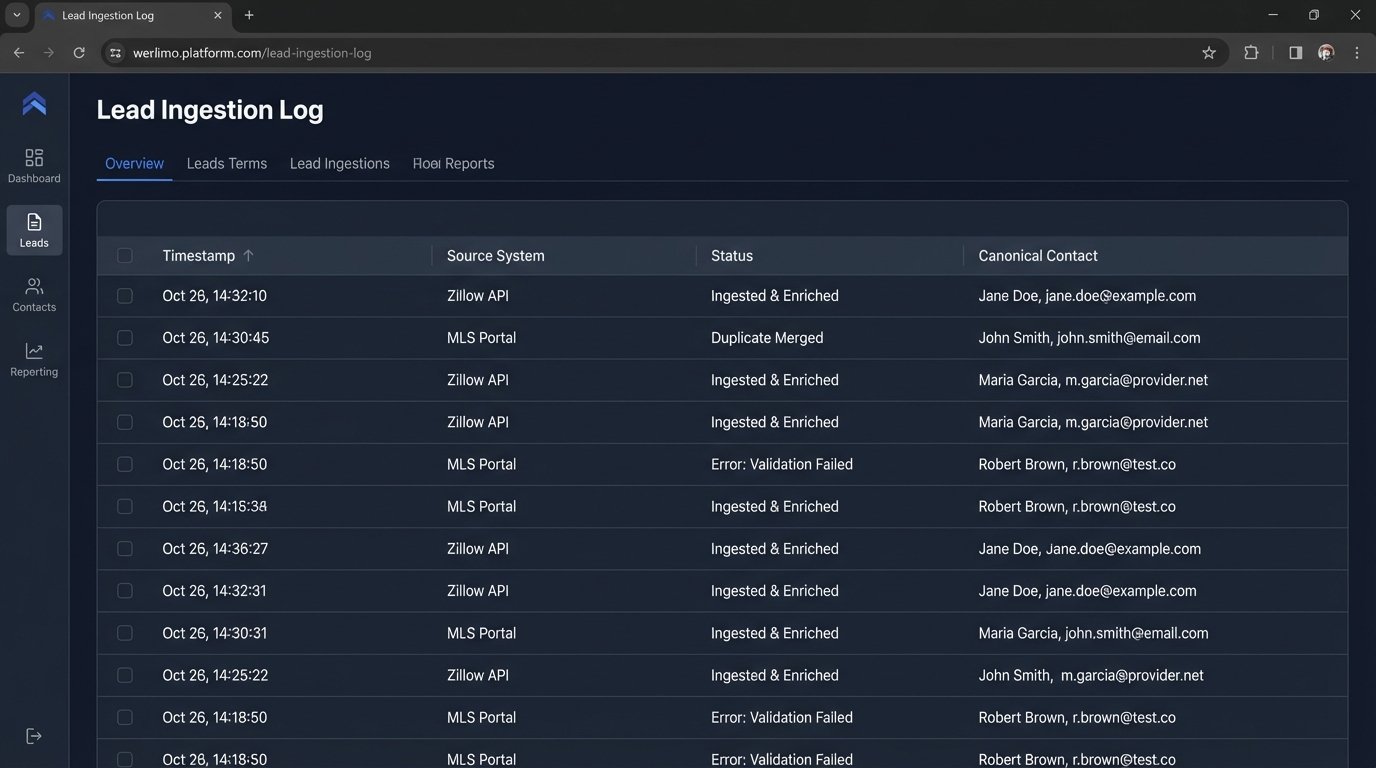
A true platform is built around a canonical data model. When a lead arrives from a Zillow API call, it is not just passed along. It is ingested, stripped of its source-specific formatting, and mapped directly to the platform’s internal “Contact” schema. This process enriches the data, standardizes fields like addresses and phone numbers, and de-duplicates it against the existing database in real-time.
This model forces discipline. All data, regardless of origin, conforms to one master schema. This eliminates ambiguity and makes automation logic radically simpler to write and maintain. The output is a clean, predictable data object that can be used consistently across all business functions, from marketing automation to commission calculation.
{

  "contactId": "con_12345xyz",

  "sourceSystem": "Zillow API",

  "ingestionTimestamp": "2023-10-27T10:00:00Z",

  "canonical": {

    "firstName": "Jane",

    "lastName": "Doe",

    "email": "jane.doe@example.com",

    "phone": "+15551234567",

    "status": "New Lead",

    "assignedAgentId": null

  },

  "history": [

    {

      "timestamp": "2023-10-27T10:00:00Z",

      "event": "Created",

      "details": "Lead from property inquiry on 123 Main St"

    }

  ],

  "linkedProperties": [

    "prop_98765abc"

  ]

}
State Management Across the Agent Workflow
With a unified model, you can manage a contact’s journey through a single state machine. A lead is not just a “lead” in three different systems. It is one “Contact” entity in your central platform with a status of `New Lead`. When an agent makes contact, that status changes to `Contacted`. When an offer is made, it changes to `Offer Pending`. The entire history of these state changes is attached to the single contact record.
This provides perfect context. Any agent can look at the record and see the complete timeline without logging into three different dashboards. Automation rules become more powerful because they can be triggered by these precise state changes. This is impossible when your lead’s status is fragmented across a CRM and a separate transaction system that do not speak the same language.
Practical Application: A Lead-to-Close Automation Pipeline
Let’s walk through how this architecture handles a real-world scenario. A potential buyer submits an inquiry on a property listing syndicated to a real estate portal. In the old, fragmented world, this would trigger a simple email notification and require an agent to manually create records. With a central platform, the process is deterministic and automated.
Ingestion and Enrichment
The platform’s ingestion service receives the lead via a webhook or API polling. The raw JSON payload is immediately parsed and mapped to the canonical `Contact` and `Inquiry` models. The system logic-checks for an existing contact record using the provided email or phone number. If a match is found, the new inquiry is appended to the existing contact’s history. If not, a new `Contact` record is created. The system can then trigger an API call to an enrichment service to pull in social profiles or job titles, adding context before a human ever sees the lead.
Rule-Based Routing and Task Injection
Once the clean contact record exists, a routing engine fires. This is not a third-party connector. It is a native function of the platform. The rules are written in a simple, declarative syntax. For example: `IF lead_source IS ‘Portal A’ AND property_zip_code IS IN (‘90210’, ‘90211’) THEN assign_to_agent ‘Agent Smith’`. The assignment is an atomic transaction within the platform’s database.
Simultaneously, the engine injects a `Task` object into the system, linked to both the `Contact` and `Agent Smith`. The task might be “Initial Follow-Up Call” with a due date of 2 hours from ingestion. This task appears in Agent Smith’s dashboard inside the same platform. No external API call to Trello or Asana is needed. The entire context of the lead, the property they inquired about, and the required action are all in one place.
The Inevitable Trade-Offs and Implementation Scars
A unified platform is not a magic fix. Adopting one is a serious engineering effort with its own set of risks. The promise of operational simplicity is paid for with the upfront pain of migration and the long-term risk of vendor dependency. Anyone who claims otherwise is selling you something.
The Migration Gauntlet
Getting your data out of a dozen legacy systems and into a single new one is brutal. You will spend weeks exporting CSVs, writing Python scripts to clean and transform the data, and mapping old, inconsistent field names to the new, canonical schema. You will discover that half your contacts in one system are duplicates of contacts in another, but with different email addresses. You will have to make hard decisions about which data to keep and which to discard.
The process is like trying to consolidate the plumbing of three old houses into one modern manifold. You’re guaranteed to find corroded pipes, mismatched fittings, and undocumented routes that break as soon as you touch them. It is a messy, thankless job that is a prerequisite for any future success.
Monolith Risks and Vendor Lock-In
Committing to a single platform means you are placing a huge bet on that vendor’s reliability and future roadmap. If their servers go down, your entire business grinds to a halt. Marketing stops, lead routing fails, and agents cannot access client information. You have created a single point of failure, and you must have a deep understanding of the vendor’s disaster recovery protocols.
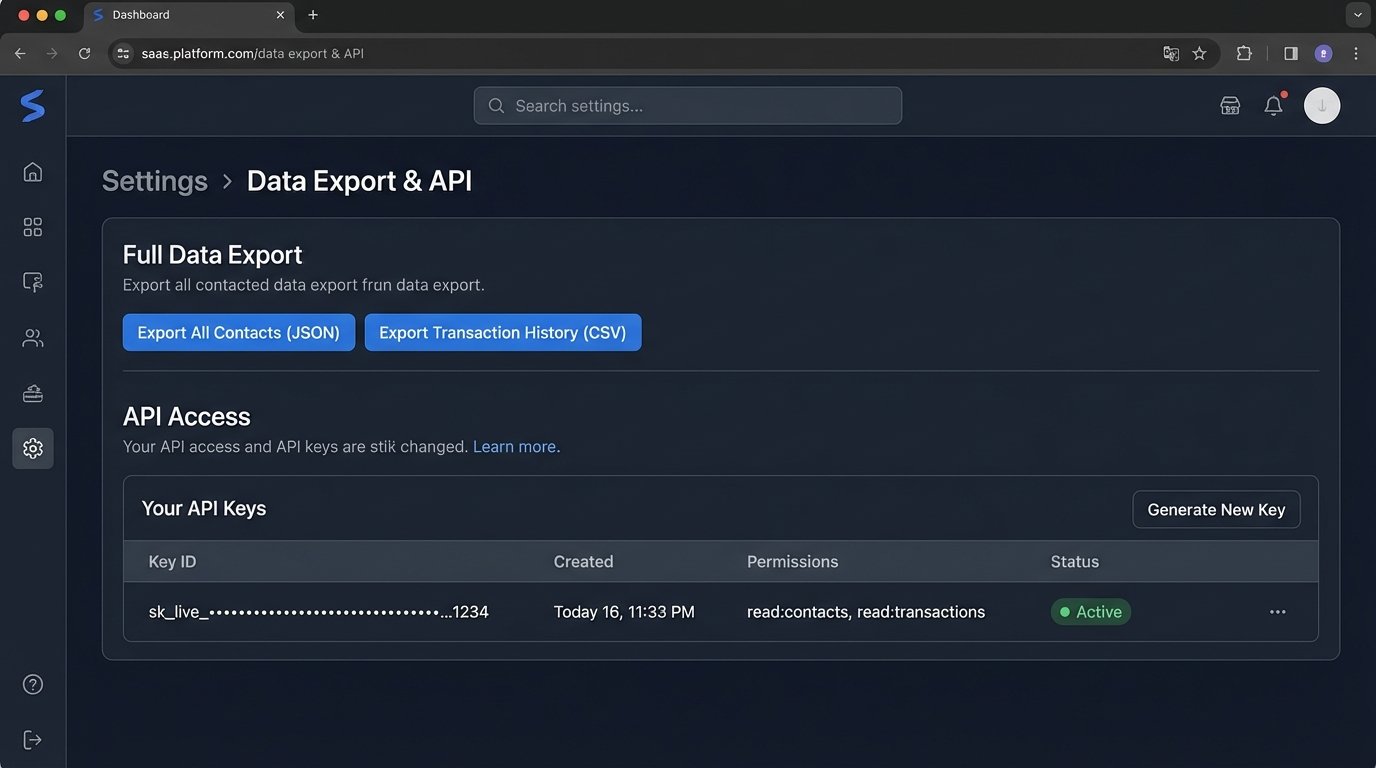
You also need an exit strategy. Before you sign any contract, you must scrutinize the platform’s export API. Can you programmatically extract 100% of your data, including all history, notes, and relational links, in a structured format? If not, you are willingly walking into a data prison. A good platform allows you to leave. A bad one traps you.
Beyond Consolidation: Predictive Analytics and Commission Tracking
The real value of a unified platform emerges after the initial pain subsides. Once you have a critical mass of clean, structured data flowing through a single system, you can start doing things that were impossible before. The focus shifts from just keeping the lights on to generating intelligent insights.
Forecasting from Clean Data
With every lead, call, email, and transaction recorded in one place against a consistent data model, you can finally build accurate predictive models. You can calculate the true lead-to-close conversion rate for each marketing channel, not just an estimate. You can analyze agent activity patterns to identify who is likely to hit their quota and who needs coaching. The platform can generate reliable commission forecasts based on the `deal_value` and `status` fields of all `Transaction` objects in the pipeline.
Automating the Back Office
The benefits extend past the sales team. When a transaction’s state changes from `Pending` to `Closed`, it can trigger a webhook to your accounting system. The payload contains the final sale price, agent commission split, and property details. This automates the generation of invoices and commission payments, removing another manual, error-prone process from your back office. This level of seamless, cross-departmental automation is the ultimate goal. It is only reachable when all your data lives under one roof.