The Spreadsheet Is a Liability, Not an Asset
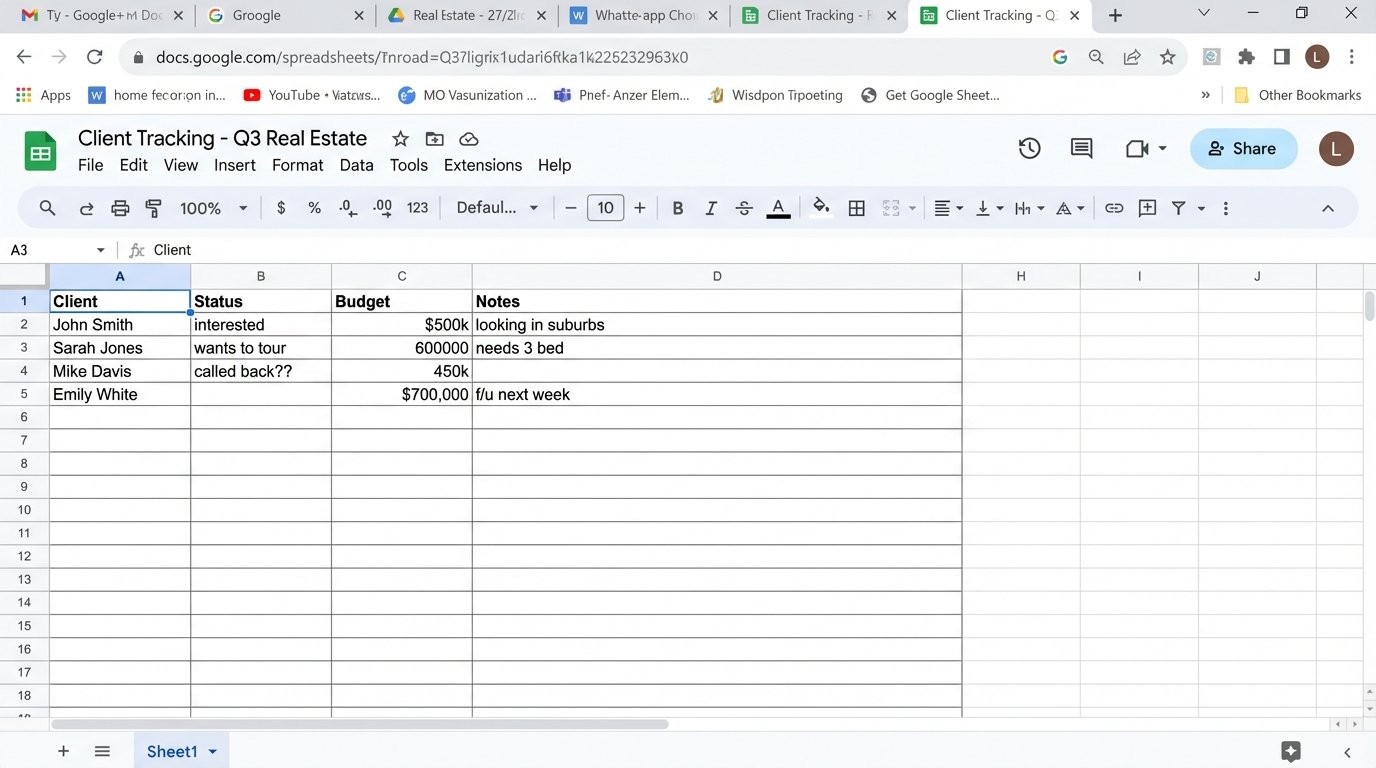
The central nervous system of most real estate brokerages is a spreadsheet. It might be a glorified Google Sheet or some legacy CRM that’s little more than a database with a clunky web front-end. Agents are tasked with the soul-crushing work of manual data entry, transcribing notes from calls, copying and pasting email addresses, and updating a client’s status from “Interested” to “Touring”. This entire paradigm is broken. It’s not just inefficient. it’s a direct source of data rot and missed opportunity.
We treat client data as a static artifact to be filed away. The reality is that client information is a high-velocity data stream. A budget mentioned in an email this morning is more relevant than the one entered into the CRM two weeks ago. A calendar invite for a home inspection is a concrete transactional signal. A spreadsheet can’t capture this velocity. It only captures a snapshot in time, usually hours or days after the fact, filtered through the agent’s memory and typing accuracy.
This isn’t about building a faster horse. The objective is not to make manual data entry quicker. The objective is to eliminate it entirely. We need to stop thinking of a CRM as a place to log history and start architecting it as a real-time terminal that processes event streams from the sources where work actually happens.
The old way guarantees your data is stale on arrival.
The Anatomy of Data Rot
Manual record-keeping introduces failure points at every step. Each time a human acts as the bridge between a communication channel and the system of record, the probability of error multiplies. A typo in a phone number renders a lead unreachable. An agent forgets to log a call, making the client’s activity history incomplete. Different agents use inconsistent tags, turning your client segmentation into a useless word cloud of arbitrary labels.
This creates dozens of conflicting sources of truth. The client’s real budget is in an email thread. Their preferred contact time is in a notepad on the agent’s desk. The official CRM record contains information that was true a month ago. When management tries to pull a report, they are not analyzing the market. They are analyzing the quality of their team’s data entry habits.
Relying on this system is like trying to build a skyscraper with buckets of sand. The foundation is fluid, unstable, and impossible to build upon with any confidence. You can’t build predictive models, you can’t automate marketing sequences with precision, and you can’t accurately forecast your pipeline because the underlying data is a mess of contradictions and omissions.
Your database is lying to you, one cell at a time.
Building the Event-Driven CRM
The architectural shift required is fundamental. We must gut the idea of the CRM as a passive database. Instead, it becomes a destination for event-driven workflows. The system stops waiting for human input and starts listening to digital signals. Every client interaction, no matter how small, becomes an event that can trigger a state change.
The primary sources for these events are the tools agents already use:
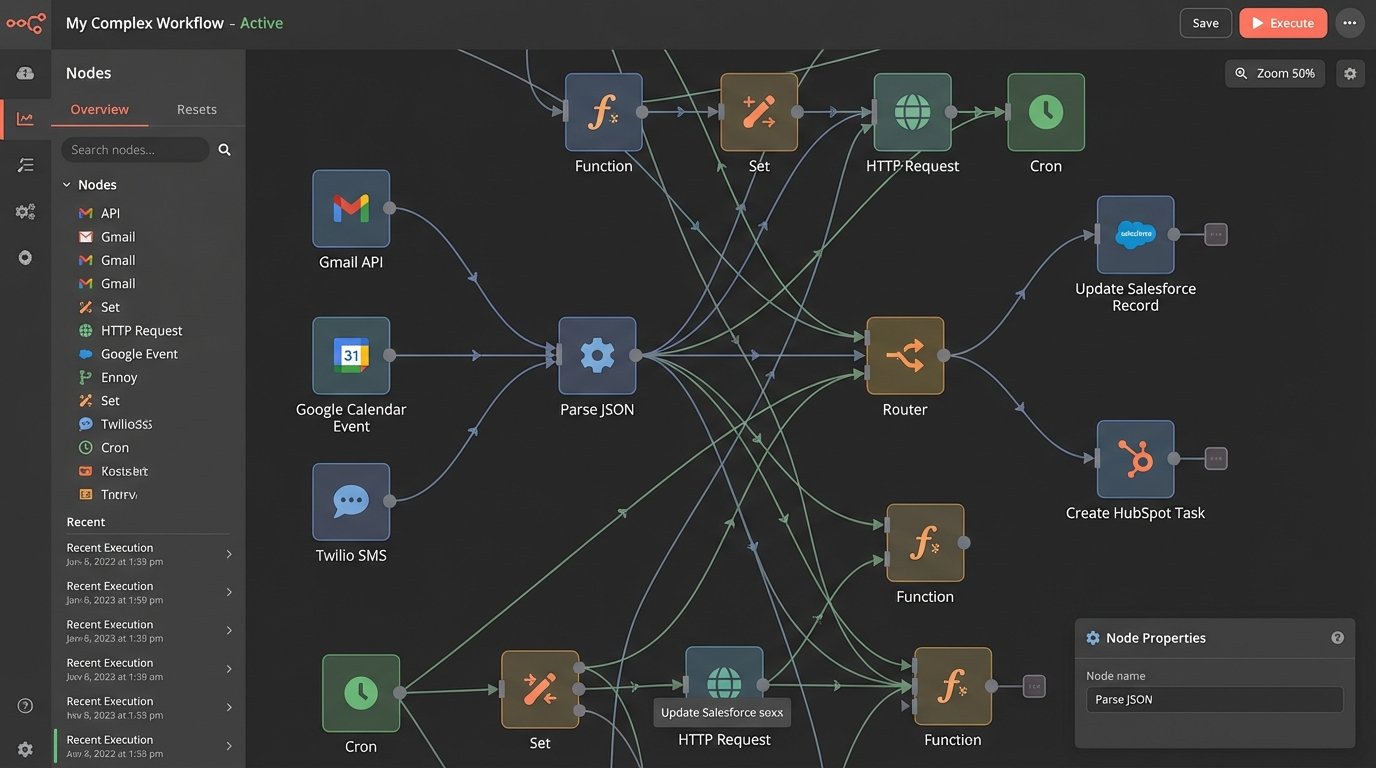
- Email: We can bridge Gmail or Outlook APIs to a workflow engine. An incoming email from a known client is parsed. Keywords like “make an offer” or “inspection report” trigger a workflow that updates the client’s stage in the sales funnel automatically. No human intervention needed.
- Calendar: A new event added to an agent’s Google Calendar with a client and a property address is a strong signal. The system can hook into this event to log a “showing scheduled” activity, link it to the correct property listing, and even queue up a follow-up task for the agent.
- Communication Logs: We can use services like Twilio to programmatically log calls and SMS messages. The duration of a call or the content of a text becomes a data point, appended directly to the client record without anyone lifting a finger.
- Website Activity: A lead fills out a form on your website. That submission should not land in an email inbox to be manually processed. It should be fired as a webhook, a direct data injection that creates or updates a client record in milliseconds.
Each piece of information is captured at its source, in real time. The CRM record becomes a verifiable log of machine-validated events, not a collection of human-transcribed notes.
The agent’s job shifts from data clerk to relationship manager.
The Integration Layer: Where the Magic and Misery Happen
Connecting these systems is where the real work lies. This is the plumbing of the automation architecture. For teams without deep engineering resources, tools like Make or Zapier provide a visual interface to build these bridges. They are excellent for prototyping and for simpler workflows. We can connect a new Typeform submission to create a contact in HubSpot in about five minutes. This is powerful.
The trade-off is cost and complexity at scale. These platforms charge per task or operation. A busy brokerage can quickly find itself with a five-figure annual bill. They also create a distributed system that can be difficult to debug. When a workflow fails, you are hunting through execution logs in a third-party interface, subject to their system’s limitations.
A custom-built integration layer, perhaps using Python scripts running on a serverless platform like AWS Lambda, offers more control. It’s cheaper to run at scale and can handle more complex logic. The obvious downside is that it requires engineering expertise to build and maintain. You are trading a subscription fee for a developer’s salary.
Connecting these disparate APIs is like plumbing a house with parts from three different hardware stores. Nothing fits perfectly out of the box. You will spend hours wrestling with different authentication methods, data formats, and rate limits. The documentation is frequently outdated, forcing you to logic-check API behavior through trial and error.
This is not a project for the intern.
You Can’t Automate Trust. You Have to Build It.
An automated system is only as good as its error handling. Forcing raw, unfiltered data into a CRM without validation is just a faster way to create a mess. What happens when conflicting data points arrive? An agent manually updates a contact’s phone number, and five minutes later an automated workflow tries to overwrite it with an old number scraped from an email signature. Which one is correct?
This is why every workflow needs a validation and conflict resolution layer. A simple rule might be that manual edits by a human always take precedence over automated updates. A more sophisticated approach would involve a confidence score. Data from a verified source like a signed document gets a higher score than data parsed from an unstructured email body. The system then only accepts updates with a superior score.
A robust architecture also includes dead-letter queues. When a workflow fails because an API is down or the data is malformed, the event isn’t discarded. It gets shunted to a separate queue. This creates a safety net. An engineer or a trained admin can then review the failed events, diagnose the problem, and re-process them manually. Without this, data is silently lost.
Building these safeguards is tedious. It involves anticipating dozens of potential failure modes. But this is what separates a fragile, demo-worthy automation from a production-grade system that you can actually depend on.
A system without checks and balances will eventually burn you.
The Real Goal: From Reactive Logging to Proactive Signals
A clean, real-time CRM is not the end goal. It is the prerequisite. The true value of this automated system is its ability to generate proactive signals from the data stream. We move from being data historians to being signal analysts. The high-quality, high-velocity data feed becomes the fuel for a new class of insights.
Imagine these scenarios:
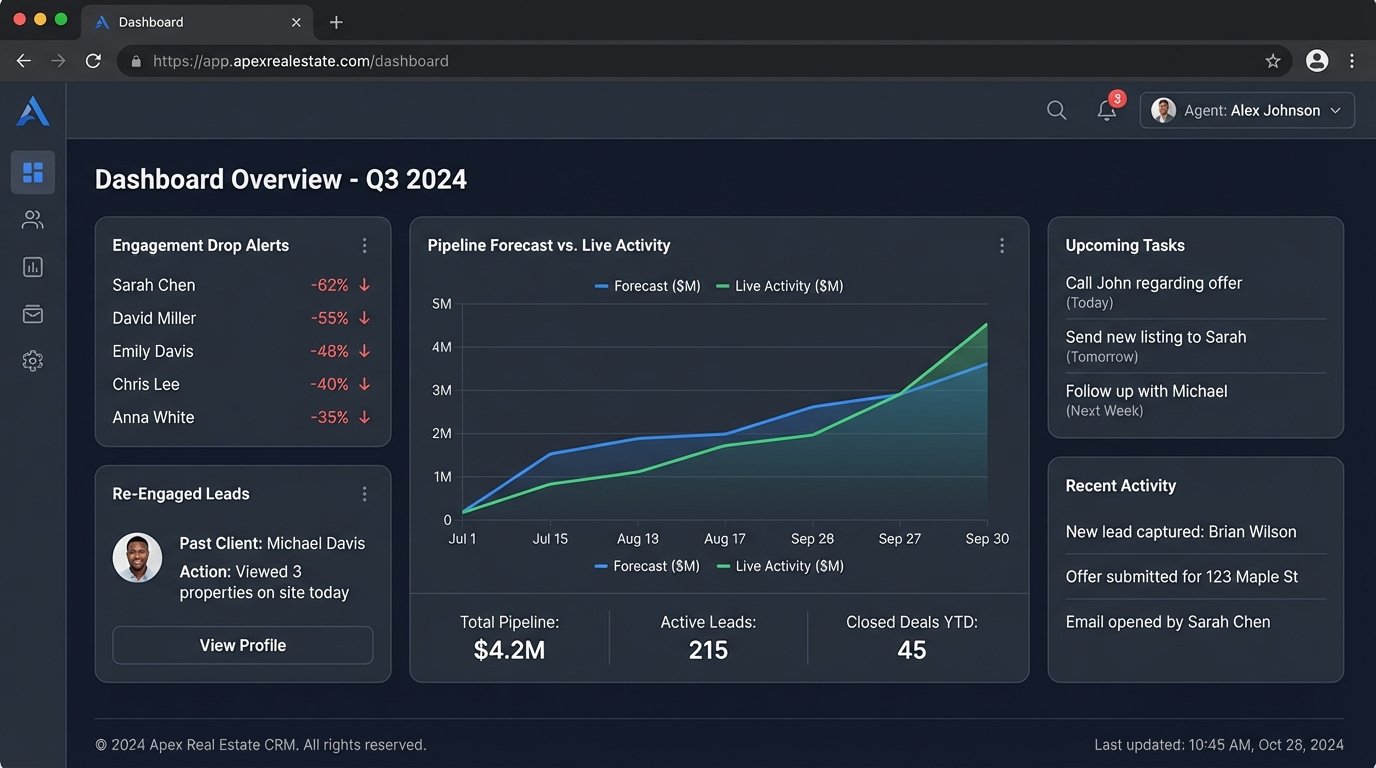
- Engagement Scoring: The system tracks every touchpoint automatically. It sees that a lead who used to open every email and click every link has gone silent for two weeks. This drop in engagement can trigger an alert, prompting the agent to re-engage before the lead goes cold.
- Behavioral Prediction: By analyzing thousands of past client journeys, the system identifies patterns. It might discover that clients who ask about school districts within the first 48 hours of contact have a 90% closing rate. This insight allows agents to prioritize their follow-up activities with surgical precision.
- Opportunity Surfacing: An old client, marked as “Closed-Won” two years ago, suddenly re-engages by viewing properties on your website. The system immediately flags this, changes their status to “Re-Engaged Lead,” and assigns a task for the original agent to reach out. This is an opportunity that would be completely invisible in a manual system.
A manual CRM is a history book. you read it to see what happened yesterday. An automated, event-driven system is a live stock ticker for your sales pipeline. It tells you what is happening right now and provides leading indicators of what might happen tomorrow.
Stop being a data janitor. Start being an architect of a system that tells you where to focus your effort.