Stop Calculating ROI on Saved Clicks
The standard pitch for an automated booking system is built on a fallacy. The vendor shows you a neat calculation: 5 minutes saved per manual booking, multiplied by 200 bookings a month, equals X hours of reclaimed administrative time. This is a flimsy justification designed to get a signature from a non-technical manager. The ROI isn’t in saving a receptionist’s time. The actual value is in the structured data exhaust the system produces.
That data stream, if you architect for it, becomes a high-velocity feed for more valuable automations. You are not buying a calendar. You are buying a data ingestion point.
The Front-Desk Fallacy
Calculating ROI based on saved administrative labor is fundamentally flawed. In most scenarios, that labor cost is fixed. You are not firing the front-desk person; you are just freeing them up for other low-value tasks. The dollar amount saved is often zero. It’s a vanity metric that looks good on a PowerPoint slide but has no material impact on the P&L.
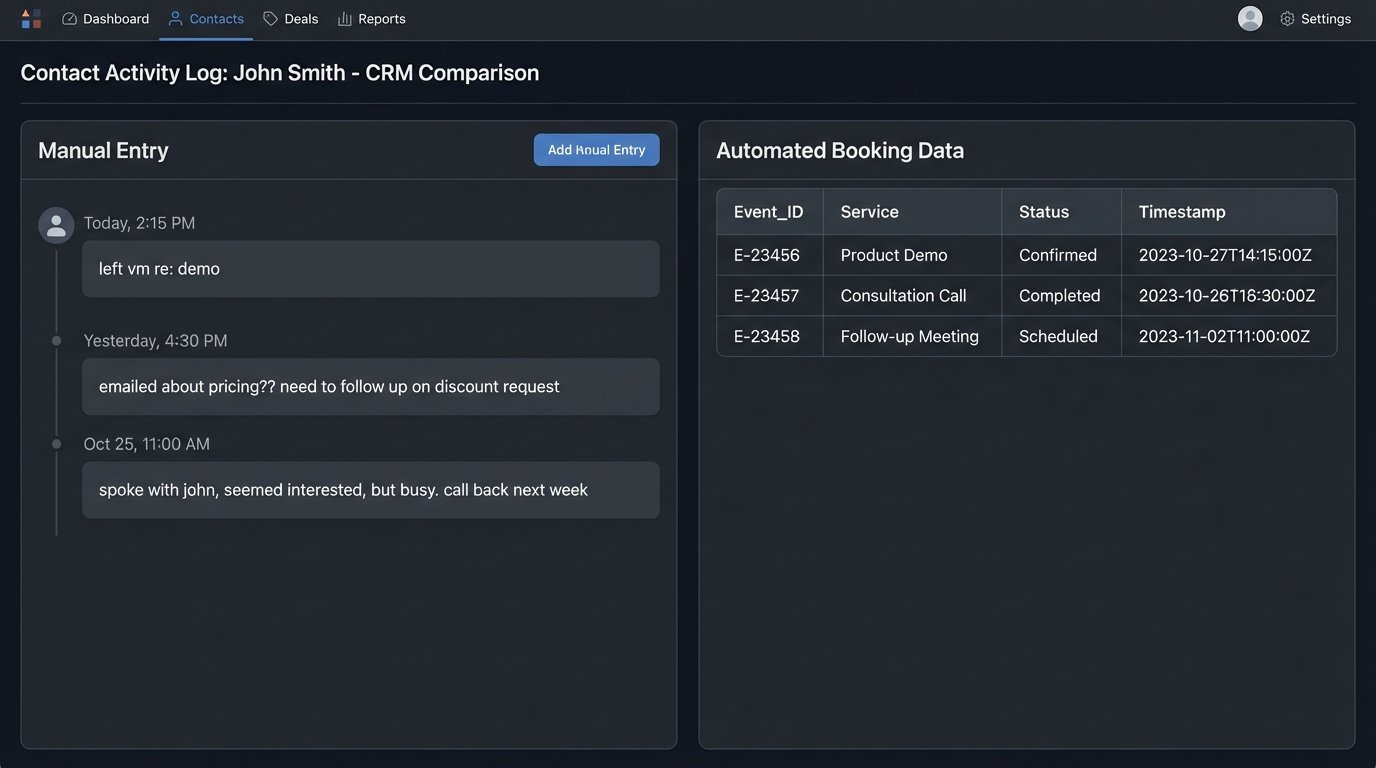
The real cost of manual booking isn’t the time spent. It’s the unstructured, garbage data it produces. Emails with typos, voicemails with unclear requests, and manually entered CRM notes create data chaos. This chaos makes downstream automation impossible without a costly and brittle data-cleaning layer. An automated booking system forces data integrity at the point of entry. That is its primary, though often ignored, function.
The Asset Is the API, Not the UI
Forget the user-facing calendar. The core components of any booking system worth its salt are the webhooks and the API. The UI is a necessary commodity for the end-user. The API is the integration point for your automation stack. When a booking is made, rescheduled, or canceled, the system should fire a webhook with a clean JSON payload. This event is the trigger, the starting pistol for everything else.
This is the difference between getting clean water from a tap versus filtering it from a muddy river. The manual process gives you swamp water that requires expensive, failure-prone engineering to make it usable. A webhook from a booking system gives you a clean, predictable data structure ready for immediate use.
From Booking to Qualified Lead in 300 Milliseconds
Consider a B2B scenario. A prospect books a “Product Demo.” With a manual system, that booking sits in an inbox until a human vets it. With an automated system, a webhook fires the instant the “Confirm” button is clicked. This is where the engineering begins.
The webhook payload hits an API Gateway endpoint, which triggers a serverless function, like AWS Lambda or a Google Cloud Function. The function ingests the payload, which contains the prospect’s name, company, and email. The first action is data enrichment. The function makes an API call to a service like Clearbit or Hunter to pull firmographic data based on the email domain: company size, industry, revenue. This strips the anonymity from a generic `info@` address.
Based on the enrichment data, you apply business logic. If the company size is over 1,000 employees, the function makes another API call to your CRM, creating a high-priority lead and assigning it to a senior sales executive’s calendar. If the company size is under 10, it gets routed to a pooled calendar for a junior rep or an automated webinar funnel. This logic-check prevents your most expensive sales talent from wasting an hour on a tire-kicker.
The ROI here isn’t the five minutes saved booking the appointment. It’s the 55 minutes of a six-figure employee’s time that wasn’t squandered on an unqualified lead. Here’s a conceptual skeleton of a Python function to handle this routing.
import json

import os

import requests
# DUMMY API keys - get from environment variables in production
CRM_API_KEY = os.environ.get("CRM_API_KEY")
ENRICHMENT_API_KEY = os.environ.get("ENRICHMENT_API_KEY")
def lambda_handler(event, context):
# 1. Ingest webhook payload from the booking system
booking_data = json.loads(event['body'])
prospect_email = booking_data.get('email')
# 2. Enrich the data using a third-party service
enrichment_url = f"https://api.enrichmentservice.com/v1/company?email={prospect_email}"
headers = {"Authorization": f"Bearer {ENRICHMENT_API_KEY}"}
response = requests.get(enrichment_url, headers=headers)
company_data = response.json()
employee_count = company_data.get('metrics', {}).get('employees', 0)
# 3. Apply routing logic
if employee_count > 1000:
assignee_id = "senior_rep_01" # ID for your top sales rep
priority = "High"
else:
assignee_id = "junior_pool_01"
priority = "Low"
# 4. Inject the lead into the CRM
crm_endpoint = "https://api.mycrm.com/v2/leads"
payload = {
"name": booking_data.get('name'),
"email": prospect_email,
"source": "Automated Booking",
"owner_id": assignee_id,
"priority": priority,
"booking_id": booking_data.get('id')
}
crm_headers = {"Authorization": f"Bearer {CRM_API_KEY}"}
crm_response = requests.post(crm_endpoint, json=payload, headers=crm_headers)
# 5. Return a success response to the webhook source
return {
'statusCode': 200,
'body': json.dumps({'status': 'Lead processed', 'crm_status': crm_response.status_code})
}
Dynamic Resource Allocation
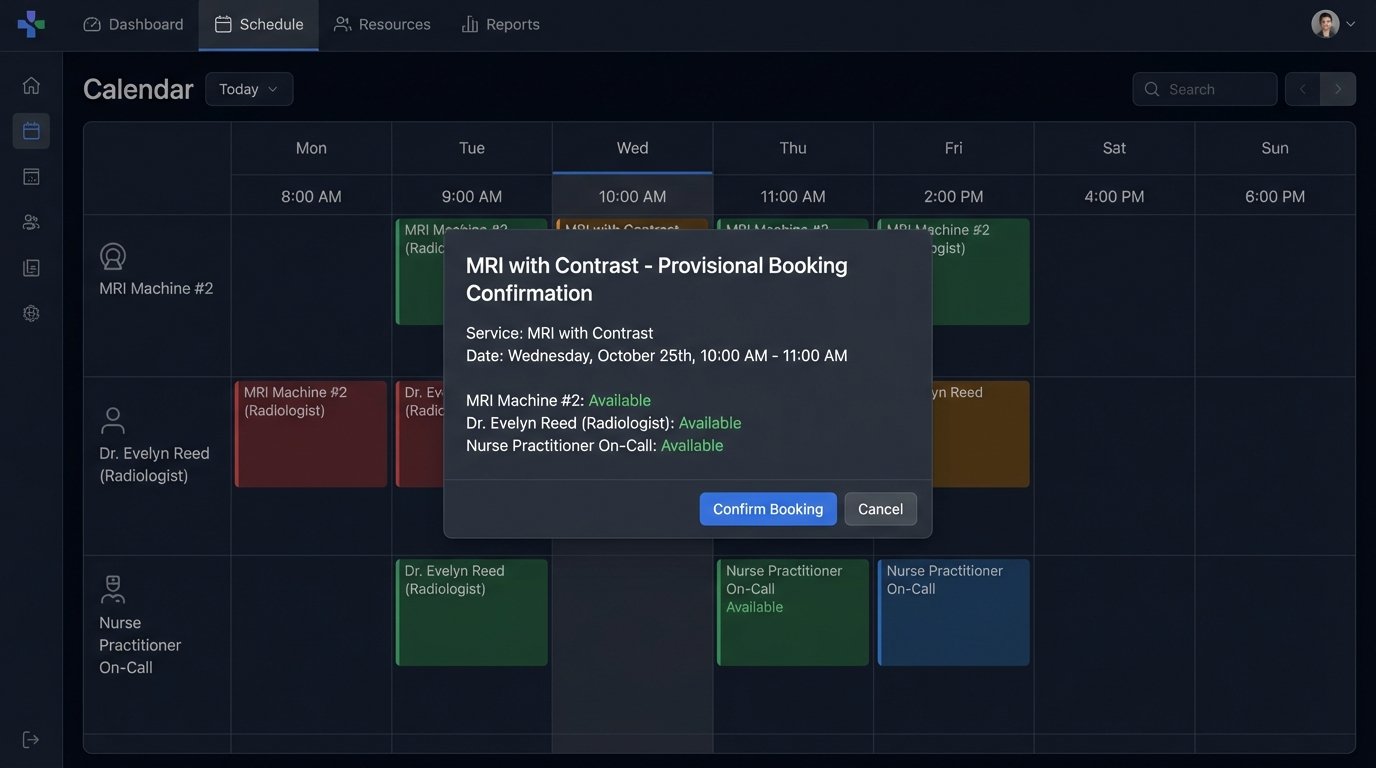
The logic extends beyond human resources. Think about a facility that manages expensive physical assets, like a medical imaging center or a video production studio. A client booking an “MRI with Contrast” requires three distinct resources: the MRI machine itself, a qualified radiologist to operate it, and a nurse practitioner to administer the contrast dye. These might be managed in three separate systems.
A properly architected booking system doesn’t just check one calendar. When the user selects that service, the backend logic must fire off parallel API calls to provisionally hold all three resources. If the machine is available but the nurse is not, the system should not present that time slot as open. It logic-checks the entire resource chain before committing the appointment. This is a Kubernetes scheduler for physical reality, preventing resource contention before it happens.
The cost of failure in this scenario is catastrophic: a patient shows up, the machine is ready, but the nurse was double-booked. The appointment is scrubbed, revenue is lost, and the patient’s trust is destroyed. Preventing that one failure pays for the entire software stack for a decade.
Cancellation Patterns as a Churn Predictor
The temporal data is another goldmine. When a client cancels or reschedules an appointment, it’s not just an administrative inconvenience. It’s a signal. A new client who reschedules their “Onboarding Kick-off” call twice is a massive churn risk. They are disengaged before they have even started.
Your automation stack should be listening for these signals. The booking system’s cancellation webhook fires. A function logs the event in a database, incrementing a counter for that client. A separate scheduled job runs nightly, querying for clients who have exceeded a reschedule threshold (e.g., more than two reschedules in 30 days). When it finds one, it injects a `[Churn Risk]` tag into their CRM profile and fires a high-priority alert into a dedicated Slack channel, tagging the account manager.
This allows the account manager to intervene proactively, not after the client has already gone dark. The ROI is the lifetime value of the one enterprise account you save from churning. That single event provides a greater return than a century of saved administrative time.
The Integration Tax and Other Inconvenient Truths
This architecture is not free. The sales demo never shows you the ugly parts. The primary cost is not the monthly subscription to the booking tool. It’s the engineering hours required to build and maintain the integrations that generate the actual value.
Many booking systems, especially the cheaper ones, have pathetic, rate-limited, or poorly documented APIs. You might spend 40 hours of developer time trying to force a connection to a system with an unreliable webhook infrastructure. Vet the API documentation with the same rigor you would vet the UI. If the developer docs are a mess, walk away. The tool is a wallet-drainer in disguise.
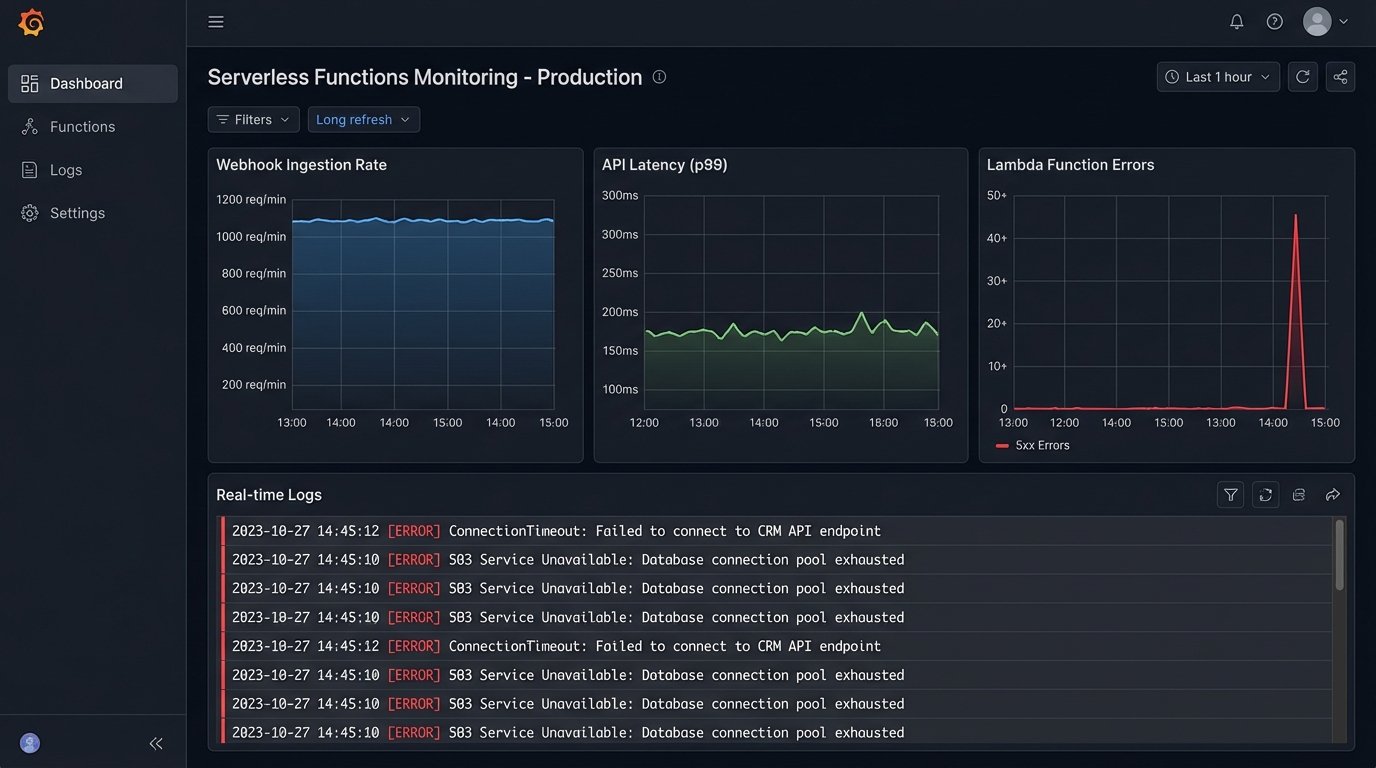
You’re not buying a finished car. You’re buying a high-performance engine. You still have to engineer the chassis, connect the fuel lines, and wire the electronics. Then you have to pay for the fuel and perform the maintenance. Webhooks will fail. Third-party APIs will change without warning. Your functions will need logging, monitoring, and an on-call rotation to fix them when they inevitably break at 3 AM.
The entire system also depends on absolute data integrity at the point of capture. If you allow users a free-text field to describe the service they want, your downstream automation will immediately collapse. You must use structured inputs like dropdowns and radio buttons. Force users to give you clean data, or the entire Rube Goldberg machine you’ve built will grind to a halt.
The conversation around these systems needs to be elevated. Stop justifying them based on efficiency metrics. Start evaluating them as critical data acquisition nodes for your core business automations. The real ROI is not in doing the old things faster. It’s in doing entirely new things that were previously impossible.