
A lead’s value decays by the minute. Your manual process is a time accelerator.
The value of an inbound real estate lead is not static. It’s a radioactive isotope with a punishingly short half-life. A prospect who fills out a form on your website at 10:00 AM has maximum intent. By 10:05 AM, they are already looking at three other listings. By 11:00 AM, a competitor’s agent who uses an automated scheduler has already booked a showing. Your attempt to contact them at lunch is already考古学.
Manual scheduling is the institutional acceptance of this decay. It injects human latency into a process that demands machine speed. It’s a systemic flaw disguised as “personal touch,” and it directly costs you commissions. Every minute spent toggling between an email inbox, a CRM, and a calendar is a minute a competitor is using to send a calendar invite automatically.
Deconstructing the Manual Failure Chain
Let’s map the typical manual workflow. An inbound lead from a portal like Zillow triggers an email notification. That email sits in an agent’s inbox, buried under dozens of others. The agent might see it in 15 minutes or two hours, depending on their current task. This initial delay is the first point of failure.
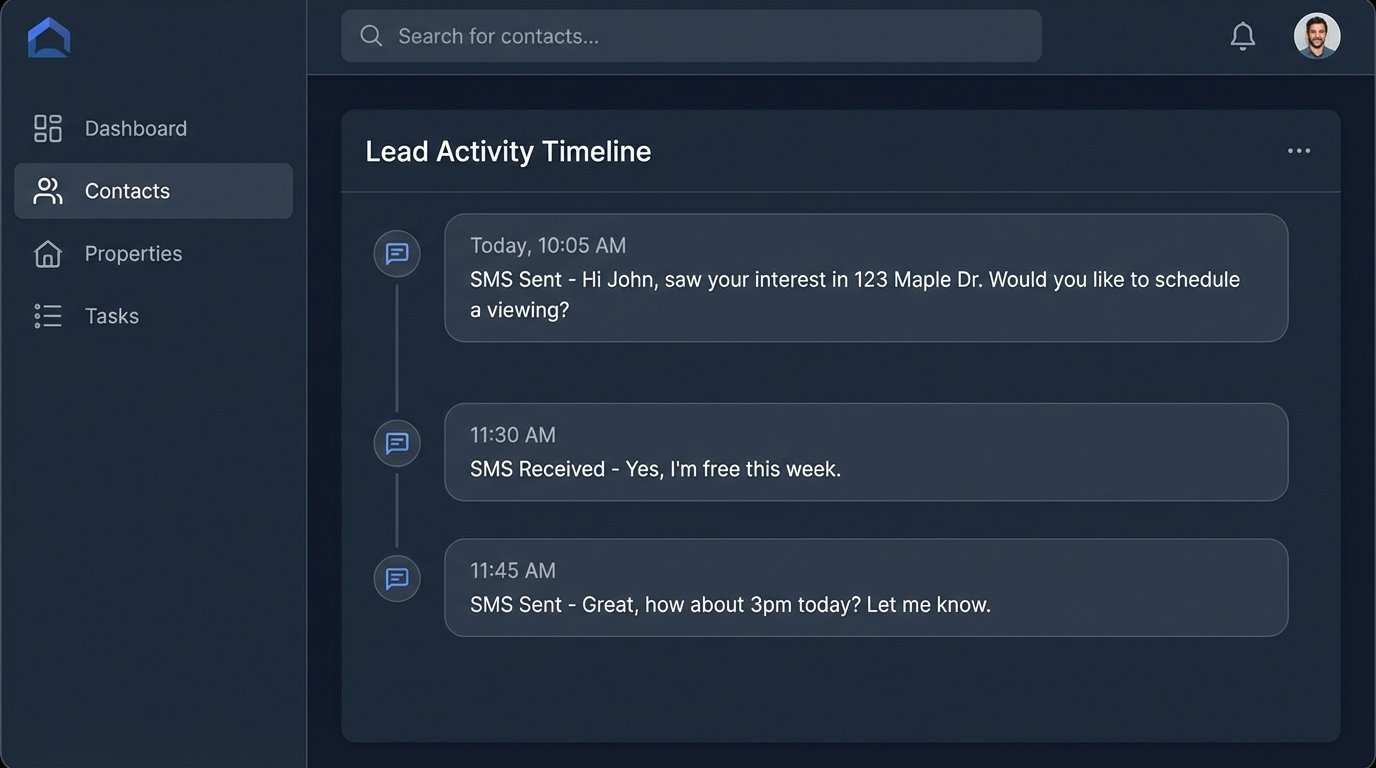
Once seen, the agent must context-switch. They stop what they are doing, open the CRM, and manually create a contact record. Then they pick up the phone. Most calls go to voicemail. The agent leaves a message and follows up with a text message. The lead, now busy, responds an hour later. This begins the painful, asynchronous text exchange to find a mutually available time for a call or showing. This back-and-forth can stretch for hours, destroying any sense of urgency the lead initially had.
An Event-Driven Architecture as the Alternative
A sane system does not rely on a human polling their inbox. It uses an event-driven architecture. The moment the lead is generated on the source platform, a webhook payload is fired at a dedicated endpoint you control. This is not a suggestion for a human to act. It is a direct machine instruction to begin a process.
This endpoint’s only job is to receive the data, validate its structure, and drop it into a message queue. This decouples the lead source from your internal processing. If your system is down for a minute, the lead is not lost. It sits in the queue, waiting. This initial step shifts the process from one of human reaction to one of immediate, programmatic ingestion.
The system treats the lead not as a person to contact, but as an object to be moved through a state machine. The initial state is `NEW`. The goal is to advance it to `SCHEDULED` as fast as possible, with zero human intervention.
State Machines and API Orchestration
Upon ingestion from the queue, a serverless function or microservice takes ownership of the lead object. Its state is immediately updated to `PROCESSING`. The first action is to normalize the incoming data. Zillow’s `phone` field becomes our canonical `contact_phone`. The lead’s name is parsed and sanitized. This prevents data contamination in the downstream CRM.
Next, the logic checks the agent assignment rules. Is it a round-robin system? Is it based on zip code? The system programmatically identifies the correct agent. It then queries the agent’s synced calendar via the Google Calendar or Microsoft Graph API to find the next three available 30-minute slots in the next 24 hours. The state is now `AVAILABILITY_FETCHED`.
This entire sequence takes less than 500 milliseconds. The lead is still hot. They are likely still on the website where they submitted their info.
Executing the Contact and Scheduling Logic
The system now constructs a carefully worded SMS message via an API like Twilio. “Hi [FirstName], saw your interest in 123 Main St. I have openings today at 3:00 PM, 4:30 PM, or tomorrow at 10:00 AM. Reply with 1, 2, or 3 to book instantly.” The state changes to `INITIAL_CONTACT_SENT`. The system now waits for a response.
When the lead replies “2”, Twilio fires a webhook back to your system. The parser logic identifies the choice, cross-references it with the options sent, and makes a direct API call to create the event on the agent’s calendar. It invites the lead’s email and adds all property details to the event description. The state is now `SCHEDULED`.
A confirmation SMS and email are sent to both the lead and the agent. The entire process, from form submission to a confirmed calendar event, can take under 60 seconds.
Here is a simplified JSON body for what a Google Calendar API event creation request might look like. Note the attendees array and the structured data in the description. Every piece of data is machine-readable.
{

  "summary": "Showing for 123 Main St",

  "location": "123 Main St, Anytown, USA 12345",

  "description": "Client: John Doe\nProperty ID: 98765\nLead Source: Zillow\nSystem Generated: Do Not Modify",

  "start": {

    "dateTime": "2023-10-27T16:30:00-07:00",

    "timeZone": "America/Los_Angeles"

  },

  "end": {

    "dateTime": "2023-10-27T17:00:00-07:00",

    "timeZone": "America/Los_Angeles"

  },

  "attendees": [

    {"email": "agent.email@realestate.com"},

    {"email": "john.doe@example.com"}

  ],

  "reminders": {

    "useDefault": false,

    "overrides": [

      {"method": "email", "minutes": 120},

      {"method": "popup", "minutes": 30}

    ]

  }

}
The Single Source of Truth: CRM Write-Back
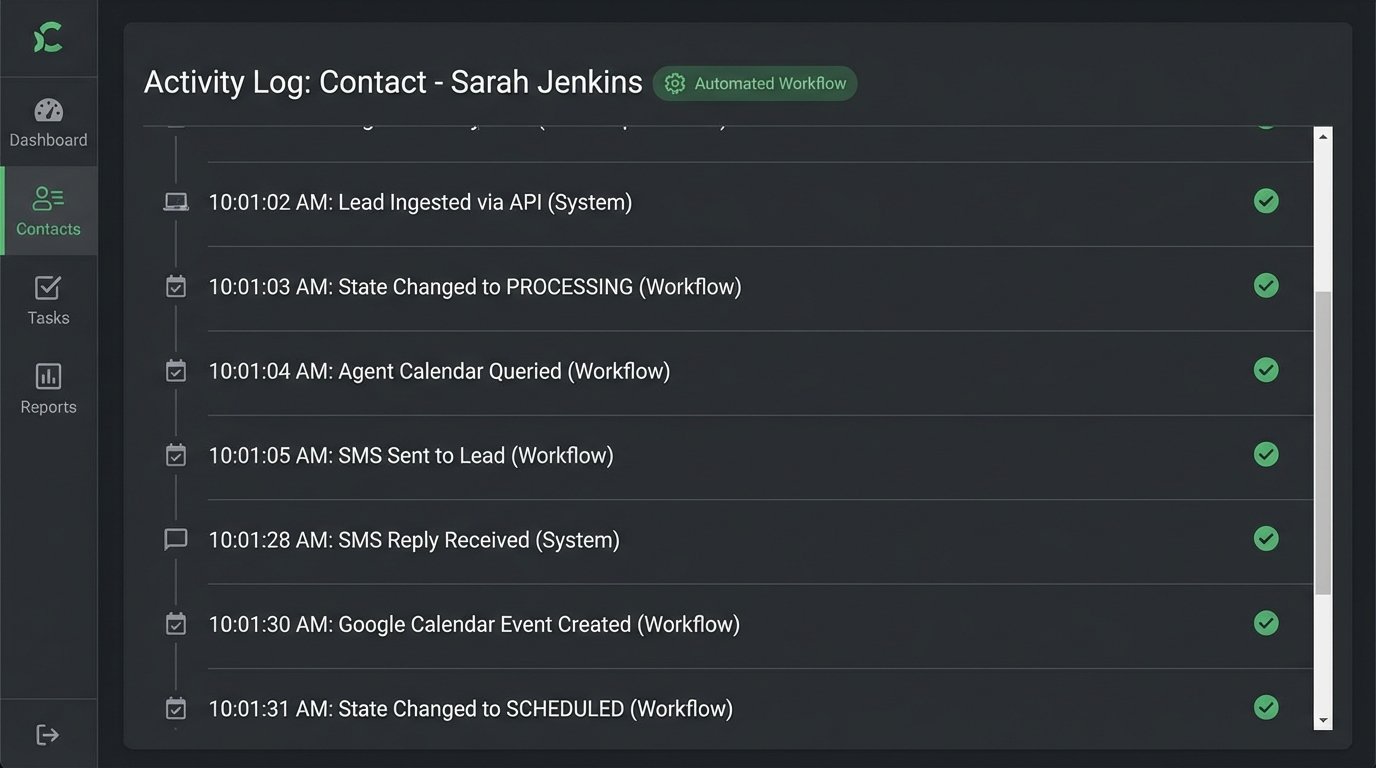
Automation without logging is a liability. Every state change, every API call, and every message sent or received must be written back to the CRM as an activity or note on the contact’s record. This creates an immutable audit trail. When the agent opens the CRM, they see the entire automated conversation and the confirmed appointment.
This is not optional. Without a reliable write-back mechanism, agents will not trust the system. They will revert to their old manual methods, defeating the entire purpose. The automation must serve as a data-enrichment engine for the CRM, not a separate, mysterious black box. It’s about building a system where the automation is shoving relevant, structured data into the CRM so a human can use it effectively, not forcing a human to hunt for it.
The Necessary Friction: Where This Gets Expensive and Difficult
This architecture is not simple to build. The primary friction is handling the messy reality of human communication. What if the lead replies, “Those times don’t work for me, how about Friday morning?” Your simple parser will fail. Your system needs a fallback. It must detect a non-standard reply, change the lead’s state to `NEEDS_MANUAL_INTERVENTION`, and create a high-priority task in the CRM for the agent, including the full message history.
Another point of failure is API reliability and rate limiting. Your SMS provider might have an outage. The Google Calendar API might return a `429 Too Many Requests` error during a high-volume lead spike. Your code must be built with retries, exponential backoff, and robust error handling. You need a dead-letter queue to catch events that fail processing after multiple attempts, so an engineer can inspect them later.
This is a wallet-drainer to build correctly. It requires development hours, API subscription costs, and server infrastructure. The ROI is not in saving an agent’s time, though it does. The real ROI is in capturing the appointments that would have been lost to the latency of manual scheduling.
Stop Measuring the Wrong Metric
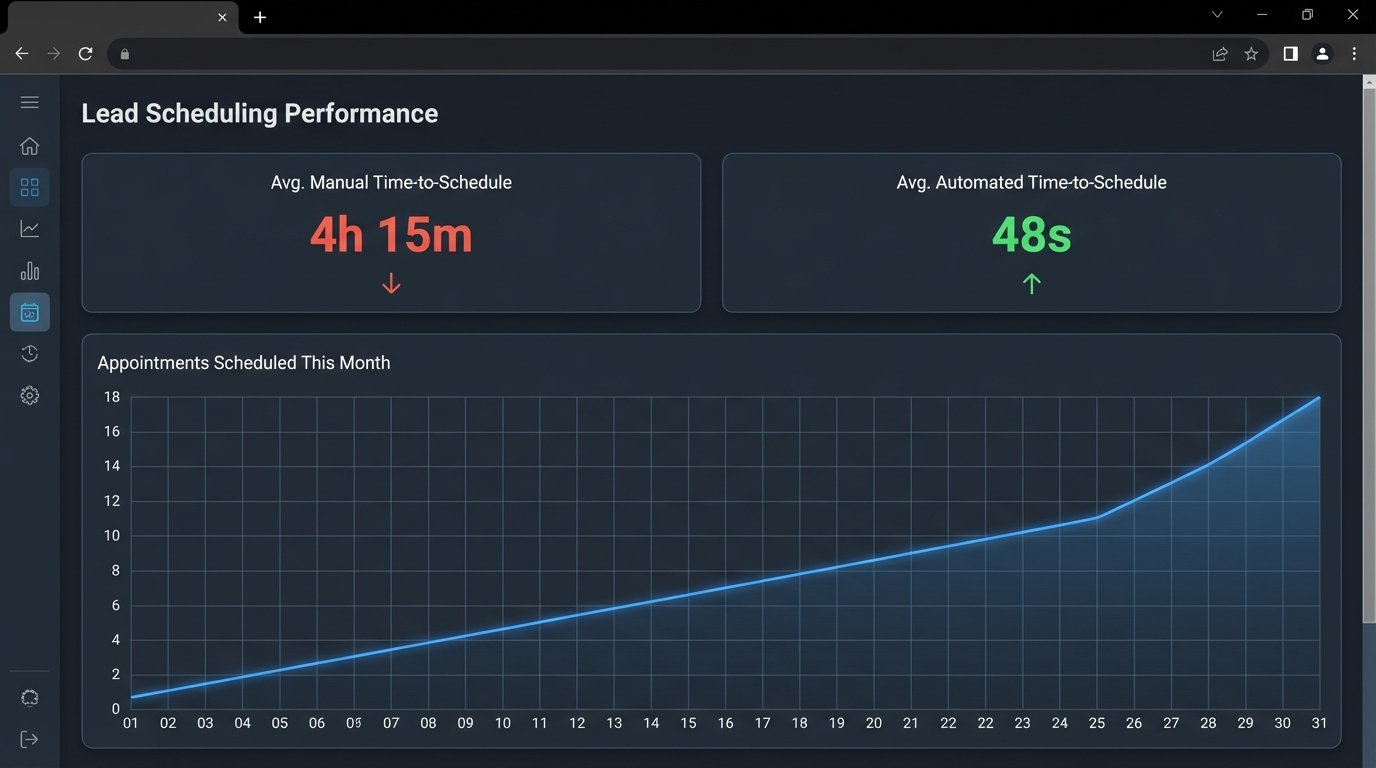
Businesses often measure the time it takes an agent to make the first call. This is a vanity metric. The only metric that matters is the time from lead creation to a confirmed appointment in the calendar. Call this “Time-to-Schedule.” Manual processes yield a Time-to-Schedule measured in hours or days. A properly architected automated system yields a Time-to-Schedule measured in seconds or minutes.
The argument is not about replacing agents. It is about augmenting them. Let agents do what they do best: build rapport, show properties, and negotiate deals. Let a deterministic, emotionless system handle the low-level, time-sensitive task of aligning calendars. Every lead that slips away because of a missed email or a game of phone tag is a failure of your process, not your people.
The choice is stark. You can continue to use a process that guarantees a certain percentage of your hottest leads will go cold while waiting for a human to check their calendar. Or you can build a system that attempts to lock in that interest instantly. In a market this competitive, accepting built-in delay is a deliberate business decision to lose money.